Cultural Reforesting - voices of the ecosystem

5 ECHOES

Location: Twickenham, Greater London, England, United Kingdom

Orleans House Gallery

Cultural Reforesting is a series of artist-led, multi-disciplinary projects set in the context of the ecological crises of our time. Scientists have given this decade as the crucial 10 years in which to find solutions, indeed Richmond Council declared Climate Emergency in 2019, so what can we all do?  

Each artist project responds to the question – how can we renew our relationship with nature? 

We at Orleans House Gallery are supporting artists wishing to explore local solutions to this crisis, and feel that the Gallery, with its vibrant grounds and creative setting can be a place where all can come to collaborate, find a community and make a difference, no matter how personal or small.  

We hope that artists, working with scientists, further researchers, volunteers and other participants will turn this place into a vibrant community of people taking action.  

Orleans House Gallery can become a place for hope and ideas in our ecological crisis. 

Cultural Reforesting is about: 

Environmental justice   Biodiversity, ecology and botany   Climate Emergency   Indigenous knowledge and perspectives   Local solutions   Imagination and creativity   Well-being   Ecocentrism   Education

Vigil

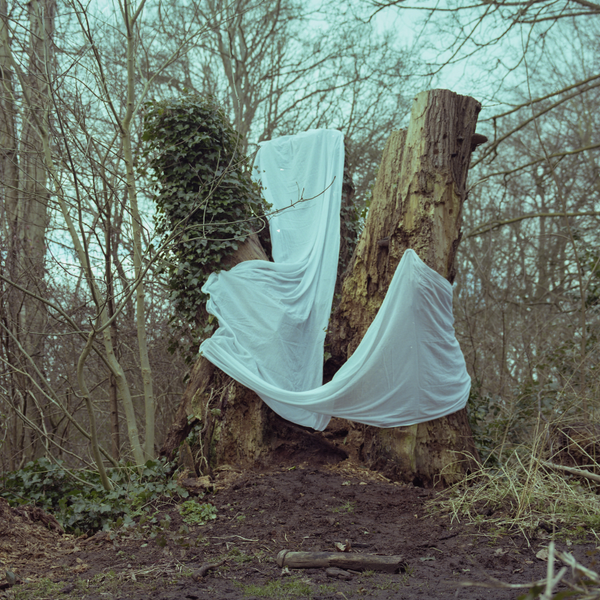
Vigil is the outcome of an interspecies collaboration seeking to endorse ecocentric perspectives, which foreground the equity and interdependence between human and ecological bodies.

It is a statement of acknowledgement that, via storytelling, ritual mourning and allusion to myth, honours the individual subjectivity of the particular Black Poplar tree at Orleans House, while also lamenting the depletion of the species that is symptomatic of broader environmental collapse. The myth of Phaeton- in particular, his grieving sisters’ transformation into Black Poplar trees, and the scourging of Earth, undergirds Vigil, providing the conceptual link between mourning, environmental trauma and the Black Poplar. Narration occurs at a pace significantly slower than is typical of human communication, which both immerses the recipient within the longer span of ecological, ‘tree time’, and facilitates an ethic of giving due attention and time to an ‘other’ species. The piece is designed to lament, but also redress, the consequences of the environmental crisis. It also confronts the conditions that perpetuate ecological violence: apathy, disconnection and the anthropomorphic perspective, which situates nature beyond the sanctioned sphere of care. The listener is invited to slow-down, witness and reflect upon their relationship to, and place within, the planetary whole, in solidarity with the Black Poplar tree.

Vigil initially existed as a short film, which is available here: https://www.youtube.com/watch?v=4HdJpmE1ZoM. Further work by the artist, Eden Spence can be found at the Instagram handle @edenespence.

Eden Spence is a cross-disciplinary documentarian, writer and artist based between London and the New Forest. She is particularly interested in stories pertaining to ecology, mythic imaginations and sustainable futures. Her projects seek to foster a radical ethic of care that encompasses human and extra-human beings equally, while simultaneously unpicking the structures that sacrelizes certain bodies, while inflicting grievous violence against ‘others’. Eden works with words, photography and illustration- drawing inspiration from ancient myths and oral traditions, woven through with contemporary eco-critical discourse and innovations, to create works which invite the recipient to pause in the rapid stream of modern time, and consider their relationship to the all-expansive planetary whole. Eden is currently studying on LCC’s MA in Photojournalism and Documentary Photography, having graduated from the University of Exeter with a degree in English Literature (First Class)in 2020.

1 sound

Nestor Pestana - Empathy and world building (Remember the Future In Conversation)

This is a recorded conversation between artist Nestor Pestana and Sámi film maker and commissioner Liisa Holmberg; designer and interdisciplinary researcher Dr Johanna; and transmedia artists Jatun Risba.

Nestor gathers artists, researchers and an indigenous thought leader for a unique and insightful discussion to explore how climate change is affecting communities and how better understanding and building empathy with other species might offer us new ways to tackle it.

In 1902, an Act of Parliament was passed to protect the natural environment that forms the view from Marble Hill in Richmond, U.K., the only act of its kind in England. More recently, similar actions have slowly taken place around the world, with the aim to protect rivers and forests, granting them with legal personhood. These are sparse and fragmented cases, but what if they were extended to include all, or at least most natural ecosystems? Can worldbuilding and storytelling help us envision such a world and inspire transformation? 

Based on such questions, this conversation aims to discuss the practical issues of how climate change is affecting communities, such as the indigenous Sámi people; and the poetics involved in understanding the human and non-human in a more equal level.  

Deeply rooted in indigenous traditions, we will gain insights on the cultural importance of storytelling through the lens of the Sámi people. Building on this, we will discuss ideas about interspecies entanglements, through storytelling devices encompassing language, performance and designed objects. 

Speaker Bios Liisa Holmberg 

Liisa Holmberg is originally from the Finnish side of the Saamiland. She is a film commissioner at the International Sámi Film Institute, in Norway, and has worked internationally with Indigenous film makers in Alaska, Canada, Greenland, Sápmi and Russia, with the purpose to establish an Arctic Indigenous Film Fund (AIFF). She is also a filmmaker and has worked in the film industry as a producer, production manager and film consultant since 1994.  

In 2018, Liisa joined the European Film Academy and was also nominated Chair of the Council for the University of the Arctic. She has worked as a rector of the Sámi Education Institute in Inari, Finland, supporting Sámi languages, cultures and livelihoods. 

Dr Johanna

Dr Johanna is a designer and interdisciplinary researcher. She is a professor of design at Folkwang University of the Arts. Her inquiry-based work explores the intersections of design, art, science, technology, and futures. She holds a degree in Digital Media from the University of the Arts Berlin (UdK) and a MA and PhD from the Royal College of Art London. Her work has been published, awarded, and exhibited internationally, including at the Institute of Contemporary Arts in London, the National Museum Stockholm, the Venice Biennale of Architecture, and Ars Electronica Center Linz. 

Jatun Risba 

Jatun Risba – ‘ki’ – is a transmedia artist, sower of kinship and parrhesiast (truth-seeker) exploring beyond human paradigms. Since 2015 Risbas has been developing the pioneering somatic practice ‘Interesse/Dance of Life’ which seeks to reveal liminal expressions of the thinking body to create opportunities to reveal, share, immunise and free oneself while acknowledging the divine comedy of life. A transdisciplinary practitioner, Risba regularly collaborates with visual artists, makers, humanists and scientists and has exhibited and performed in numerous venues including Bangkok Biennial 2020, Fabbrica del Vapore Milan, Kersnikova Institute and Škuc Gallery in Ljubljana, etc. Ki has given lectures/workshops widely and has published texts in various printed and online publications. 

Nestor Pestana 

Nestor Pestana is a Venezuelan-Portuguese educator, art director and digital designer, whilst developing a new media arts and research practice. Nestor engages in collaborations with scientists and technologists to promote knowledge exchange, critical thinking and lifelong learning. Projects are research based, focusing on the necessity for critical engagement with contemporary and emerging issues related to technology, ecology and politics. Nestor has exhibited internationally, in places such as the Design Museum, Somerset House, D-Lab Tokyo Gallery, Seoul National University, Venice Biennale and Porto Planetarium. His work has been acquired by the Welcome Trust and awarded by the Royal College of Art and YouFab Global Creative Awards.

1 sound

May Abdalla and Monica Gagliano - Messages from a Post Human Earth (In Conversation)

Monica and May discuss their fascinating collaboration on Messages from a Post Human Earth.

“Not everything everywhere is for us.” Stanislaw Lem, The Invincible

‘Hello human person. In a moment you will be asked to face the future. A world without you. A world after you. The person with you will explore the past, and so you will have to lose each other. But not yet…’

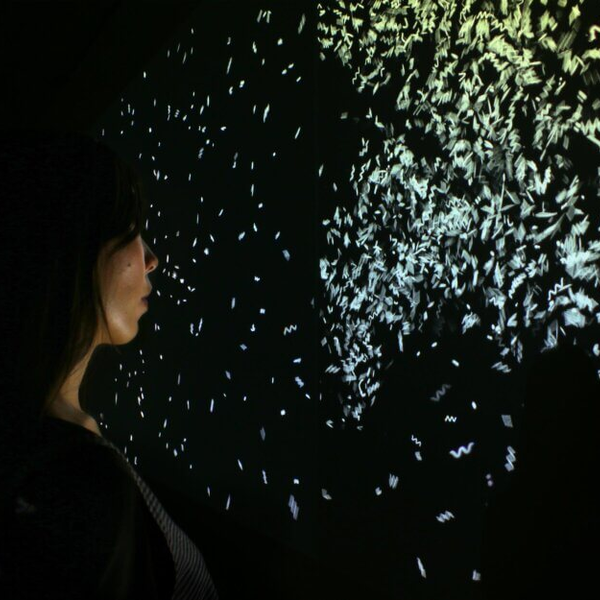
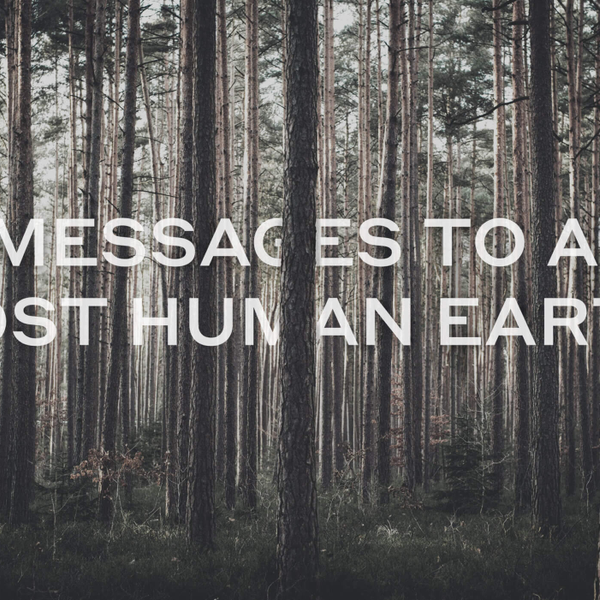
MESSAGES TO A POST HUMAN EARTH is an interactive, multi-sensorial journey through the beautiful grounds of the Orleans House Gallery, where you and your partner will embark on an evocative audio journey featuring augmented reality (AR), to reimagine your relationship with the natural world.

The story explores the work of Monica Gagliano and an essay by science fiction writer Stanislaw Lem, which he wrote for the Human Interference Task Force in the 1980s. Lem’s essay was written in response to a request for ideas of what to do with nuclear waste and its incredibly long life span; he suggested encoding messages into the DNA of plants. Gagliano is well known for her research into plant intelligence and the behaviours that demonstrate memory by the Mimosa plant.

Designed for two people to experience together, you will be provided with a special device and props before being sent off to explore the natural world; a hearing, living thing, sensorially alert like you.

You and your partner’s short journeys are different but will work in synchronicity with the other. Like a symbolic choreography, both of your actions become a performance for the other.

Invisible to the naked eye, the audio narration and AR content comes to life to invite musing on the living environment and a future world in which humans will no longer be present.

1 sound

Bryony Benge-Abbott - Wild Drawing and the more-than-human world (Remember the Future In Conversation)

Bryony Benge-Abbott was joined by Ian Wright and Ellie Mackay to discuss her residency at Orleans House Gallery on 15 September 2021.

Bryony Benge-Abbott is a British-Trinidadian artist, curator and producer working at intersection of art and science, with a particular focus on nature connection. Her practice spans street art to oil paintings, textile design to drawing, playing with pattern, scale and composition, and moving between symbolism, abstraction and expressionism in the search for immersive encounters with nature. She also brings a strong community engagement and participatory focus to her public realm based work. Alongside her artist practice, Bryony has 15 years experience of curating and producing social history and science exhibitions, most recently leading the inaugural public engagement strategy for exhibitions at the UK’s largest lab, The Francis Crick Institute. She has a BA Hons in Fine Art Painting from Bath Spa University and an MA in Museology with a Curatorial Fellowship at the Sainsbury Centre for Visual Arts.

Ellie Mackay is an award-winning documentary filmmaker and science communicator specialising in environmental storytelling, and using disruptive, positive messaging to change the narrative and encourage renewed thinking and action. Her work has explored everything from sustainable palm oil production to plastics, littering and the circular economy. She is particularly interested in our connection to natural systems and both the mental health and environmental health benefits of living and working more holistically with nature.

Ian is a sculptor, landscape architect and environmentalist. He attended the Royal College of Art where he claims to have ‘failed with distinction’ before moving to Ireland in 1974, where his longstanding interest in forestry led to the purchasing of 70 acres of land in Cork in 1997. There, he developed an environmentally and economically sustainable forest and established the Irish Natural Forestry Foundation, now The Green Economy Foundation, to demonstrate best practice. The Foundation successfully challenged the decision of the Irish forest service (through the European Union) to only grant aid for the planting of alien conifers. Ian’s campaigning continues to influence Irish forestry policy and its relationship with forestry companies and private landowners and to date, Ian estimates he has planted 2 million trees in Ireland.

Today Ian is based in the Caribbean where he is one of the co-founders of Corbin’s Local, a wildlife park on Tobago that has introduced a breed and release programme for the island’s endangered animals and is soon to be the site of a new Biodiversity Awareness Centre.

1 sound

DOWNLOAD OUR APP TO DISCOVER THIS TOUR AND MANY OTHERS.

play-storeapp-store

Or start creating tours, treasure hunts, POI maps... Just let your imagination guide you.


Other walks nearby

Lines of Dissent - The Tale of the Cedar of Lebanon

Lines of Dissent - The Tale of the Cedar of Lebanon

Twickenham
The Tale of the Cedar of Lebanon by Dimitri Scarlato Curator and artist, Dzifa Benson wanted to comprehend the majesty of this 250 year old tree, with all it has seen and experienced over that time. A tree given special status by Nellie Ionides when she passed Orleans House to the Borough Council to become a contemporary art gallery, we were asked to prize this tree so all may enjoy the emotional attachment that comes from being deeply, awe-inspired by nature. Dimitri captures this essence through the elevation of a new piece of music, experience it in the gallery or at the tree and allow all senses to fill you. Dimitri Scarlato is a composer and conductor born and raised in Rome where he studied Composition, Piano and Conducting, before he moved to London to complete his studies at the Guildhall School of Music & Drama and at the Royal College of Music, who selected him as a RCM Rising Star in 2010. His music has been performed in several venues across Europe such as Barbican Hall and Cadogan Hall in London and Gran Teatro La Fenice in Venice. His activity spans contemporary classic music, opera, theatre, films and pop music. In 2011, Dimitri was selected for the Royal Opera House’s VOX3 - Composing for Voice and the Berlinale Talent Campus 2011 as a film composer. The Accademia Filarmonica Romana premiered his opera Fadwa in May 2013 at the Teatro Olimpico in Rome. In 2014, he was the music/conducting coach for Sir Michael Caine on the film Youth, by the Oscar winning director Paolo Sorrentino. In 2015, he won the 3rd Composition Competition at the International Spring Orchestra Festival with his piece Caduceo, written for two pianos and had his opera The Christmas Truce premiered at the Teatro Palladium in Rome. Over the last years, he has worked on several cinematic projects including Sparks & Embers, a British independent film starring Kris Marshall (2015), and Thala my Love, a Tunisian independent film about the ‘Arab spring’, previewed at the Carthage Film Festival 2016. Highlights from 2017 include conducting the premieres of three new contemporary operas at Stara Zagora (Bulgaria) and Later with Jools Holland as arranger and conductor for the American indie band Queens of the Stone Age. In 2019 he released his album Colours, performing it live in London, Florence and Rome. He also composed the music for the soundtrack of the feature film Il Talento del Calabrone, released in autumn 2020 on Amazon Prime Italy. Dimitri also won the 2nd prize in the Opera Harmony digital opera festival in September 2020, with his mini opera A Life Reset and in August 2021 won an award for his soundtrack to the short film Intolerance. In October 2021, his piece for choir A le superne rote was premiered by the Hungarian National Choir at the Dante 700 concert, which celebrated the anniversary of the Italian poet. In April 2022, Dimitri conducted the closing concert of the 16th Malta Spring Festival, premiering his work for chamber orchestra Lumière à la Tombée de la Nuit in a programme including Xenakis, Gubaidulina and Mahler. In June, he collaborated with the poetess Dzifa Benson, composing I Told it to the Sea to accompany her poetry, performed at the Whitstable Biennale. He is currently working on a new piano piece commissioned by the pianist Peter Jablonsky and on a film about the Italian poet Alda Merini. Dimitri is also active as an educator, being the Area Leader in Composition for Screen at the Royal College of Music, and being visiting lecturer for the London Film School and Southbank University, where he lectures up and coming film directors about the function of music in films.
free
Tribute to the Thames

Tribute to the Thames

London
A trubute to the Thames. (From the archive UbuWeb) An extensive iteration of Roni Horn's encyclopedic project to photograph the Thames, staged at the Art Institute of Chicago, saw the artist partner her own signature fluidity with the solidity of the modernist canon. Curated by James Rondeau, this remarkable exhibition, "Some Thames," consisted of seventy-seven framed photographs installed throughout twenty-five galleries devoted to the museum's permanent collection of modern and contemporary art, as well as in its corridors, stairwells, lobbies, offices, and library. The footnotes that Horn employs in her work usually provide textual counter-points, but in Saying Water, 1999-, a monologue that she performed at the exhibition's opening, literary allusions became discursive. Dressed in black jacket and pants, she assumed the mannered cadence of a poet, showing slides and interrogating her work, her viewers, and herself. Emphasizing in her poses the androgyny of her name, her self-conscious attitude shifted to become by turns conversational, anecdotal, and seductive. Paired with the non-narrative structure of her photography, chains of quotations linked figures as disparate as Emily Dickinson, Hank Williams, and Martin Heidegger. These accumulations reiterated a desire for transparency in the face of opaque mundane experience. "Water is the master verb," stated Horn, "an act of perpetual relation." Horn's attention to what she characterizes in her accompanying text as "the minuscule," the "aberration that is rare formation," accounts for the work's haunting presence. If we accept Horn's larger project as a sustained meditation on identity, then our task is equally charged by its endless variability. We followed the unexpected contingencies of "Some Thames" like a treasure map. The identification of Monet with water may be cliched, yet as we viewed Horn's photograph next to Matisse's Interior at Nice, 1919-20, a sunny seascape reverted to what it actually consists of, a slice of blue paint. In a gallery of German Expressionism, the sour effect of Ludwig Meidner's 1913 portrait of Max Hermann Neisse was heightened by Horn's mustard-colored photograph. Elsewhere an orange speck on a mottled Thames surface echoed the edge of Clyfford Still's abstraction 1951-52. Not only formal, Horn's edits were also conceptual. Like a liquid connoisseur, she replaced one too many Giacomettis with a photograph in which a brittle black branch matched the paintings' skeletal linearity. Abutting a Juan Gris Portrait of Picasso, 1912, the choppy river informed the jittery gestures on the canvas. Horn's glittering surfaces chimed with the hallucinatory landscape of Roberto Matta Echuarren's The Earth Is a Man, 1942, and the popular Magritte Time Transfixed, 1938, will never seem quite the same after Horn's pairing of the steam from the locomotive with the water's smoky wake. Twins are never truly identical, and by Horn's analogy, water does not reflect us, but rather we reflect the water, in all its confounding mutability. The theoretical implications of this installation complemented and supplemented the chronology of the museum. We were encouraged to proceed through the modernist canon as if walking beside a river, Horn's quasi-abstract surfaces provoking reciprocal exchanges that marked formal and iconographic similarities between permanent masterpieces and temporary photographs. An allegorical exercise, "Some Thames" partook of and amplified conventional taxonomies while resisting their classification. In most cases, Horn's image was the other to the museum masterpiece, and yet, following its wide-ranging itinerary, the Thames became the figure, the collection the ground. The absence of labels for Horn's series signaled the uncertainty of authorship yet marked the photographs as interlopers. In this project, Horn complicated her system once again. In its insistence on doubling and difference, "Some Thames" first queered the river, then the museum in which we were reflected.
free

Are you a creator?

START HERE

Privacy & cookie policy / Terms and conditions

© ECHOES. All rights reserved / ECHOES.XYZ Limited is a company registered in England and Wales, Registered office at Merston Common Cottage, Merston, Chichester, West Sussex, PO20 1BE

v2.5.15 © ECHOES. All rights reserved.