Singing Musical Fragments: Halifax

8 ECHOES

Location: Halifax

DACT.CHANT
DACT.CHANT
The Digital Analysis of Chant Transmission is a research project that aims to understand how chant traveled and adapted over time and place, beyond the European Middle Ages to other continents and to the modern era.

Yale University, Beinecke Rare Book and Manuscript Library, MS 748 (Fragmentarium: F-4ihz)

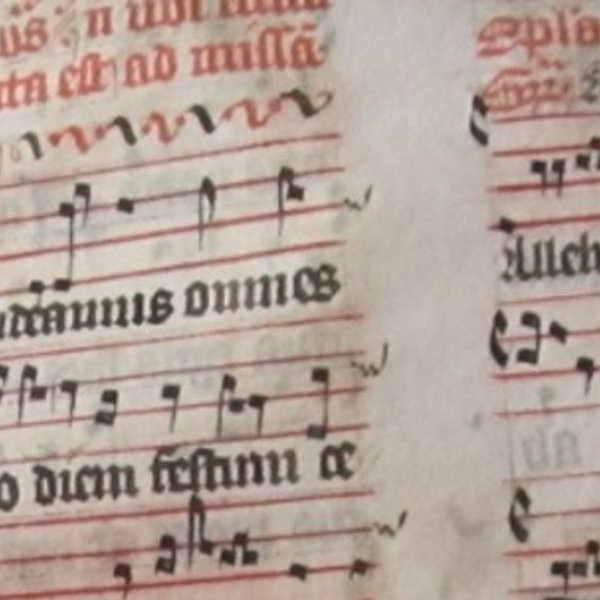
This beautiful page comes from a manuscript known as The Beauvais Missal. The manuscript was produced in France in the late 13th century for use by a priest in the Beauvais Cathedral of St. Peter. After the secularization brought on by the French Revolution at the end of the 18th century, the Cathedral library was dispersed and the Missal disappeared into private hands. In 1926, it was purchased at auction by none other than American industrialist William Randolph Hearst, who brought it to the United States. After sixteen years of happy ownership, he sold it in turn to an antiquarian bookseller in New York named Philip Duschnes. Working with his business partner Otto Ege of Cleveland, Duschnes dismembered the manuscript in 1942. He and Ege sold its leaves one by one to collectors and institutions across North America, knowing they would make more money selling single leaves than if they had sold the complete manuscript. This destruction in the name of capitalism was, unfortunately, quite common at the time, and thousands of manuscripts were destroyed this way, their leaves scattered to the wind. This destruction of cultural heritage objects cannot be undone, but digital tools offer reparative possibilities. The Beauvais Missal is currently the subject of a digital reconstruction project; so far, 122 of the original 309 leaves have been found. This leaf, preserving chants from the Common of Martyrs, now belongs to the Beinecke Rare Book & Manuscript Library at Yale University. - Lisa Fagan Davis, Executive Director, Medieval Academy of America

1 sound

Brussels, Bibliotheek Koninklijke Conservatoria Brussel, P-2-01880 (Fragmentarium: F-ubu8)

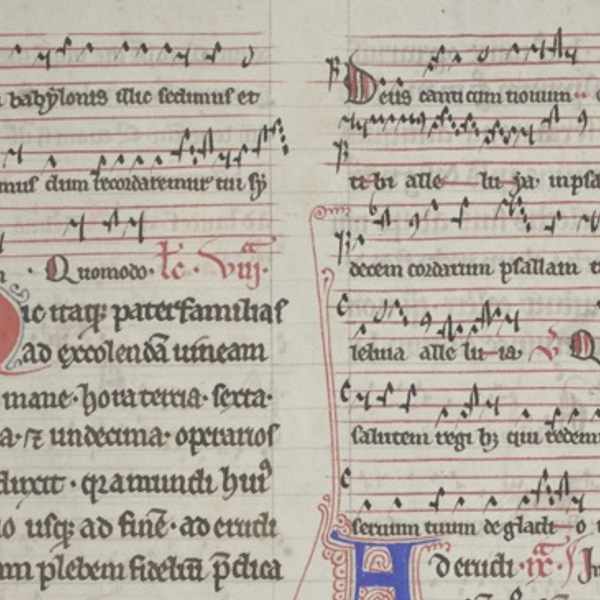
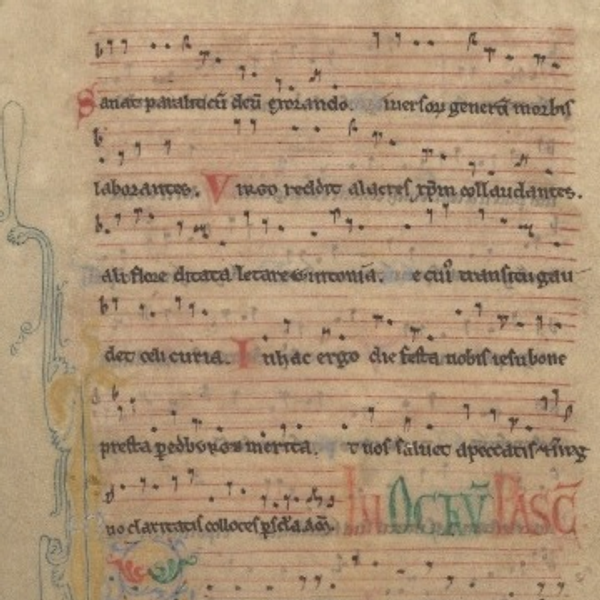
This double-sided parchment leaf comes from the second half of the 13th-century, and now lives in the library of the Royal Conservatory of Brussels. It would have been part of a large book called a noted breviary which combined both text and music for all worship services other than the Mass, which was given its own book. This leaf contains chants and readings that would have been heard before and during sunrise on the fourth Sunday after Easter. The blocks of text are portions of a sermon by Pope Gregory I, and the music that surrounds them are the pre-dawn responsorial chants for Matins and the shorter, but jubilant ‘Alleluias’ at the morning service of Lauds. The intricate pen-flourished initials in red and blue help to set off the two readings from the rest of the chanting, but the handwriting, classified as Northern gothica textualis formata is beautifully consistent throughout. The music is written in Lorraine notation on a red, four-line staff on which the ‘C’ line, and occasionally the ‘F’ line, is given at the left edge of each new system. The careful observer will notice the occasional b-flat sign amongst the note-heads. Interspersed between the Alleluias are indications of the musical pattern to which psalm verses would be sung. When you listen to this page, you will hear one example psalm verse sung to these ending-formulas, although in a service, you would have heard many verses.

  • Kate Helsen

1 sound

Ridgefield, CT, Private collection (Fragmentarium: F-e78r)

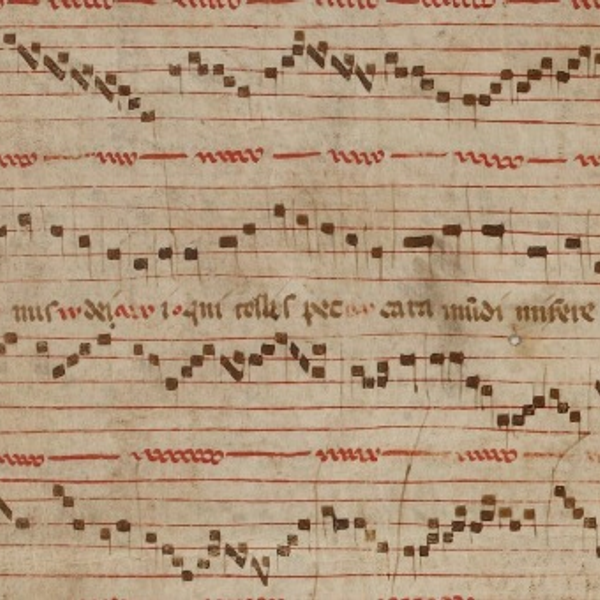
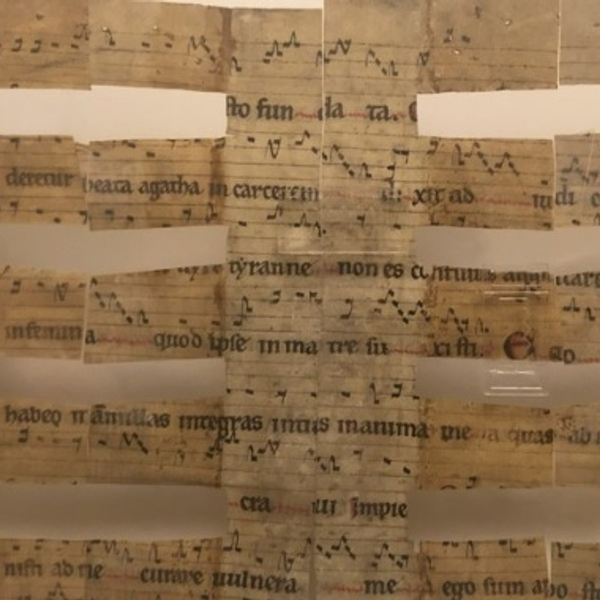
This partial page of chant likely came from a thirteenth-century antiphoner (a book of chants for daily services) used by a monastery or convent of the Cistercian order in northern France or Belgium. Cistercian monks and nuns sang distinctive, and consistent, chants that varied little from one institution to another, making their books readily recognizable. Some time in the eighteenth century, this book was recycled for other purposes, and several pages were cut up for use as bindings for a multi-volume work on church history—where they remained hidden until their host volumes were disbound by a collector in 2023. Two pieces of this page were used for Volume 14, two others for Volume 22; the whereabouts of the other half of the page is unknown. When used as a binding, the pieces acquired their current “comb” shape: the vertical margin aligned with the covers of the book, while the strips curved over the spine, and the gaps left room for the stitching that held pages together. (In its current state, the performers have to decide how to stitch together these gaps in the music!) The chants are responsories for the celebration of the feast of Agatha, an early Christian martyr, commemorated on February 5. According to legend, Agatha was put to death by the Roman prefect Quintianus when she refused to abandon her faith and marry him. The chants give voice to several of Agatha’s statements against her tormentors, and the structure of the most complete chant loops back to repeat her accusation against the “impious tyrant.”

  • Anna de Bakker

1 sound

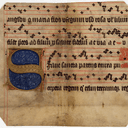
Bratislava, Slovenský narodný archív, Inv.Nr. 197 (Slovak Early Music Database)

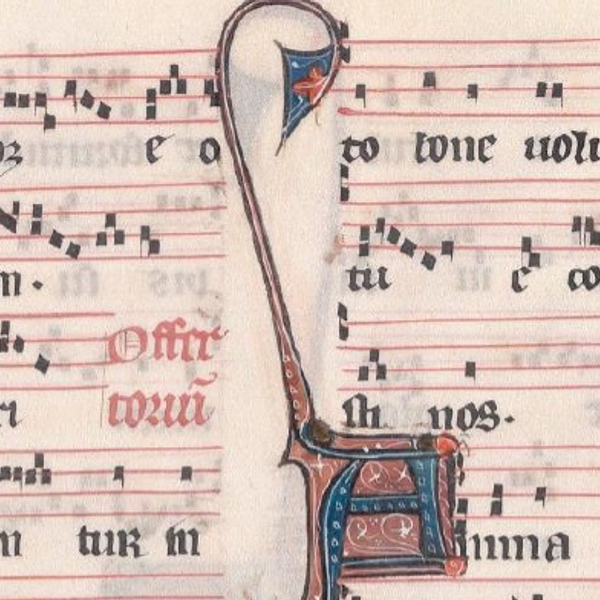
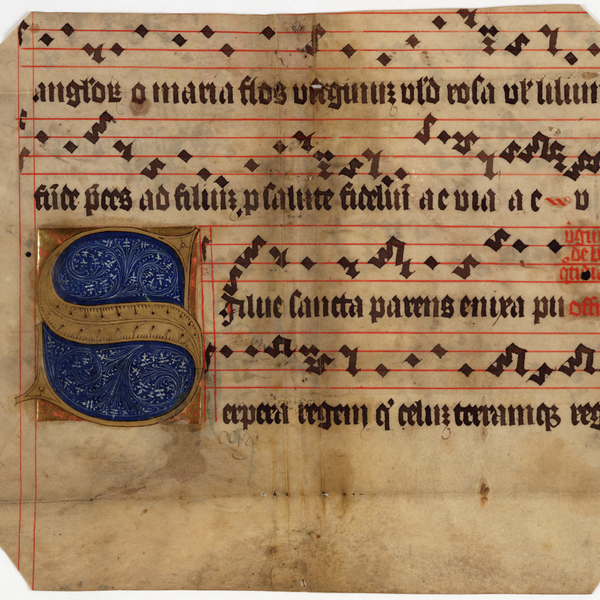
This fragment of a gradual, deposited in the Slovak National Archives (Bratislava, Slovakia) was once part of a large liturgical codex. The manuscript was intended for the singers of a schola. It was produced and used in medieval Hungary (the present-day territory of Slovakia, Hungary, Romania, Croatia, and parts of the territories of present-day Slovenia, Austria, Ukraine, and Serbia). This cut-off part of a gradual survived as the cover of an administrative book of the Demesne of the Červený Kameň Castle (Ledger of 1650, Inv. No. 197). According to the art-historical analysis of the golden initial S-alve, the original, late medieval manuscript from which the fragment was cut off dates to between 1420 and 1450. It has a high artistic standard of painting (golden embossed initial with blue ornamental filling). The fragment contains several chants of the liturgy of the Mass for the feasts of the Blessed Virgin Mary (de Beata Maria Virgine). The opening chant of the Holy Mass for the feasts of the Blessed Virgin Mary, the Salve sancta parens introit (in mode II), which has a beautiful illumination, must have been very important for the institute that commissioned the manuscript, as it is beautifully ornamented. The gradual is notated with the monumental type of the so-called Esztergom notation that came into being in the early 12th century and was used only in the territory of medieval Hungary. Although this extant fragment comes from the 15th century, it exhibits all the typical features of the early medieval local, so-called Esztergom system, which include a fluent shape of the two-note pes neume (two ascending notes: a lower and a higher one) and of the three-note scandicus neume (three or more ascending notes: lower – higher – higher note), or a vertically positioned climacus (three or more descending notes: bipunctum (higher) – lower – lower). In the late medieval period, the Esztergom notation was used mainly in Paulinian scriptoria (Ordo Sancti Pauli Primi Eremitae in Latin, a medieval monastic order founded in the thirteenth century in medieval Hungary, which followed the Esztergom liturgy), therefore the original codex was presumably produced for one of the major Paulinian monasteries in Hungary (either for their Buda monastery of Saint Lawrence or for their monastery in Marianka near Bratislava, de valle Marie in teuptunico Thal).

  • Eva Veselovska

1 sound

DOWNLOAD OUR APP TO DISCOVER THIS TOUR AND MANY OTHERS.

play-storeapp-store

Or start creating tours, treasure hunts, POI maps... Just let your imagination guide you.


Other walks nearby


Are you a creator?

START HERE

Privacy & cookie policy / Terms and conditions

© ECHOES. All rights reserved / ECHOES.XYZ Limited is a company registered in England and Wales, Registered office at Merston Common Cottage, Merston, Chichester, West Sussex, PO20 1BE

v2.5.15 © ECHOES. All rights reserved.