LSN: London Street Noises

11 ECHOES

Location: London, Greater London, England, United Kingdom

Mattia Cobianchi
Mattia Cobianchi

In September of 1928 five locations across central London were recorded by a team from Columbia Records led by Commander Daniel and supported by the Daily Mail. The project was prompted by a pressing concern for the impact on health and wellbeing from traffic noise.

These historical recordings are now available to you within this soundwalk at the exact locations of where those recordings were originally taken.

You now see a map with blue bubbles representing the 5 locations where the recordings were taken in September 1928. You can start with any of them, but you’ll be able to hear the recording only within the area delimited by the bubble. By tapping on a bubble, you will see the name of the location, and by tapping on the name of the location, you can access some background information.

The same background information is available as a read aloud version in an area adjacent to the relative location if you prefer to hear it instead of reading it on your device screen. A sixth bubble along Oxford Street contains some info about the recording technology used at the time.

Once you’ve listened to the 1928 soundscape, please fill in the anonymous google form linked in the location description.

When the soundwalk is open in map view, you can also tap on the ‘List’ icon on the top right corner to see a list of the locations and their descriptions. By tapping on the items in the list, you will then access the full description.

MORE ABOUT THIS PROJECT: www.londonstreetnoises.co.uk www.facebook.com/londonstreetnoises Twitter: @londonnoises

HUSH City app If you want to anonymously share the current soundscape of the location you are in with the community, please install the Hush City app. The recordings will be then publicly available here https://map.opensourcesoundscapes.org

Android http://bit.ly/AndroidHush iOS http://bit.ly/HushLSN

When answering the first question “What prompted you to record this sound?” please reply ‘LSN’, so that we can identify the recording as part of the London Street Noises project.

For feedback or questions about the project, please email us at londonstreetnoises@gmail.com

private
LeicesterSquare_1928 soundscape

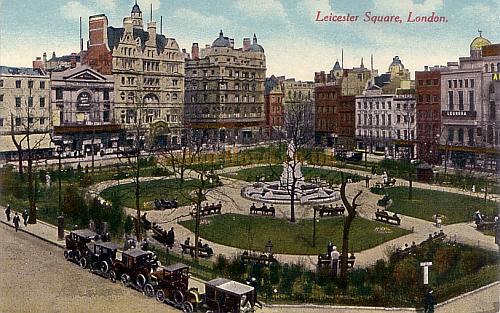
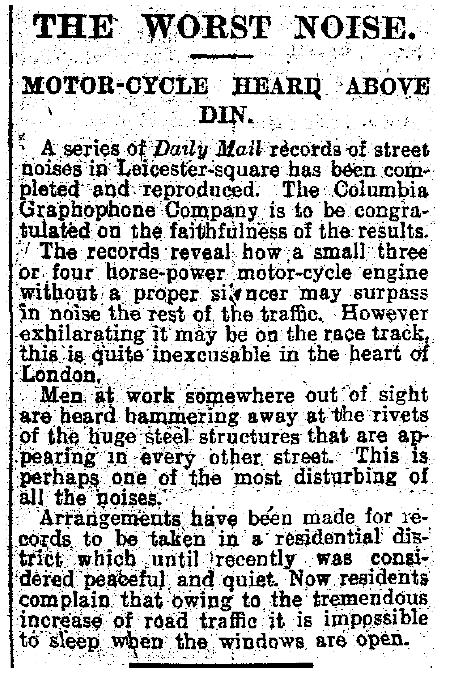
In 1928, the sonic environment of Leicester Square used to be described as a medley of transportation noises dominated by motor horns. The excessive use of it was the biggest cause of public reaction. A series of records of street noises were taken in this location as part of the Daily Mail investigation on the same year, and this time, it was revealed that the sound of the motor-cycle engines can surpass the rest of the traffic noise. It was found ‘inexcusable’. In the related newspaper article titled ‘The Worst Noise’, there is also a mention of the sound of the builders hammering steel structures which can appear in almost every nearby street. The recordings which were taken in five different locations including Leicester Square played an important part in convincing the Home Office that the noise problem was serious enough to make special regulations. The project had been successful and after the demonstration of the recordings officially (Home Office) and publicly (BBC broadcast), a draft to regulate excessive horns in traffic was introduced. Source: Daily Mail, 14.09.1928, ‘The Worst Noise’, Issue: 10107, p.9 and ‘Quieter Motor Horns’, 26.10.1928, Issue: 10143, p.11. Once you`ve listened to the 1928 soundscape, please fill in this anonymous google form http://bit.ly/LSNleicester

HUSH City app If you want to anonymously share the current soundscape of the location you are in with the community, please install the Hush City app. The recordings will be then publicly available here https://map.opensourcesoundscapes.org Android http://bit.ly/AndroidHush iOS http://bit.ly/HushLSN When answering the first question “What prompted you to record this sound?” please reply “LSN”, so that we can identify the recording as part of the London Street Noises project.

1 sound

Whitechapel_1928 soundscape

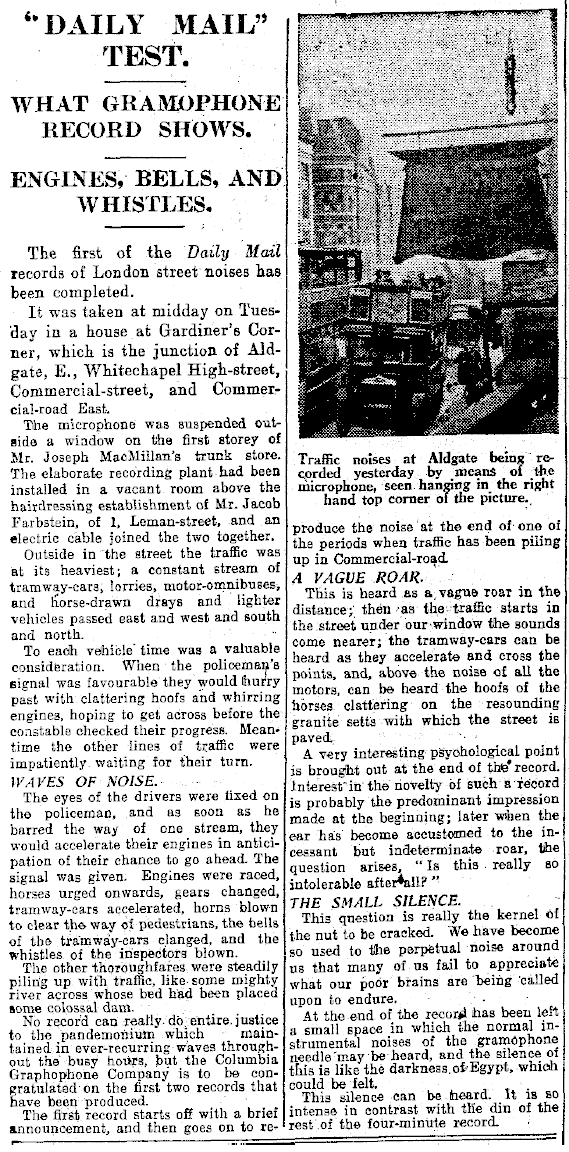
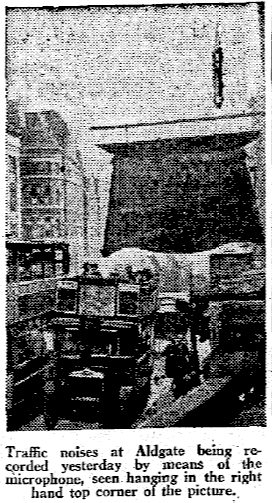
The sound recording taken at 1 Leman Street, Whitechapel, was the first in the series of “London street noises” investigation of the Daily Mail. On the 4th of September at midday, a microphone was suspended outside a window of the first level of a trunk store. The recording plant itself, which would require a large space, was set up in a room above a hairdresser in the building. The microphone and the instrument were then joined by an electric cable. Behind this technical feat there was the Columbia Gramophone Company, which was congratulated upon capturing the impossible-to-be-grasped ‘pandemonium which maintained in ever-recurring waves’. The overall traffic noise consisted of a non-stop ‘stream of tramway-cars, lorries, motor-omnibuses, and horse-drawn drays and lighter vehicles passed east and west and south and north’. Source: Daily Mail, ‘London Street Noises’, 06.09.1928, Issue: 10100, p.9. Once you`ve listened to the 1928 soundscape, please fill in this anonymous google form http://bit.ly/LSNwhite

HUSH City app If you want to anonymously share the current soundscape of the location you are in with the community, please install the Hush City app. The recordings will be then publicly available here https://map.opensourcesoundscapes.org Android http://bit.ly/AndroidHush iOS http://bit.ly/HushLSN When answering the first question “What prompted you to record this sound?” please reply “LSN”, so that we can identify the recording as part of the London Street Noises project.

1 sound

Beauchamp Place_1928 soundscape

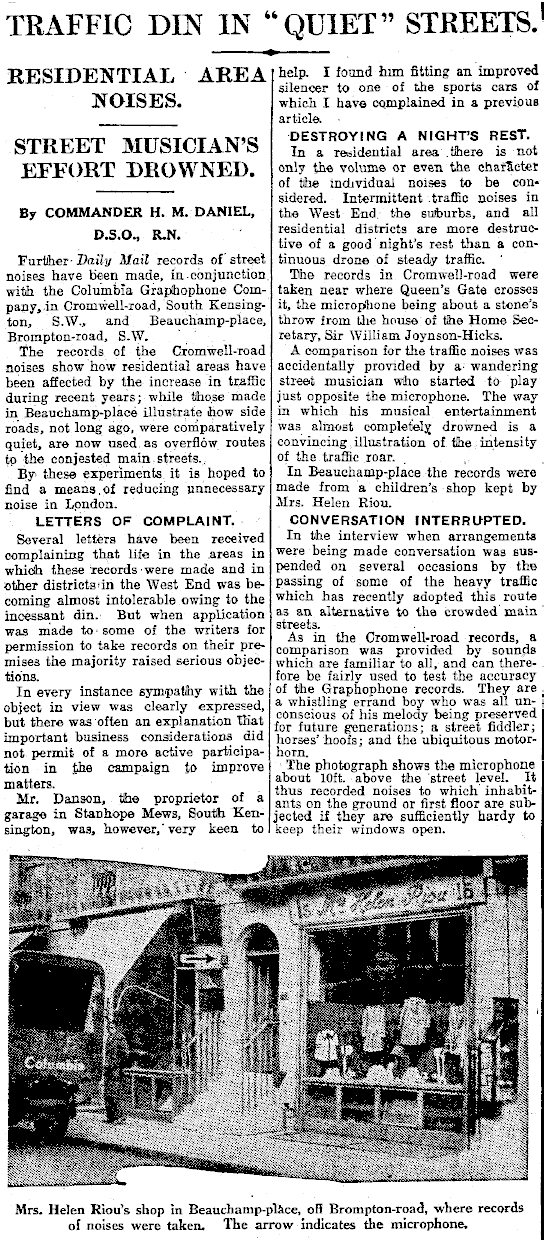
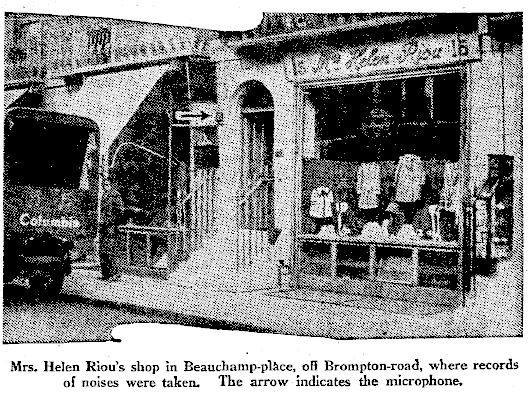
The recordings at Beauchamp Place and Cromwell Road had demonstrated the different character of the sonic environment present in the then residential areas. According to Commander Daniel, who investigated London street noises for Daily Mail in September 1928, it is not only the loudness or other particular aspects of noises that affect a good night’s sleep. Intermittent noise, which was being heard in the suburbs and some parts of the West End, was considered to be more disruptive for sleep and resting than a ‘continuous drone of a steady traffic’. In Beauchamp Place, the recording instrument was located in a children’s shop off Brompton Road. The microphone was placed about 10ft above the street level, thus gathering the sounds which people living or working at ground level or on the first floor could hear if they had kept their windows open. Commander Daniel notes that their interview with the shopkeeper was interrupted several times by the passing of heavy traffic, which had recently increased thanks to the diversions from crowded roads. Both Cromwell Road and Beauchamp Place soundscapes also include street musicians as their keynote. Source: Daily Mail, ‘Traffic Din in “Quiet” Streets’, 25.09.1928, Issue: 10116, p.10. Once you`ve listened to the 1928 soundscape, please fill in this anonymous google form http://bit.ly/LSNbeauchamp

HUSH City app If you want to anonymously share the current soundscape of the location you are in with the community, please install the Hush City app. The recordings will be then publicly available here https://map.opensourcesoundscapes.org Android http://bit.ly/AndroidHush iOS http://bit.ly/HushLSN When answering the first question “What prompted you to record this sound?” please reply “LSN”, so that we can identify the recording as part of the London Street Noises project.

1 sound

Cromwell Road_1928 soundscape

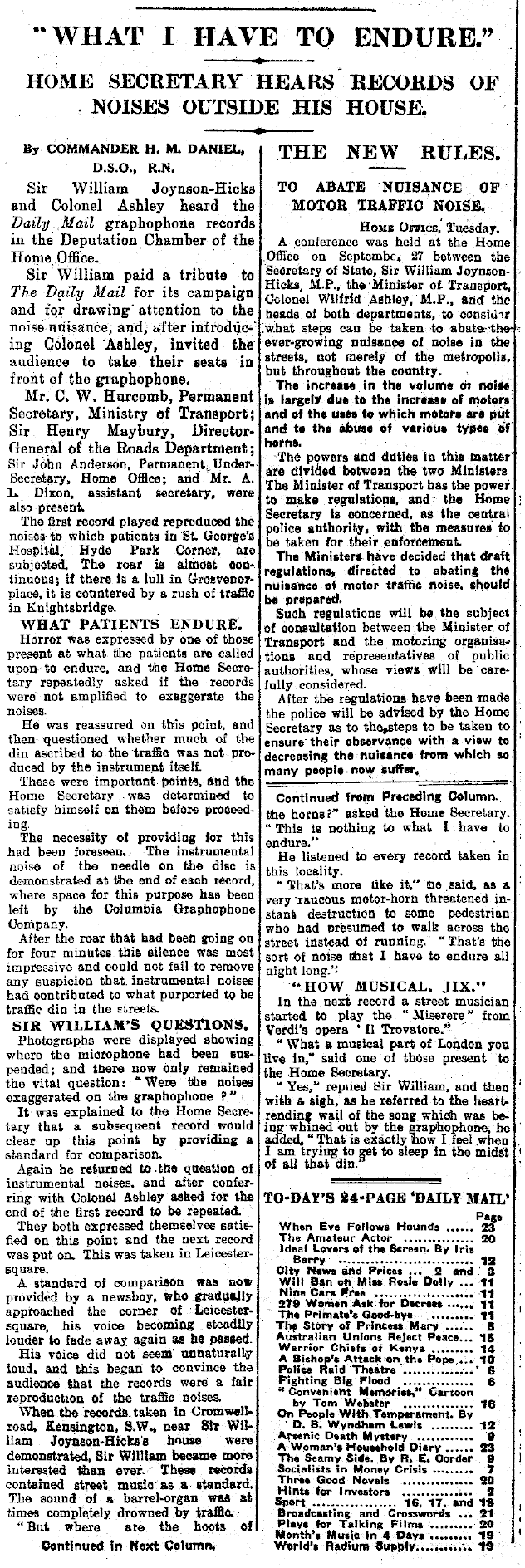
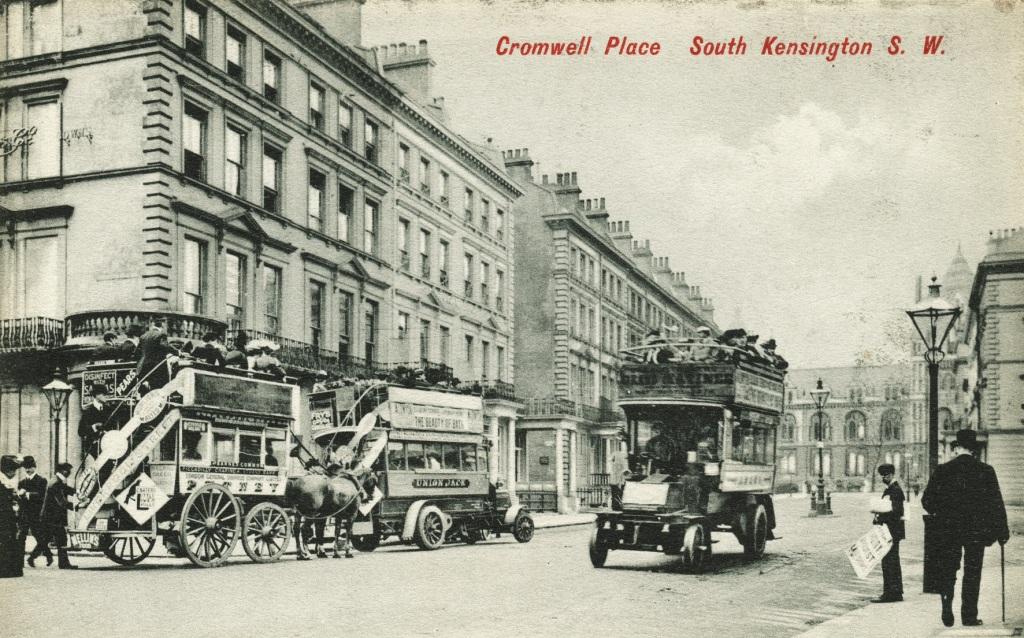
As a residential area, Cromwell Road was turned out to be noisier than expected. Commander Daniel speaks of some letters of complaints they received from the residents living around the area as to noise becoming almost intolerable. But he also adds that most writers of the letters did not accept his offer to take recordings from their place, nor to actively support a campaign for noise abatement. The recording for this location was taken near the intersection of Queen’s Gate and Cromwell Road and the microphone were placed next to the house of the home secretary of the time, Sir William Joynson-Hicks. When Joynson-Hicks listens to the reproduction of the noises around his neighbourhood, he reacted: ‘But where are the hoots of the horns? This is nothing to what I had to endure.’ Source: Daily Mail, ‘Traffic Din in “Quiet” Streets’, 25.09.1928, Issue: 10116, p.10 and ‘What I Have to Endure’, 03.10.1928, Issue: 10123, p.13. Once you`ve listened to the 1928 soundscape, please fill in this anonymous google form http://bit.ly/LSNcromwell

HUSH City app If you want to anonymously share the current soundscape of the location you are in with the community, please install the Hush City app. The recordings will be then publicly available here https://map.opensourcesoundscapes.org Android http://bit.ly/AndroidHush iOS http://bit.ly/HushLSN When answering the first question “What prompted you to record this sound?” please reply “LSN”, so that we can identify the recording as part of the London Street Noises project.

1 sound

Grosvenor Place_1928 soundscape

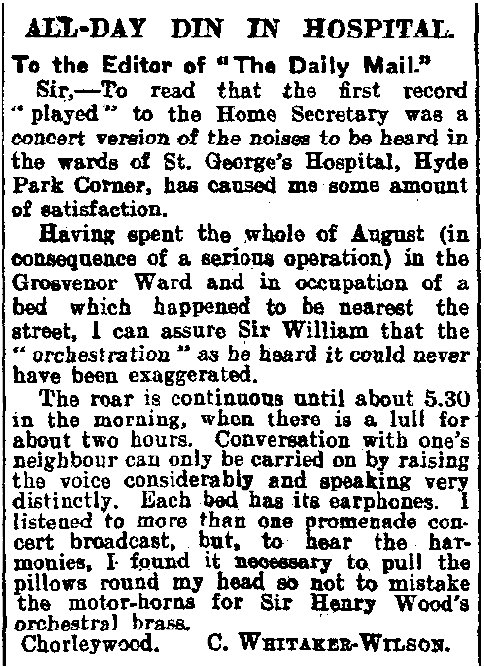
The second series of London street noises were taken from St. George’s Hospital (now the Lanesborough Hotel), Hyde Park Corner, where traffic noises would be heard from 6.30am till 4am. The microphone transmitting the sounds was positioned outside the window of one of the women patients’ wards on the first floor which was overlooking towards the corner of Knightsbridge and Grosvenor-place. The recording caught public attention and was covered in several stories in the Daily Mail. Concerns about wellbeing had indeed culminated in an article published earlier, which triggered this investigation, in which Sir Percival Philips describes noise as a ‘menace to nerves and health’. Then, few months later, a worrying 21-hours exposure to road traffic noise for the sick, who need peace the most, was revealed. In order to protect themselves, the elderly patients were provided with cotton wools or ear plugs and everyone had an earphone by their bed through which they would listen to the Proms concerts. Source: Daily Mail, ‘Cities’ Worst Plague’, 16.06.1928, Issue: 10055, p.11; ’21,5-Hours Traffic Roar’, 08.09.1928, Issue: 10102, p.9 and ‘All Day Din in Hospital’, 04.10.1928, Issue: 1024, p.13. Once you`ve listened to the 1928 soundscape, please fill in this anonymous google form http://bit.ly/LSNgrosvenor

HUSH City app If you want to anonymously share the current soundscape of the location you are in with the community, please install the Hush City app. The recordings will be then publicly available here https://map.opensourcesoundscapes.org Android http://bit.ly/AndroidHush iOS http://bit.ly/HushLSN When answering the first question “What prompted you to record this sound?” please reply “LSN”, so that we can identify the recording as part of the London Street Noises project.

1 sound

DOWNLOAD OUR APP TO DISCOVER THIS TOUR AND MANY OTHERS.

play-storeapp-store

Or start creating tours, treasure hunts, POI maps... Just let your imagination guide you.


Other walks nearby


Are you a creator?

START HERE

Privacy & cookie policy / Terms and conditions

© ECHOES. All rights reserved / ECHOES.XYZ Limited is a company registered in England and Wales, Registered office at Merston Common Cottage, Merston, Chichester, West Sussex, PO20 1BE

v2.5.15 © ECHOES. All rights reserved.