The Bird (in The Sanctuary)

room 12 ECHOES

Location: Bird Sanctuary Loop, Los Angeles, California 90027, United States
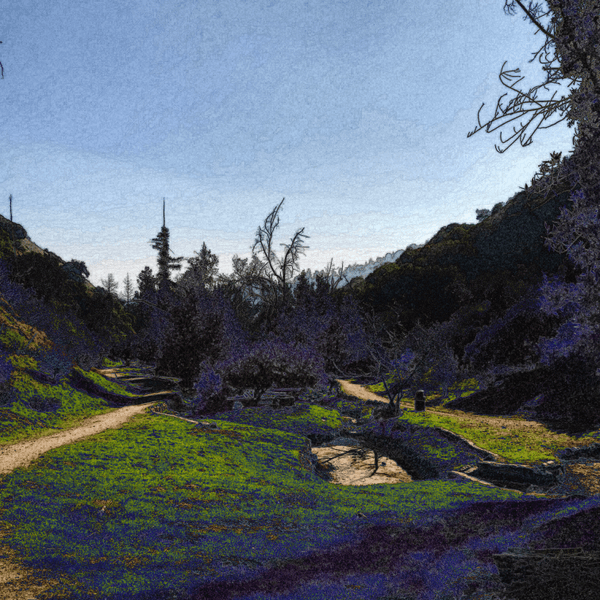
"The Bird" is an augmented reality soundwalk realized by Los Angeles based Sound Artist Henry Webster in collaboration with Chicago based Composer/Sound Artist davy (vocal performance and composition). The Bird is alive, as we suppose any other is. Elements will change, alter and migrate. This iteration of "The Bird" is accessible in Griffith Park by entering from Hillhurst Avenue and locating the Bird Sanctuary, north of The Greek Theater.

This work is presented on Tongva land.


Henry Webster
Henry Webster
Los Angeles based Sound Artist, Composer, and Teaching Artist.

DOWNLOAD OUR APP TO DISCOVER THIS TOUR AND MANY OTHERS.

play-storeapp-store

The Echoes


You Found It!

Settling In

Relax

eye in the storm

Made Paradise

Red Carpet

Zone 1

Zone 2

Zone 3

Zone 4

Zone 5

Garden

Discover more geolocated content in our apps.
play-storeapple-app-store

Or start creating tours, treasure hunts, POI maps... Just let your imagination guide you.


Other walks nearby

This is Tongva Land: Griffith Park, LA (PSA)

This is Tongva Land: Griffith Park, LA (PSA)

This is Tongva Land, Griffith Park, LA (PSA) The Tongva (/ˈtɒŋvə/ TONG-və) are an Indigenous people of California from the Los Angeles Basin and the Southern Channel Islands, an area covering approximately 4,000 square miles (10,000 km2).[1][2] In the precolonial era, the people lived in as many as 100 villages and primarily identified by their village name rather than by a pan-tribal name.[3] During colonization, the people were referred to as Gabrieleño and Fernandeño,[a] names derived from the Spanish missions built on their land: Mission San Gabriel Arcángel and Mission San Fernando Rey de España.[b] The name Tongva is the most widely circulated name and gained popularity in the late 20th century. Others choose to identify as Kizh and disagree over use of the term Tongva.[4] Along with the neighboring Chumash, the Tongva were the most influential people at the time of European arrival. They developed an extensive trade network through te'aats (plank-built boats) and a vibrant food and material culture based on an Indigenous worldview that positioned humans, not as the apex of creation, but as one strand in a web of life (as made evident in their creation stories).[5][1][2][6] Over time, different communities came to speak distinct dialects of the Tongva language, part of the Takic subgroup of the Uto-Aztecan language family. There may have been five or more such languages (three on the southernmost Channel Islands and at least two on the mainland).[1] European contact was first made in 1542 by Spanish explorer Juan Rodriguez Cabrillo, who was greeted at Santa Catalina by the people in a canoe. The following day, Cabrillo and his men entered a large bay on the mainland, which they named "Baya de los Fumos" ("Bay of Smokes") on account of the many smoke fires they saw there. This is commonly believed to be San Pedro Bay, near present-day San Pedro.[7] The Gaspar de Portolá land expedition in 1769 led to the founding of Mission San Gabriel by Christian missionary Junipero Serra in 1771 and initiated an era of forced relocation, enslavement, and exposure to Old World diseases.[8] This led to the rapid collapse of Tongva society and lifeways.[9] Resistance and rebellions occurred in retaliation, including an unsuccessful rebellion in 1785 by Nicolás José and female chief Toypurina.[1][3] In 1821, Mexico gained its independence from Spain and secularized the missions, selling mission lands to ranchers and forcing the Tongva to assimilate.[10] Most became landless refugees during this time.[10] In 1848, California was ceded to the United States following the Mexican-American War. The US government signed 18 treaties between 1851 and 1852 promising 8.5 million acres (3,400,000 ha) of land for reservations. However, these treaties were never ratified,[11] and were negotiated with people who did not represent the Tongva and had no authority to cede their land.[12] During American occupation, many of the people were targeted with arrest and used as convict laborers in a system of legalized slavery to expand the city for Anglo-American settlers, who became the new majority in 1880.[10] In the early 20th century, an extinction myth was purported about the Gabrieleño, who largely identified publicly as Mexican-American by this time. However, a close-knit community of the people remained in contact with one another between Tejon Pass and San Gabriel township into the 20th century.[8][13] Since 2006, four organizations have claimed to represent the people: the Gabrielino-Tongva Tribe, known as the "hyphen" group from the hyphen in their name;[14] the Gabrielino/Tongva Tribe, known as the "slash" group;[15] the Kizh Nation (Gabrieleño Band of Mission Indians);[16] and the Gabrieleño/Tongva Tribal Council.[17] Two of the groups, the hyphen and the slash group, are the result of a hostile split over the question of building an Indian casino.[18] In 1994, the state of California recognized the Gabrielino "as the aboriginal tribe of the Los Angeles Basin."[19] No organized group representing the Tongva has attained recognition as a tribe by the federal government.[11] In 2008, more than 1,700 people identified as Tongva or claimed partial ancestry.[11] In 2013, it was reported that the four Tongva groups that have applied for federal recognition had over 3,900 members collectively.[20]
free
My Hollywood Renaissance

My Hollywood Renaissance

December 27, 2019 8 HAS 4 HALF’S & 2 PARTS IN 1 I My name has two parts, Dani is what I’d like to call calm, Ela lies with the pretty little cats, The first is light, bold and smart; The second one carries blood, cities and scars. Whichever I pick, depends on the position that the sun shines across the cosmic sky. Sometimes it gets dark, and when it rains, Ela gets harsh. Dani stays in a corner reading Kerouac. If an angel called a demon, I wouldn’t know where to park, the drives of a woman, who’s name is probably online. Meanwhile in heaven, bakesales are divine, with tons of books, lavender and candle lights. Sage burns discretely in half; my second self gets infused like a pomagranate tartar. You can invocate a psychopath, or just a quiet girl with a sweet talk, ugh why is life so hard? All hail good things like water and wine, there wouldn’t be no paradise if it wasn’t for the flames of a burning hell and back.
free
Lawrences Walk

Lawrences Walk

free
Reflections

Reflections

Part walking poetry experience, part meditative memorial, and part experimental sound art installation, Reflections is a response to this moment, designed to give voice to a diversity of people living through the current crisis and to make space in the public square for reflection on our shared experience of living through a pandemic. Dozens of participants from across LA County and other quarantined regions of the world were interviewed as part of this project. Participants were asked: What have you learned about yourself from living through this time? Has this experience changed you? What is one memory from this time that you think will stick with you forever? What do you hope the world learns from this experience? The 7 compositions included in this installation are comprised of clips from these interviews arranged thematically and collaged with the sounds of places, events, and materials that participants invoked during their reflections. The themes, which emerged organically in response to open-ended questions, include: scarcity and abundance; gratitude and inequity; inwardness and action; vulnerability, humility, and connection; and grief, resilience, and radical joy Total runtime: 70 minutes, with 7 unique tracks, each running approximately 10 minutes. www.glendalereflections.com This installation is generously sponsored by the Glendale Arts and Culture Commission, through funding from the Urban Art Program, and support from Glendale Library, Arts & Culture and Glendale Community Services and Parks.
free
Pictures and Spaces

Pictures and Spaces

“Pictures and Spaces” is a concept album focusing on environmental sound design for imaginary spaces inspired by real spaces. The idea for the album was to create impressionistic ambient soundscapes based on real places that I had visited around Los Angeles. The tracks are made from a combination of field recordings which were arranged, resampled, and digitally processed along with synthesized sounds for the final result. This walk is best experienced by using the publicly accessible elevated walkways. It is recommended to start at Figueroa St. and West 3rd St.
free
Soundwalk

Soundwalk

What does it feel like to walk through campus and listen to the music that student's would have listened to during the time they attended the historical Loyola High School?
free
Berendo lot walk

Berendo lot walk

a walk in the lot.
free
home walk eleanor

home walk eleanor

testing out geofencing at this random residence
free
Loyola's commons soundwalk

Loyola's commons soundwalk

If Malloy Commons could make sounds related to the area and buildings that surround it what would it sound like?
free

Are you a creator?

START HERE

Privacy & cookie policy / Terms and conditions

© ECHOES. All rights reserved / ECHOES.XYZ Limited is a company registered in England and Wales, Registered office at Merston Common Cottage, Merston, Chichester, West Sussex, PO20 1BE

v2.4.30 © ECHOES. All rights reserved.