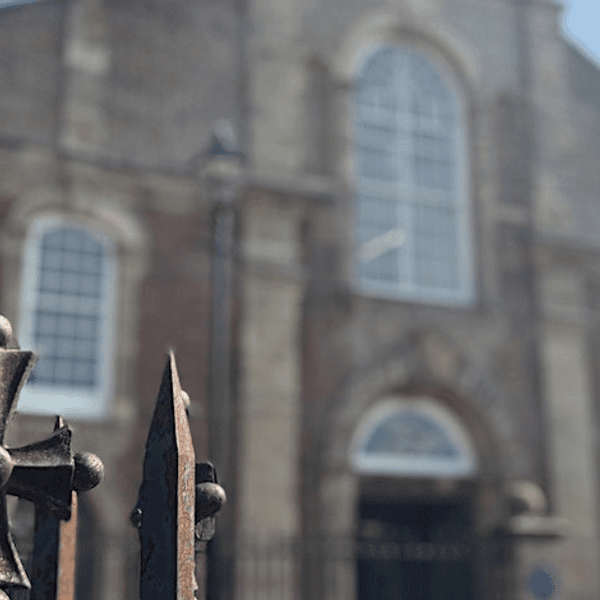
Seventeen Nineteen - Holy Trinity Church
1 sound
Although giving their name to another part of Sunderland, the Thornhills' wealth entered the town in this area.
The Thornhill family were the main benefactors of enslaved people in Sunderland, using some of their accumulated wealth to build St John’s Church. The church here, Seventeen Nineteen (formerly Holy Trinity), formed the model for St John's Church which was built by the Thornhills.
The old exchange building (demolished in the 1960s) was at the bottom of Church Street and would have been the one used by the Thornhills when they first established their quay in a prime position which is now taken up by Corporation Quay.
You might be able to see on the map that the furthest point for the streets here is called 'Barrack Street', which is where the barracks were situated. St John's would have stood between Barrack Street and Hartley Street on Prospect Row, facing the town moor.
The Thornhill family became wealthy initially through shipping, but later invested in plantations in India. John Thornhill commissioned the building of St John’s Church as a mirror image of Holy Trinity in 1764. He was a divisive figure, famously described by local historian James Corder as 'a curious mixture of piety, public spirit, conceit and fraud'. The Thornhills moved to North Yorkshire in the late eighteenth century but their legacy remains in the area of Sunderland that still carries their name.
Interestingly, John Thornhill was so enamoured with the church that carried his name that he was said to have been buried under its altar. However, when the church was demolished in 1972, no trace of him was found.

