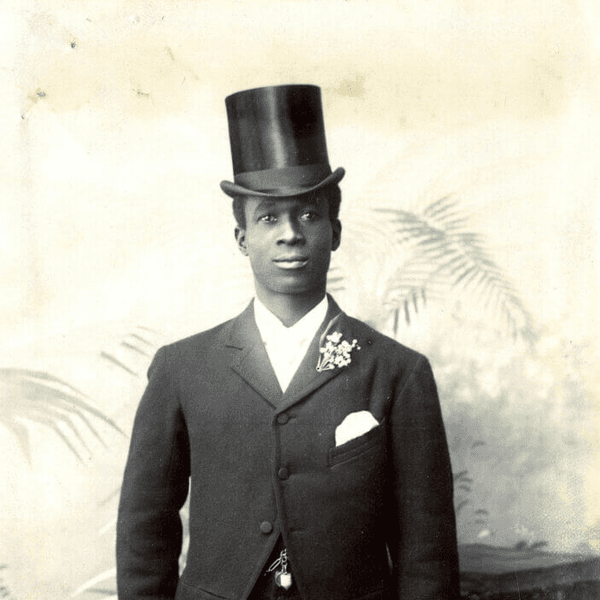
Blue Plaque to Celestine Edwards
1 sound
As you look upon this beautiful grade II listed building, formerly a bank, it is easy to feel it has historical significance. However, the history of the ground upon which it stands runs deeper still. Before this building was erected, another building stood proudly here. The Sunderland Assembly Hall was built on the site of the old Ebenezer Chapel, on the northern corner of Fawcett Street and St Thomas Street. It was opened in 1884. The building was converted into the Assembly Hall at a time when the street was moving from being primarily residential to commercial.
It was in the old Assembly Hall that speakers such as Celestine Edwards spoke out against slavery and racism.
Edwards was a passional anti-racism and anti-imperialism activist, and regularly spoke at the Assembly Hall in the 1880s and 1890s. He lived in Sunderland for a short time.
(Samuel Jules) Celestine Edwards was born sometime in late 1858 or early 1859, on the island of Dominica. The youngest of ten children, his free-born French-speaking parents moved to the neighbouring island of Antigua when Celestine was very young. There he went to school until the age of about twelve. He ran away to Gaudaloupe and then to sea. The reason for this is not known, but there are some stories that he was bullied by his older brothers. When at sea, Celestine recalled later that he learned to swear and drink like a sailor.
Although born into a Christian family, it was only when he was working as a sailor that he fully committed to the faith. In 1877, he arrived in the UK, first in Edinburgh where he worked as a labourer. He then moved to live in Sunderland, where he had a career change again and worked as an insurance agent, earning the sum of £80 per year, a sum which is considerably higher than that of the average skilled labourer at that time (about £1 a week). By this time, he was a committed Methodist, and fully embraced the temperance movement associated with this.
Edwards became a passionate speaker in favour of temperance, and spoke at length on religious matters at various locations both in Sunderland and more widely. He was a regular speaker at the new Assembly Hall on Fawcett Street, but also spoke at the Bethesda Chapel on Tatham Street, and at other venues around the city.
A very tall man at just under 6 feet at a time when the average height for men was around 5 feet 6 inches, he was an imposing figure. From newspaper reports of his many public appearances in Sunderland, it seems he was a very popular and engaging speaker, who was not afraid to argue on points of theology, imperialism and race. He was particularly critical of some of Darwin’s ideas, highlighting the implicit racism of these (perhaps also linking them to Darwin’s eugenicist cousin, Francis Galton). In a speech recorded in the Sunderland Daily Echo on 30th September 1891, he is reported to have
'dealt at length with the theory of evolution, and said that Darwin had somehow got the negro race mixed up in his book, and had stated that in his opinion it was somewhere in Africa that the human race first originated from ape. The lecturer then dealt with the various objects raised against the negro, and caused much amusement by the comparison he made between negroes and white men. The lecture was listened to with great attention, and was much applauded, Mr Edwards concluding a fine peroration by saying that the time was coming, and coming fast, when public opinion would be turned, and it would be found that, given equal opportunity and equal time, the negro race would show as honourable a record as any race with which the earth was blest.'
Edwards lived only two or three years in Sunderland. Details of his life are somewhat sketchy as he moved around a great deal. Sunderland is one of the few places he actually settled for any length of time. He did move to London in the late 1880s, where he moved around various locations. He helped former slave Walter Hawkins write his autobiography, 'From Slavery to Bishopric' (1891). He became editor of the Christian fortnightly magazine, Lux, and also the Society for the Recognition of the Brotherhood of Man’s newsletter, Fraternity. He thus becomes what is thought to be Britain’s first black editor. He used these publications to fight for racial equality, the demise of imperialism, and of course temperance. In the 10th December 1892 edition of Lux, he wrote that
'as long as such unrighteous deeds as cold-blooded murders are permitted under the British flag, as long as avarice and cupidity prompt the actions of a missionary nation, so long we shall protest against public money being spent in the interest of land-grabbers. The injustice under which the black man is smarting will come home to his oppressors’ children’s children. He will surprise and disappoint those who never dreamt that the quiet happy-go-lucky black would turn like the worm upon those who wronged him. If the British nation stole no more, they have stolen enough and have sufficient responsibility at home and abroad to occupy her maternal attention for the next hundred years. If the British nation has not murdered enough no nation on God’s earth has.'
In this extract, we can see that he is clearly arguing against racial inequality and imperialism, telling uncomfortable truths. It is a message he repeated in Lux a few months later, pointing here to the trading habits of the British in their colonising avarice.

