The Gardiner & The Humber Archway Bridge
1 sound
From an architectural walk led by Christie Pearson for Urbanvessel and riverMOUTH
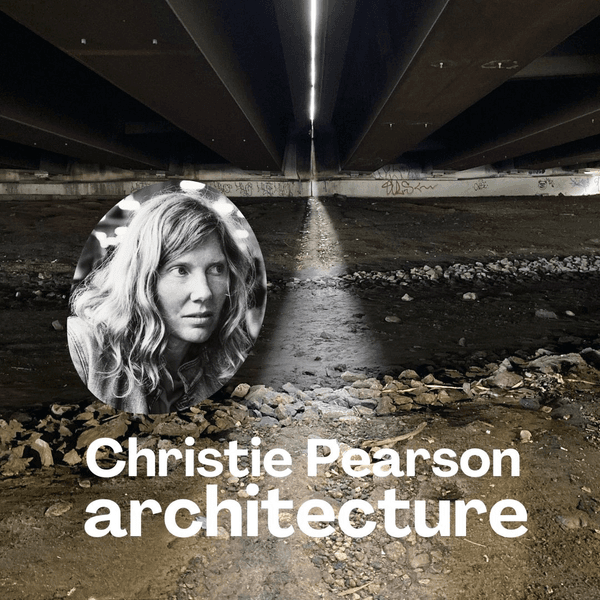
You can imagine that moment of the Gardiner coming through and dominating this landscape — such a wide swath — when you walk underneath it. To be under the train lines and under the expressway — it was a beautiful restoration of the underside of the Gardiner here, which actually makes it feel semi-recreational in a weird sort of way.
But this would've been the end of the shoreline. The land that we have here is more landfill, but it also was a sort of a natural beach. There were a lot of natural beaches and estuaries. Older maps that I've seen of this show a smattering of islands and wetlands that come and go depending on the year and the season.
The Gardiner expressway in 1955 is a very bold intrusion into the landscape of Toronto and the death of these beautiful beaches — recreational spaces that headed in both directions from the Harbor. If you continue on the trail there's a monument to the Palace Pier and its ambition to be like the great amusement piers in the UK from the early from the 1910s and twenties.
But then we have this other kind of vision of Toronto: this bridge here, the Humber Archway bridge by Montgomery Sisam and a whole team of artists and designers and engineers and with the Indigenous art consultant Ahmoo Angeconeb. A lot of the features of the design of this bridge, as a pure recreational bridge, were trying to connect to Indigenous culture, especially in the Anishinabe motifs that you see like the Thunderbird. If you go down there and you stand underneath, you can see that Thunderbird motif is in the steel structure itself in a moving and graphically satisfying expression of steel engineering. And then if you go around the base of the bridge, you'll see motifs of the snake and the turtle and salmon and the many species that made this massive estuary, their home — and, of course, a lot less so today. But we still have them. So next time you're on that bridge look around for these design details that are thoughtful and beautifully done.
The price of the bridge is something shockingly low. I thought that was worth noticing — it's something like four or four and a half million dollars. We can't seem to build anything in Toronto now - the subway extension goes on and on — but in the fifties, there was the rapid construction of the subways. And then even here in 1996, they were able to build this elegant bridge with a competition and a lot of design excellence.
I think it's a nice counterpoint to thinking about the design of the Oculus that we just looked at. There is a relation in terms of the expression of a steel structure in a more contemporary way and then the suspension.
Learning a little bit about the history makes you look at it in a different way — these spaces that we're zipping by on our bikes all the time. And also to think there's a process to all this stuff: politics, finance, and a lot of designers that work on these places. Knowing a bit about the history we can think about the future and how we could do things more consciously of where we're coming from and where we want to head towards.

