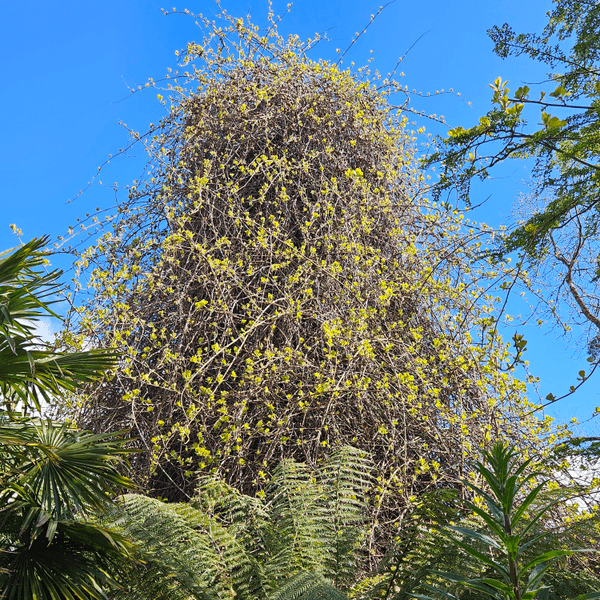
Kiwifruit
1 sound
Transcript >John If you were here in the gardens before 10 o'clock in the morning, you would very often see local red squirrels enjoying their breakfast amongst these vines, then vanishing before the visitors arrive. And if you look carefully, you might be able to pick out the fruits that they are gorging on. They're kiwi fruits; and this vine, it doesn't look very special, but it is very special, as we'll find out, because it has quite an international story. So, I've got Kelly Wang here, and she is going to help me to understand about the history of these vines. >Kelly The kiwi fruit actually comes from my home country, China. We call it the mi ho tao, which means macaque fruit or monkey peach. So, the macaques love it in the wild and it has been harvested in China since at least the Song Dynasty, which is at least 800 years ago. >John Did you know it made its way from China to New Zealand in 1904? And thanks to Isabel Fraser, who collected the seeds when visiting her sister, a missionary in the Yangtze Valley, and took the seeds back, and there they were germinated, and the first fruits appeared in 1910. Now, at about the same time, seeds were introduced to the UK and America, but they didn't bear fruit. And that was because the seeds were all male, whereas the seeds that were sent back to New Zealand were male and female. >Kelly It's pretty cool. The plants have genders. >John It's amazing. Although, by the 1990s they had bred them so that they were both the same gender. And so you only needed one plant to produce fruit. But before 1990, you needed two plants, a male and a female. >Kelly That's fascinating. >John Fortunately for the New Zealand vines, and because all the seeds look the same, Isabelle had won the lottery and brought back both male and female seeds. So, there are two vines climbing over this old tree, a male and a female, or there would be no fruit. >Kelly That's very interesting. So, New Zealand became the first big producer. I've read that originally it was called Chinese gooseberry for its taste and origin, right? >John Yes, exactly. But once it became popular for export, especially after the Second World War, when US soldiers are said to have taken a liking to it, the name changed. By 1959, they named it kiwifruit, which was much easier for shipping and marketing. Now, New Zealand grows about 40% of the world's kiwi fruit. >Kelly Wow. Mount Stewart's kiwi fruit must be rather special then. Many vines in China have only male or female plants. So, if yours fruits so well, they must have both. >John That's right. And I climbed in under the tree and I could find; I found two stems. >Kelly I'm surprised the weather here, that you can actually grow kiwi fruit. >John That's amazing, isn't it? Yes. Well, that's because of Strangford Lough and the mild climate; so it grows. >Kelly It doesn't need loads of sunshine. >John Apparently not. If you happen to be visiting here in about February March look on the ground and you will see kiwi fruit. In fact Lady London made jam out of the kiwi fruit wow. >Kelly Never tried kiwi fruit. >John But nobody would eat nobody ever ate it. >Kelly I can't - I can't imagine what that tastes like. >John1 No, she offered it to her guests, but nobody ever ate her jam. >Kelly Okay. Well, you know, with all the red squirrels enjoying the kiwi fruit, perhaps you should rename the vine. In China, we call the kiwi fruit mi ho tao, meaning monkey peach, but here maybe it deserves to be called song shu guo, a squirrel fruit, or song shu tao, squirrel peach. >John Brilliant idea. >Kelly Thank you. Thank you.

