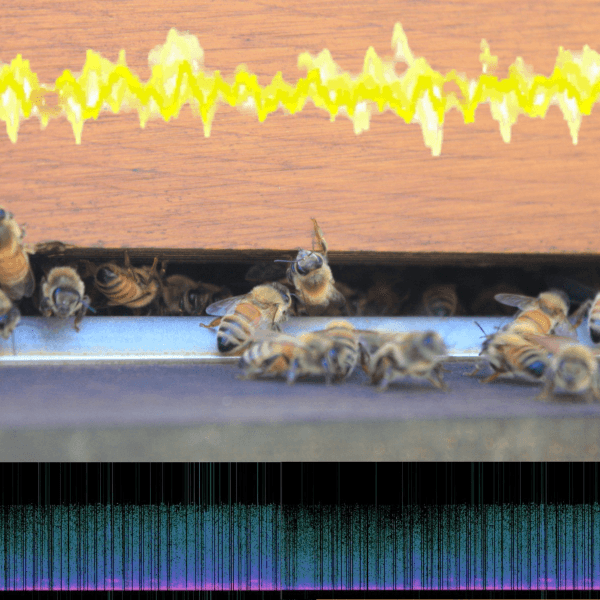
Bee hive
1 sound
During the 'Enlightenment' period, the Cartesian theory of mind/body dualism vaulted vision to the pinnacle of the sensory ways of knowing. Visual perceptions could be more accurately and objectively quantified than the 'lower subjective senses'. Yet, as social theorist Boaventura de Sousa Santos notes, 'Deep seeing is not just about seeing; we might call it a meeting of seeing and being seen.'
The visual experience of bees (Apis mellifera) is one that is finely tuned to the needs of their ecology. Bees are sensitive to polarization, which allows them to navigate using the sun's position even on cloudy days. While their compound eyes, ommatidia, allow bees to see in many directions at once and perceive motion in order to navigate through complex environments. They are able to see ultraviolet light emitted by flowers to guide them to their nectar and pollen. Bees also have a unique ability to detect patterns, which helps them to recognize and remember different types of flowers.

