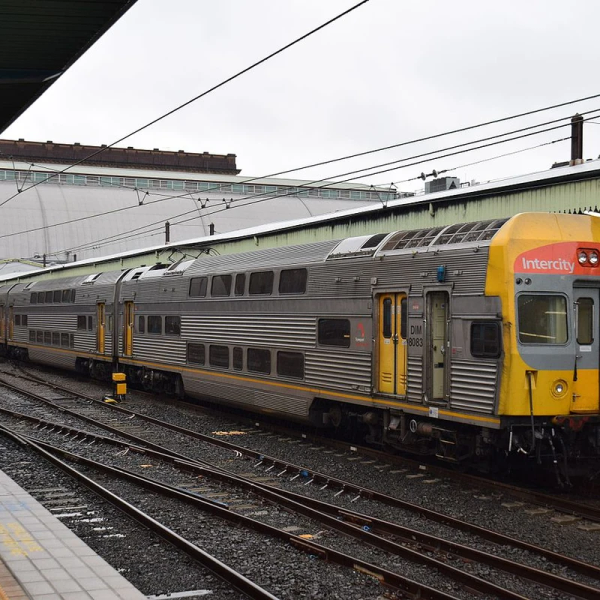
The Train soundscape begins in a train foyer, where piercing high frequencies subsume the listener in an overcrowded soundscape. This dense orchestra of noise is averted in the sitting compartment of the train, which is separated by a door. The door allows noise to be filtered out and is assisted by the white noise of air conditioning which attempts to mask the loud noise of the traction motor and screeching of train tracks. In this environment, the deafening high frequencies created by the train are filtered out, and the harmonics and transients of the engine remain in dissonant harmony. The white noise of the air conditioning is an installation of “Audio analgesia”, defined simply as “the use of sound as a painkiller, a distraction to dispel distractions”(Schafer, 1993). however, it does not succeed in this function completely. and as a result, multiple layers of sound are in competition, each attempting to overpower the other in a vapid ecosystem of noise. This results in a disorienting and nauseating “sound wall”. Furthermore, this continuity of mechanical noise, defined by Schafer as “the flat line in sound” is a result of the Mechanical revolution, and a keynote sound of machinery as industrial machines “create low-information, high-redundancy sounds,......... possessing little personality or sense of progression” (Schafer, 1993). So although the sonic anaesthetic of white noise may attempt to be “a distraction to dispel distractions”, it, in turn, intensifies the disharmony of the train soundscape. Therefore, the listener must tune out, and listening to music in headphones allows one to do so. The listener is able to bury themselves beneath the mountain of noise which previously subsumed them. In this sense, music becomes a sedative and is effective in masking the “swaths of broad-band noise” often present on the train.
Element 1 involves a variety of highpass and low-pass filters which are intricately implemented to achieve the modality of the train soundscape (specifically NSW train-link V set). High-pass filters accentuate the grain and texture of white noise, whereas low-pass filters (often applied in automation), bypass high frequencies as the listener is transported through successive layers of the composition. By boosting the harmonic peaks on each of the “engine drone” tracks the natural pitch captured on the recording is accentuated.
References
Schafer, R. M. (1993). The Soundscape : Our Sonic Environment and the Tuning of the World. Inner Traditions International, Limited.
more