RED HOOK MURALS TOUR

6 ECHOES

Location: New York, New York, United States

Come explore Red Hook like never before! The Red Hook Business Alliance invites you to discover the neighborhood through its vibrant murals—and uncover the surprising stories behind this unique waterfront community

Augmented Reality

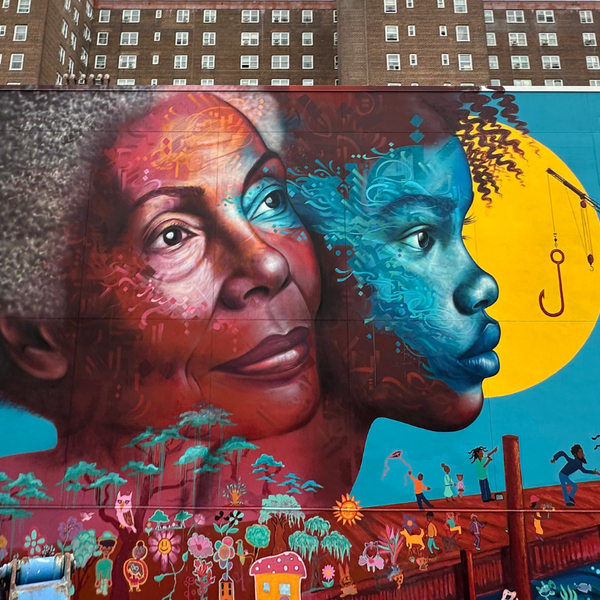
Artists: Artolution & Woken Arts Date: 2024. Location: Coffey Park, Red Hook, Brooklyn, NY Commissioned by: Red Hook West Resident Association, NYCHA, the Public Housing Community Fund, in collaboration with Snapchat.

This mural is the most recent—and largest—ever painted in Red Hook, spanning 2,500 square feet. It’s an initiative of the Red Hook West Resident Association, in partnership with the Public Housing Community Fund, to bring soul to the new constructions added to the Red Hook Houses. Remember, in 2012, Red Hook was hit hard by Hurricane Sandy. The basements of these buildings were completely flooded, leaving residents without electricity or hot water for months. Today, the boilers and backup power generators have their own separate building—built high off the ground. And now that construction is finally wrapping up, after eight very long years, it was time to celebrate! But really, this mural isn’t just about the buildings. It’s about Red Hook itself—its strength, its spirit, and above all, the creativity and determination that helped it rise after Sandy. In the years since the hurricane, Red Hook has become one of the most organized and outspoken communities in the city when it comes to environmental justice. And that energy came through in the making of this mural. Young people, adults, long-time residents—everyone got involved. They met, discussed, drew, and painted. Together, they shaped the vision behind what you're looking at now. To bring that vision to life, they needed a very special team of artists. On the recommendation of Dustin Yellin from Pioneer Works, they partnered with Artolution, founded by artists Joel Bergner and Max Frieder—renowned for their powerful, community-driven murals around the world. They also brought in Woken Arts, a Brooklyn-based collective known for turning local stories into vibrant public art. And here is the result. On the left, you’ll see Joel Bergner’s vibrant portraits. These faces don’t represent specific individuals—they’re symbolic. They honor the diversity of Red Hook and the bonds across generations. Look at the background: the intricate lettering, the deep blues, the way a grandmother and child are connected through color and line. It speaks to identity, legacy, and care. In the center section, Woken Arts painted Red Hook’s heart—its harbor. You’ll see old cranes, containers, piers, seagulls, and, in the distance, the Statue of Liberty. Note, that she’s more than a landmark here. To locals, she’s a neighbor. And to the right is Max Frieder’s iconic tree. If you look closely, the leaves are made of human faces—dozens of them—woven together into one giant silhouette. It’s a powerful symbol of community interconnection. Now let’s focus on the bottom of the wall. These sections were painted entirely by residents. That’s actually very rare in community murals. Most adopt a paint-by-numbers approach. But here, residents were invited to paint freely—whatever they felt—so long as they used a shared color palette to keep the overall piece cohesive. And that’s how Jacket the squirrel made it into the mural. He’s something of a local celebrity in Red Hook—easily recognized by his half-black, half-white fur. In the mural, his colors are playfully reimagined, and he’s holding a bright red hook in his paw—becoming the unofficial mascot of Red Hook’s fight for environmental justice. And one last detail that makes this mural truly unique… Thanks to a collaboration with Snapchat, 15 teenagers and young adults residents of the Red Hook West Houses have been train to design Augmented Reality lenses for the mural. With their new skills, they turned parts of the mural into digital experiences. Point your phone at the wall, and the painting comes alive—images move, stories unfold. It’s a beautiful blend of analog and digital, old and new, art and technology. This mural is more than just a painting. It’s a declaration—of resilience, of identity, and of a community’s power in transforming its own story.

1 sound

DASPLATZ

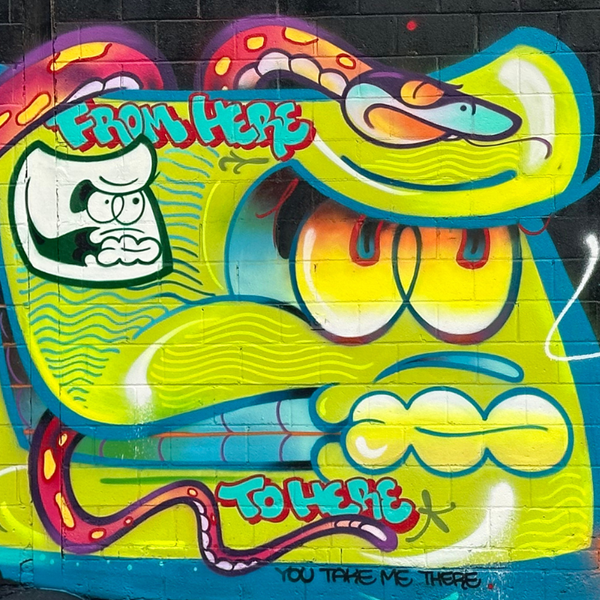
Artists : RIME, KEO XMEN, Grey PVC, PURE TFP, SP.ONE Date : 2025 Curated by : DASCOOL NYC Commissioned by : Red Hook Business Alliance

Welcome to DASPLATZ- Red Hook’s newest mural installation. This isn’t just a wall—it’s a vibrant tribute to the legacy of New York City graffiti. These five murals were created by some of the city’s most iconic graffiti artists, who began their journeys in the ’80s and ’90s tagging subways, highways, and rooftops. Now recognized as pioneers, they’ve helped redefine what graffiti can be—and they’re still pushing creative boundaries today.

This collection of artists was curated by Brooklyn-based design studio DASCOOL. The selection of artists was rooted in the history of the location: over a decade ago, several of them painted this very same wall. Remnants of that original, almost secret urban gallery still remain, making the site a living monument to the pioneers of New York graffiti. This new mural honors that legacy while creating a new one.

Every mural here tells a story. Look closely, and you'll see decades of evolution in every stroke. RIME, also known as Jersey Joe, unleashes a burst of colorful, psychedelic creatures that seem to leap off the wall. His work reads like a visual diary—each symbol and character drawn from a personal sketchbook. For this piece, he took his process outside the box—transforming it into a dynamic, skull-shaped canvas. KEO XMEN pays homage to the Saturday morning cartoons that inspired a generation of writers. A key figure in preserving traditional New York subway styles for over four decades, KEO brings deep historical knowledge to his work, with precision in every line and authenticity in every form. GREY PVC, active for over 25 years, is known for his global graffiti presence—hitting major cities around the world before social media made that easy. His style is bold, colorful, and boundary-pushing. Now based in Los Angeles, he remains active with both the AOK crew in New York and PVC in San Francisco. PURE TFP, raised in the Bronx, painted a 3D “portal” that twists and flows, creating a sense of depth and movement. It connects to a larger mural he created in Mexico City. A member of the legendary TFP crew—founded in 1974 and still active today—Pure continues to innovate while honoring graffiti’s roots. SP.ONE, also known as Greg Lamarche, celebrates spring with explosive color and kinetic joy. A Queens native who began tagging trains in the early ’80s, Lamarche is equally known for his intricate, hand-cut paper collages—bold letters layered with vintage prints and textures. His work has been featured in major galleries, books, and media around the world.

These artists share more than talent—they share a history. Many began painting when they were just 12 or 13, dodging police and sneaking into train yards under cover of night. Spray paint was illegal for minors, so even getting supplies took hustle, risk, and creativity. “Getting up”—having your name seen across the city—was everything. It was about visibility, identity, and respect. But these artists didn’t just survive that world—they helped create and shape it. They laid the foundation for what graffiti would become: a global art movement rooted in rebellion, style, and self-expression. Their influence stretches far beyond the walls of New York, inspiring generations of writers around the world and bridging the gap between street culture and contemporary art.

This wall isn’t just about looking back—it’s about moving forward. These writers never stopped creating, never stopped pushing the boundaries of graffiti art. Their work has appeared in galleries, on album covers, and even in classrooms. But here, on this wall, they return to where it all began—out in the open, in full color. This is top-tier New York City graffiti: raw, brilliant, and alive. So take a moment. You’re not just looking at paint—you’re looking at a legacy.

1 sound

Migratory Pathways

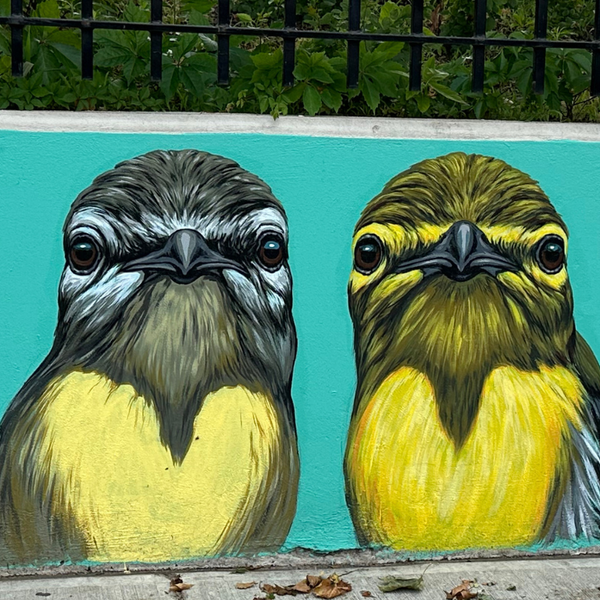
Artist: George Booruyi Year: 2024 Curated by: Audubon Mural Project Sponsored by: Red Hook conservancy.

Welcome to the mural at Red Hook Park. What you're looking at stretches nearly 1,000 feet — a vibrant procession of birds in motion, painted along the retaining wall. This project was sponsored by the Red Hook Conservancy and curated by the Audubon Mural Project, which invited Brooklyn-based artist George Boorujy to bring it to life. For Boorujy, who lives nearby in Gowanus and has been swimming at the pool across the street for years, the mural’s long, low surface immediately brought to mind the sweeping flights of migrating birds. “I wanted to use the length of this site to show the length of these migration journeys,” he explains. The mural features eight bird species, each traveling different distances to New York—some stopping just briefly, others nesting here. The birds are arranged by the length of their migrations—from the Rose-breasted Grosbeak, which comes all the way from Venezuela, to the Eastern Meadowlark, a short traveler from New Jersey. Between each pair of birds, you’ll see flying silhouettes over bright colors—turquoise, pink, orange—with the names of the places they travel through. To Boorujy, these birds echo the stories of the people who live here. “We all come from somewhere,” he says. “We all have migrated to survive, on some level.” But no matter where they’re coming from, birds need green spaces in the city—places to rest and refuel. That’s why you’ll also find eight native plant species woven into the mural, including Black-eyed Susan, Canada Goldenrod, and Lowbush Blueberry—all essential food sources for birds like the Great-crested Flycatcher, which Boorujy painted mid-snap, munching on a wasp. Each pair of birds tells its own story. Some are meant to catch your eye—like the Grosbeak and Flycatcher. Others invite a second glance: the Philadelphia Vireo and Yellow-throated Vireo are like little twins, similar at first glance but distinct in detail. The Yellow-rumped Warbler, full of energy, looks out over the more low-key Worm-eating Warbler, which Boorujy calls “subtle and sophisticated.”. And at the far end, the Eastern Towhee sings its loud call, while the Meadowlark stares boldly at the viewer. But beneath their beauty lies a warning. Climate change threatens every species on this wall. According to Audubon’s Survival by Degrees report, the Eastern Towhee could lose more than 80% of the places it lives in summer if the climate keeps warming. The Yellow-throated Vireo faces the opposite problem—it could lose most of the places it spends the winter. That’s why protecting birds isn’t just about where they nest or feed—it’s about protecting every stop they make along the way.’ As both artist and educator, Boorujy bridges science and art. He originally planned to be a marine biologist, but found his calling in painting wildlife—something he’s loved since childhood. He teaches at the School of Visual Arts, where he leads classes in drawing, anatomy, and bio art. His work, including several pieces with the Audubon Mural Project, reminds us: we’re not separate from nature—we’re part of it. And maybe, just like these birds, we’re all navigating the same sky—searching for safe ground, and learning how to protect it.

1 sound

Greetings from Red Hook

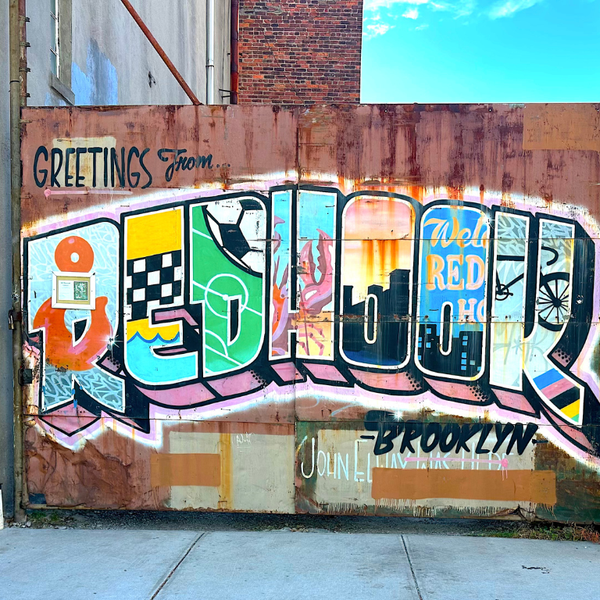
Artists: Victor Ving & Lisa Beggs Year: 2014 Commissioned by: Emma & Beriah Wall

Welcome to the Greetings sign of Red Hook, painted over ten years ago in bold, vintage postcard-style letters. It all started in 2014, when artist Beriah Wall—a longtime Red Hook resident—was still living here. He was known for creating artistic coins engraved with messages, many of which are still in circulation throughout the city. The outside of his studio was blank and boring, so his daughter, Emma, reached out to her friends, Victor Ving and Lisa Beggs, to see if they'd help bring some color to the gate. Victor was a former NYC graffiti artist, and Lisa a photographer. They had just completed their first Greetings mural in Chinatown and were excited to try the concept again. They painted the mural in just one day—no primer, just raw graffiti in a vintage style. What’s funny is that they had no idea they were creating the prototype for what would become their famous Greetings Tour—an artistic road trip they launched the following year. They drove their van through 30 states and painted postcard murals for 70 communities. Now, let’s decode what you’re seeing. Each letter in "RED HOOK" highlights something special about the neighborhood: The "R" features a Red Hook anchor—the maritime symbol that defines this waterfront community. The "E" shows the yellow water taxis that connects Erie Basin to the rest of the city. They were the only ferries existing at the time. The "D" refers to the local soccer fields. After Hurricane Sandy devastated the area, the fields were rebuilt and transformed from a toxic wasteland into a community gathering place, where hundreds of families come to watch games on summer evenings. The "H" celebrates the famous lobster joints that helped make Red Hook a destination. The first "O" captures the sunset over the Red Hook Grain Terminal. The second "O" represents the Red Hook Houses, home to many of the neighborhood's residents. The "K" pays tribute to the Red Hook Crit, a fixed-gear bike race—no brakes, no gears—that put Red Hook on the international map. The last race was held in 2018. One last detail: if you look at the bottom of the mural, you’ll see the original "John Elway" graffiti that was already on the wall. Victor and Lisa chose to keep it as a tribute to the street artists who came before them. That respect for the neighborhood’s history is part of what makes this mural so authentically Red Hook. So next time you pass by this wall, remember—you’re looking at the birthplace of an idea that traveled thousands of miles, connecting communities one mural at a time. And the story continues. Today, the former studio hosts the Wall Gallery, curated by two local artists, Scott Pfaffman and Franz Landspersky.

1 sound

Red Hook Octopus

Artist: Mike Makatron Year: 2023

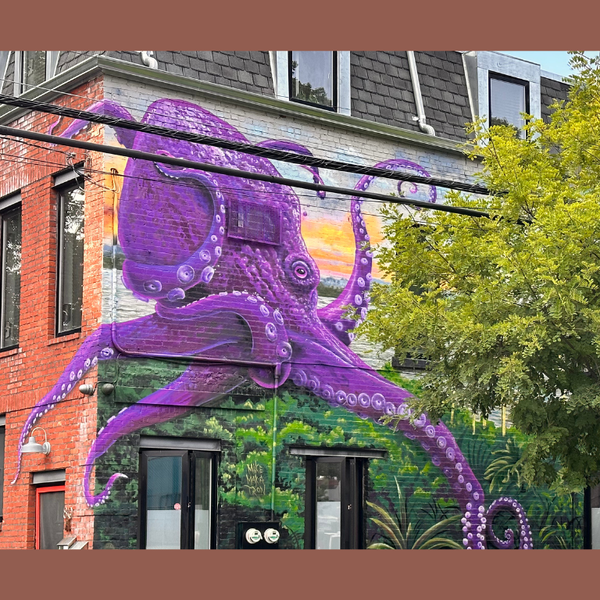
This mural is hard to miss—with a giant purple octopus crawling across the wall, wrapping itself around the corner of the house. Painted in 2023 by Australian artist Mike Makatron, it’s more than just street art. It’s a portal into another version of Red Hook—one where the jungle has taken over. No people, no noise—just birds, sea creatures, and vines creeping over the remnants of a forgotten industrial world. Mike Makatron is an internationally renowned artist. He has painted in over 50 cities across every continent, with a significant number of murals in New York, where he lived for five years. His work explores the collision between the natural world and urban life, often imagining surreal environments where nature reclaims space. The mural was commissioned by Stephen, the owner of this house—and also the director of Q Bank Gallery in Queenstown, Tasmania, an artist residency and gallery he co-founded with friends in an old bank building. When Stephen bought this place in Red Hook, he didn’t just want to renovate it. He wanted to offer something back to the neighborhood. A gift. He reached out to Mike. They’ve known each other for years, back in Melbourne, and Mike once even did a residency at Q Bank in Tasmania. Together, they dreamed up this vision of Red Hook: stripped of human life, but still pulsing with memory and wild rebirth. It was Stephen’s kids who chose the octopus. They loved how Mike paints sea creatures. For Mike, it was a way of connecting with the ocean of Red Hook. It felt like the perfect fit. The octopus stretches across the wall, massive and surreal, as if it’s always been here, silently watching. Next to it, you’ll notice the tall, rusted yellow towers that once held the water tanks supplying the warehouses of the shipping industry. It’s one of Red Hook’s last remaining industrial landmarks. Stephen insisted on including it in the mural. To him, it’s an icon of Red Hook’s fading past—soon to vanish in real life, but preserved here in the mural. Now, look closely at the Statue of Liberty. Something’s different. She’s holding… an ice cream cone. Unexpected and funny—but it’s rooted in local memory. While painting, Mike met someone who once ran an ice-cream store in the same building—sixty years ago. That moment stuck. The torch was replaced by this sweet human touch. Finally, toward the end of the mural, you’ll find a vibrant hummingbird, its purple providing the perfect counterbalance to the octopus—a bright spot in the overgrowth : something brief and beautiful in a world without people. As you can see, this mural is a forest of stories - a sea creature chosen by teenagers, an old industrial landmark on the verge of disappearing, a moment shared between friends, family, and neighbors. It also offers a new way of seeing Red Hook—one shaped by nature, memory, and imagination.

1 sound

Man, what are you doing here ?

Artist : Esteban del Valle Date : 2014 Sponsored by: Widow Jane

It started with a bicycle ride and a chandelier. The muralist Esteban del Valle was riding through Red Hook when he discovered Botanica — a quiet bar with an elegant chandelier that became his favorite place to sketch. This chandelier stuck with him, and soon he incorporated it into a mural he was painting at 5Pointz, an old factory building in Long Island City that had become a global graffiti mecca in the early 2000s. Quickly, the mural took off on Instagram. 5Pointz, curated by the graffiti artist Meres One, had become such a must-see art destination in New York, and Esteban’s piece got a lot of attention. In 2013, it was even named one of the top 50 street art works in the world. But then — almost overnight — it was gone. The building’s owner whitewashed all 45 murals across the 12-story façade, with no warning, no permission. Just gone. It was heartbreaking. Back at Botanica, sketching away, Esteban mentioned the story to the bartender — how it all began with that chandelier in the corner, and the unexpected journey that followed. Word got around, and soon it reached Daniel Prieto Preston, the bar’s owner. Prieston made Esteban an offer: paint whatever you want on my wall, just include Widow Jane somewhere in the composition. Very little money, but complete creative freedom. It was November when Esteban started to paint, with very few people on Red Hook’s industrial streets. Esteban used acrylics and brushes with an unconventional process — color comes first and then directs the drawing. He chose to paint a piano man — a character that had been haunting his sketchbooks for years, appearing repeatedly in his work. This figure had multiple faces, extra hands, and a tangled scarf that seemed to strangle as much as warm him. The main sentiment behind the piece is the feeling, as an artist, of being alien in this world — always having to do other physical jobs while a whole world underneath is there and you are burning to express it. The multiple faces capture different layers of personality, the masks we all wear. The extra fingers represent creative energy and movement. The tangled scarf becomes a metaphor for the constraints that bind us — financial pressures, social expectations, the need to perform roles that don’t reflect our true selves. Soon the resonance with Billy Joel’s classic song, “Man, what are you doing here ?,” became so evident that the name of the song was added at the top of the mural. Now, years have passed. The artists of 5Pointz finally won their case.
In 2018, a federal court ruled in favor of 21 artists who sued the developer — affirming that street art can achieve recognized stature, and that even temporary works deserve protection. As for the piano man?
He took a much quieter path.
He still stands on that Red Hook warehouse wall, silently performing his concert for passersby.

1 sound

DOWNLOAD OUR APP TO DISCOVER THIS TOUR AND MANY OTHERS.

play-storeapp-store

Or start creating tours, treasure hunts, POI maps... Just let your imagination guide you.


Other walks nearby

LIVES OF THE NEW KIND OF SAINTS

LIVES OF THE NEW KIND OF SAINTS

New York, New York, United States
Lives of the New Kind of Saints: A geo-located theater/music/sound piece in seven locations in Battery Park, New York City. Created to center energy and intentions for justice, social harmony, equality and shared humanity. Designed to live up to and including Election Day, November 3, 2020, also the Feast Day for San Martín de Porres, the saint of work for inter-racial harmony & justice. Selected by the USITT PQ23 jury and curators to be featured in the USITT Prague Quadrennial 2023 National Exhibit and competition (USA). Originally commissioned by INTAR Latino Theater (NYC) and The Radio Drama Network Credits: Music/Sound/Original Concept\_Cristian Amigo Play/Texts\_Migdalia Cruz Orisha Santos Sculptures/Images\_Jorge Luis Rodriguez Director\_Rebecca Martinez Musicians\_JD Parran, Cristian Amigo, Henry Webster, Guillermo Cardenas, Cuco Pacha Kuti. Actors\_Carlos Ibarra, Desiree Pinol, Michael Leon, Ashley Alvarez, Yadira De La Riva, Jacqueline Guillen, Daniela Thome, Stephanie Chloe Hepner, Benjamin Manno, Camila Pérez Producers\_Lou Moreno, Paul Slee Rodriguez, Alejandra Maldonado Costumes\_Harry Nadal Stage manager\_Amanda C.Lopez Photos/Video\_Mike Shane YouTube Audio for Event: https://youtu.be/z\_mOTw0c89Y info: livesofthenowknownsaints2020@protonmail.com All original audio/text/image content. OHM Sound\_copyright 2020-2023 I am deeply grateful to the many beautiful people and organizations who contributed their time, energy, and creativity to the realization of this piece in the world. - C. Amigo NOTES: Written for ten to twenty-four voices/actors: 7 Saints, 7 Orishas, 7 Archangels, 3 Guardian Angels. The actor’s lines will be written in threes, but one actor could read all three lines. Recorded sound will be a sound enhancement to the live action by the actor(s) present. Each circle will have 1-3actors: an Orisha, a Saint and an Archangel. If there is only one actor per circle, then that person will personify all three characteristics—Orisha, Saint, Angel. Ideally there will be 7 circles. And the “set” may be a large tarot card for each circle, and the “costumes” will reflect either an orisha, a saint or an archangel—or all three in one. All of it should look simple, elegant, but perhaps homemade. 1-3 Guardian ANGELS can walk around the audience and the circles and help with questions, getting people signed in, etc. I imagine this person dressed like San Martín de Porres or perhaps with black to light brown wings—a spectrum/kaleidoscope of color. Tune IN info is posted on Large Tarot Cards featuring different symbols for each circle. Circle One features the Magician on one side and instructions on the other which could be a QR code on the sign so people can point at the card and get connected to the Echoes App. Or the YouTube streaming of the sound? There can also be a fixed placard at the center of Circle One with all the instructions.
free

Are you a creator?

START HERE

Privacy & cookie policy / Terms and conditions

© ECHOES. All rights reserved / ECHOES.XYZ Limited is a company registered in England and Wales, Registered office at Merston Common Cottage, Merston, Chichester, West Sussex, PO20 1BE

v2.5.15 © ECHOES. All rights reserved.