A sound walk/off-site exhibition by Dennis McNulty.
This walk doubles as a partial retrospective exhibition, presenting a selection of some of the audio works McNulty has produced in response to other locations around the world: Sao Paulo, Dublin, Vancouver, New Jersey and Kilkenny.
Commissioned by Grazer Kunstverein for "Grazer Kunstverein is Moving!" Image courtesy of Edward Clydesdale Thomson.
http://www.grazerkunstverein.org/en/der-grazer-kunstverein-zieht-um/andritz.html
http://www.dennismcnulty.com
[Audio element]
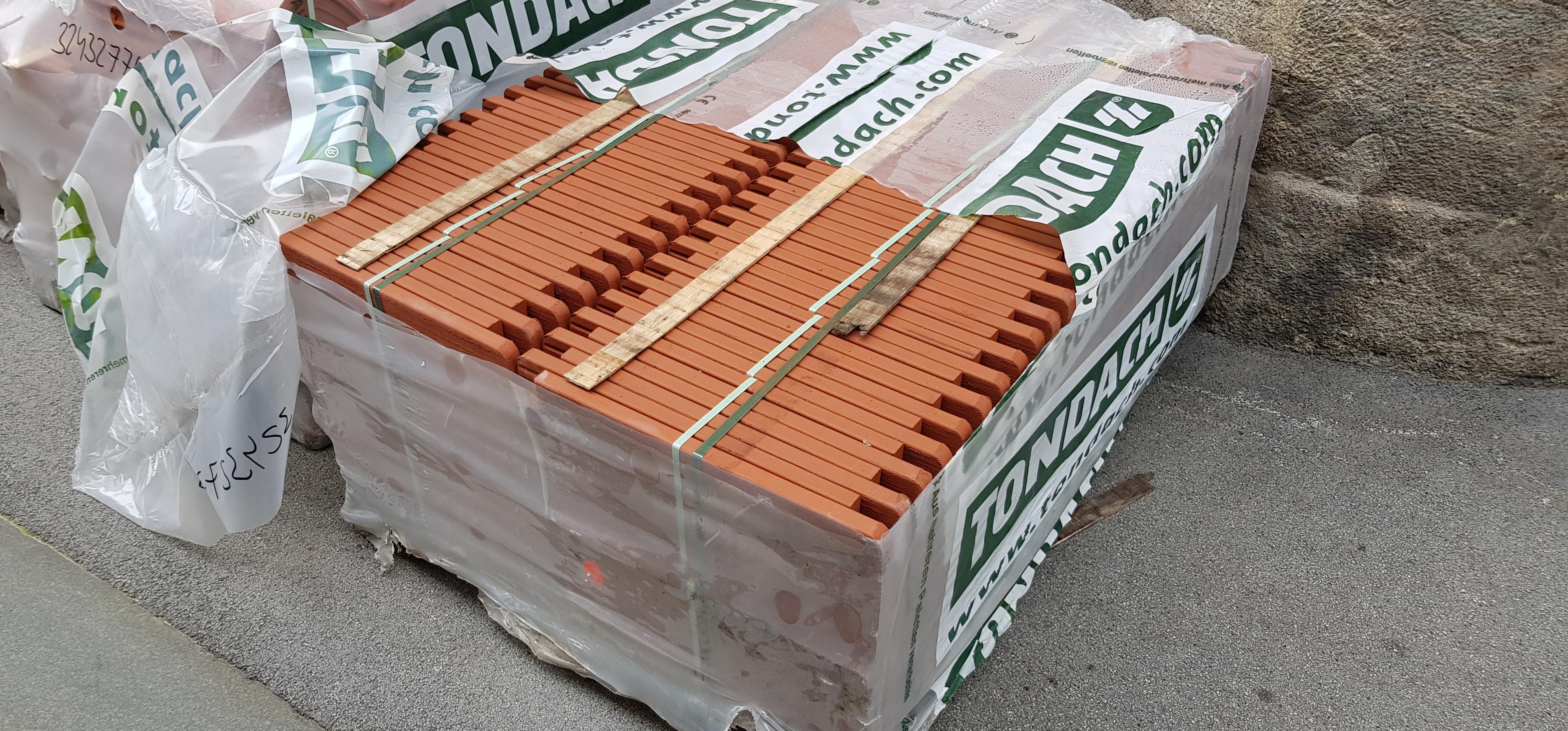
The rooftops of Graz is a Unesco Heritage Site. In this piece, a clay roof-tile becomes the basis for a rhythm, a melodic loop.
One of a number of audio elements from "The Moment Space", a promenade performance commissioned by Grazer Kunstverein for the exhibition TTOPOLOGY.
Supported by the Arts Council of Ireland and Culture Ireland.
[Performance recording excerpt. Duration 07:35]
"I once had a dream so I packed up and split for the city".
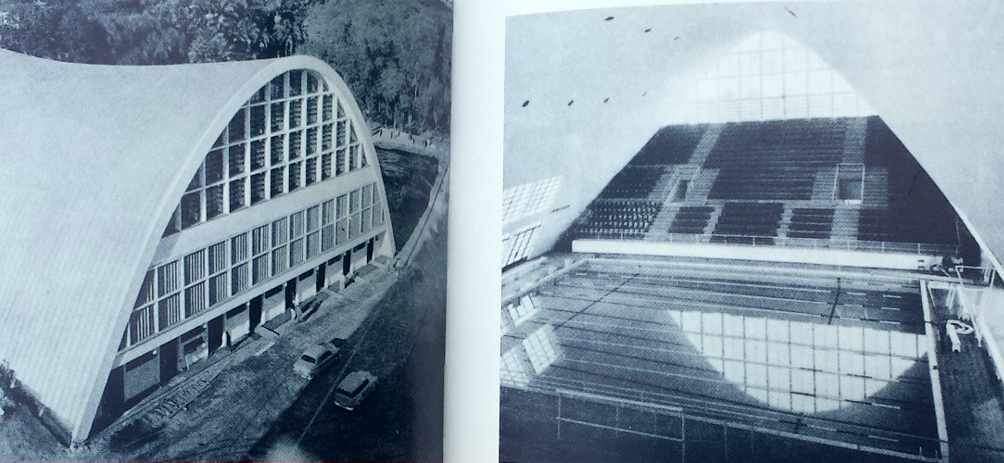
The Baby Barioni sports complex had been around for over fifty years when we first walked through the door in January 2004. I had spotted two black and white images in a book a few months earlier, an interior shot of its massive soft curve of a ceiling overhanging a glassy pool, facing an exterior shot of it looking a bit like a saddle with distant skyscrapers visible beyond a neighbourhood of trees. I had a sense that it might sound good inside, smoother than the usual splashy clatter, but a bit more extreme, so Valerie and I paid it a visit to see if we might absorb it into my Bienal project.
Inside, under spacious curves, we lost words to the echo of our own voices. I paced the tip of one of the two opposing wedges of concrete seating, and paused to clap a test, counting and listening for the fleshy smack to die away. One elephant, two elephant … a sound cloud before Soundcloud, an invisible plume billowing through the bright heat … four elephant, five elephant … thinning fuzz dissolving into that omni-hum from somewhere deep in the structure … eight elephant … tingling diffused and scattered, and other sounds claiming the foreground, my impulse signal and its vapour trail finally absorbed into the gelatinous air. I counted nine seconds, but maybe it was seven. Either way, a cathedral.
September 19th 2004
We rented a PA system from a local hire company. Our friend Renato brokered the deal. It arrived in a van with two guys and we asked them to set it up along one side of the pool, at the foot of the stepped concrete slope. On the opposite side, about half way up, I connected some wires to my computer and sat it on a table. One of the sound hire guys ran two long cables downhill from me, extending them back around the water’s edge to the PA amp. Then the fader goes up and the concrete parabolas are inflated with Mike Love’s voice, cut up, slowed down and rolling backwards. Al and Bruce and the Wilsons join in on harmonies, singing "That’s not me". It’s acapella and digitally bent out of shape and it sounds totally unreal. We all breathe a deep sigh of relief.
A small crowd slowly arrive a little later on, sprawling themselves out across the bleachers behind me. We’re all pointed in the same direction, looking at the empty double of our seating structure, at the skyline tower lights, just about visible through the arching window across the water, and at the grain of the building, which somehow seems older and less sure of itself at night-time. I play a duet with the super-saturated acoustics. We bat The Beach Boys about between us. Fluorescent lights buzz like mad, distance rounding their treble. I break up acapella phrases, making gaps so we can hear Ícaro de Castro Mello’s geometries respond in the present, and in the midst of this rising and falling, The Beach Boys sing about cities and desire, about the tidal wave of migration that erased the countryside surrounding this compound to make a metropolis.
– Dennis McNulty (August 2014)
http://alpha60.info was Dennis McNulty’s project at the São Paulo Bienal in 2004. The project’s commissioner was Valerie Connor. Thanks to Jenny Haughton, Alvaro Petrillo, Renato Patriarca and Carlos Farinha. Produced with the support of The Arts Council of Ireland.
[Audio element. Duration 37:02]
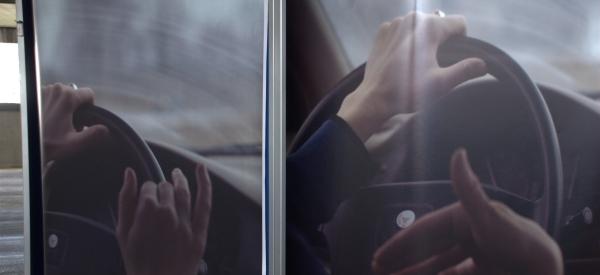
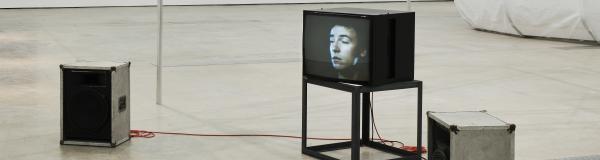
The location: the sixth floor of a multi-storey car-park (parking garage), just off the main street in the centre of Kilkenny, Ireland. A structure consisting of some panels from a modular display system and a specially made mild-steel transportable framework was dismantled each night, stored in the back of the van and then re-assembled each morning.
During exhibition hours, the structure was arranged across from the van, which was parked with its doors thrown open. A soundtrack playing on the stereo filled the space. The sound was audible from within the stairwell at the other end of the building, which was the main point of entry.
The title of the work is taken from the book "Freeways", by the landscape architect and designer Lawrence Halprin.
Special thanks are due to the invigilators and the production team, especially Lindsey Perry, who invested a lot of time and effort to make this piece possible.
Commissioned for Surface and Reality, Kilkenny Arts Festival, Kilkenny, Ireland. Curated by Oliver Dowling.
[Audio element. Duration 05:34]
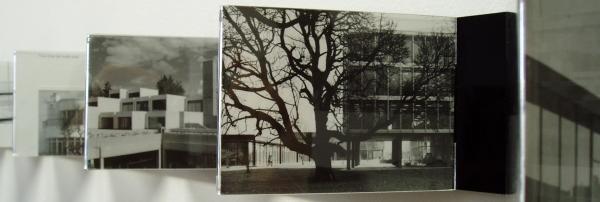
An armature holds 48 images at an angle from a backplate so that the viewer is presented with a different image sequence depending on which direction they walk in. In effect, they edit the image sequence by walking back and forth in front of the piece.
A science-fiction narrative, is presented on headphones, looping seamlessly as an accompanying soundtrack. It concerns a performer who possesses the ability to hear what a photographer would have heard on capturing an image. They perform for small audiences as a kind of dj, by hearing a sequence of images in this way and transmitting the resulting flow of sound telepathically to their audience.
There are two versions of this work. The first (pictured below) displays images from the book 20th Century Architecture, Ireland (Prestel, 1997). The second displays of images of a series of 'locations'.
Version two of this piece was shown at Our need for consolation is impossible to satiate in November 2009, which was curated by Helen Carey.
[Audio element]
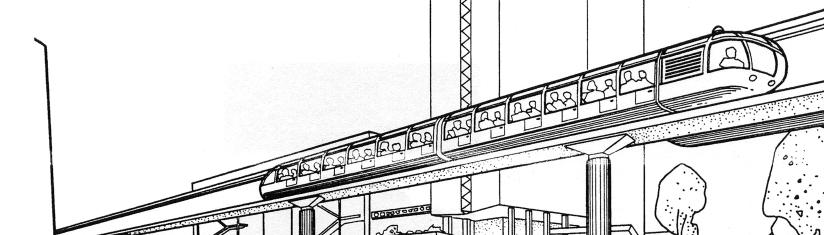
A book sits on a custom acrylic holder, open to a page describing Welles Coates' 1957 proposal for a monorail system for Vancouver, Canada. In the accompanying soundtrack, which is presented on headphones, a calm modulated female voice is layered to produce a portrait of the Skytrain, Vancouver's contemporary metro system.
The voice is that of Karen Kelm, who was employed by BC Transit when the Skytrain was built for Expo '86. Word in the office was that Kelm had some theatre experience, and so she was asked to record the new transit system's station announcements. While in Vancouver in 2008, I tracked her down and she agreed to help me make this work. I asked her to listen to a sound collage I had made of recordings of the Skytrain and its surroundings, and to describe what she could hear.
The sound element of the work was originally produced for the exhibition The sound I'm looking for (part 1) at the Charles H. Scott Gallery, Vancouver, October 2008, which was curated by Cate Rimmer. Supported by Culture Ireland.
[Audio element. Duration 12:22]
"I'm on Fire" was one of the many singles from Bruce Springsteen's “Born in the USA” album. Its melancholic tone betrays the fact that it was written in the sessions for "Nebraska", the stripped down collection of songs The Boss mythologically recorded solo on a 4-track portastudio in advance of his mid-80s rise to global superstardom. On its release, “I'm on Fire” was accompanied by a cinematic video directed by John Sayles, in which a mechanic (Bruce) drops a car off to a wealthy female customer who lives in a house in the leafy suburbs.
The songs elements are basic: voice, drums, synth and a guitar with rockabilly slap-back echo. Like Prince's "When Doves Cry", there is no bassline. The human voice is placed in dialogue with the electric guitar's electromechanical technology and the synth's digital electronics. Bruce sits between the Newtonian cause-and-effect of the gold standard and the quantuum weirdness of rapidly accelerating and increasingly unregulated market speculations.
Fragments of the original track, which is a mere two and a half minutes long, are rearranged here in the manner of a Disco-Edit to produce hypnotic repetitions that frame a human voice snagged in the transition from Fordism to post-Fordism.
David (Timefeel) was produced for the exhibition TTOPOLOGY at VISUAL, Carlow, Ireland with the support of the Arts Council of Ireland.
[Audio element. Duration 05:20]
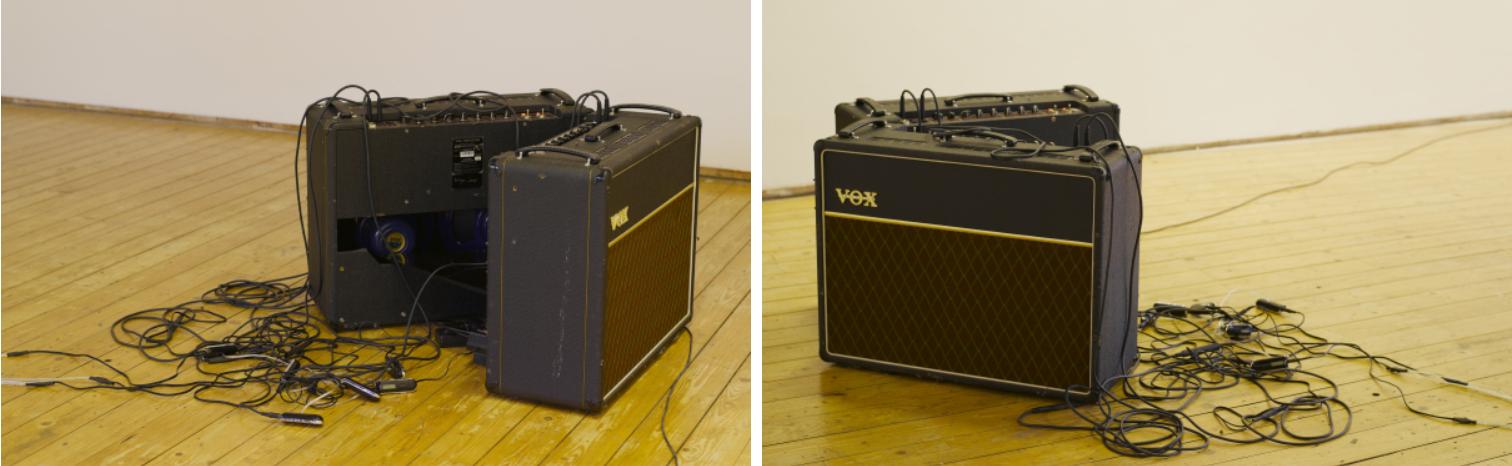
Three mp3 players are loaded with the same series of soundfiles and then set to shuffle. The files are designed to produce a potentially infinite, subtly shifting drone that fills the gallery space. Over time, harmonics pile up and are stripped away.
This sound work references architect Sam Stephenson's original proposal for the Central Bank Building on Dame St. in Dublin which would have been thirteen stories high. The design which was finally constructed on the site is about half that height.
http://dennismcnulty.com/archive/s13f.php
Love what we do? ➔ become our Open Collective backer
Privacy & cookie policy / Terms and conditions
© ECHOES. All rights reserved / ECHOES.XYZ Limited is a company registered in England and Wales, Registered office at Merston Common Cottage, Merston, Chichester, West Sussex, PO20 1BE
v2.5.11 © ECHOES. All rights reserved.