DID YA HEAR? Cabra West

10 ECHOES

IMPORTANT INFORMATION: when streaming, please select "PREMIUM" for better listening experience.

Did Ya Hear? is a local history audio walking tour available through the Echoes app. Created by Alexander Partridge, a fourth-year Creative Digital Media student, the project explores the hidden stories that shaped Cabra West.

This locative audio tour guides listeners through the area as stories play automatically along the route, revealing the people, places and events connected to Cabra West’s past.

Alexander grew up in Cabra West and developed this project as part of his final-year studies, with the aim of creating a meaningful local history experience for the community. He plans to expand the project to include other areas in the future.

Cabra West is a place rich in history, and many of these hidden stories are right on your doorstep. The streets and roads you walk today still hold traces of the past and the lives of those who once lived here.

1. Introduction.

[Narration] Ah, there ye are! Welcome to the Did Ye Hear? audio walking tour. This is a locative audio tour where you will discover the hidden local stories of the people who have shaped Cabra, and what was happening here during those times.

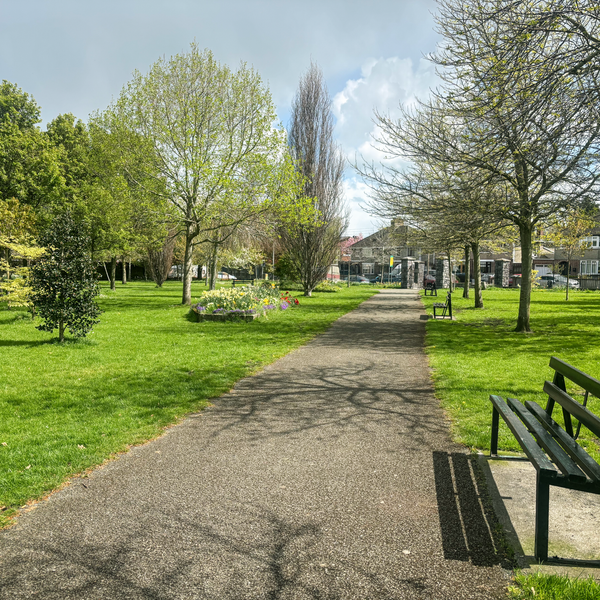
This section of the audio tour begins at Bogies Park, continues along Fassagh Avenue, and leads you towards Broombridge Bridge.

This audio tour is presented by Alexander Partridge, a 4th-year Creative Digital Media student, for his final-year project. I will be the narrator of this audio tour. Cabra West is a place filled with rich and interesting history, and many of these hidden stories are right on your doorstep.

The streets and roads you walk along today hold traces of the past from bridges with equations carved into them, to the hidden river that flows beneath Cabra, just to mention a few places and stories of the people who lived here and what once stood in their place.

This locative audio tour will tell you about the characters, interesting stories, and facts connected to this part of Cabra.

[Instructions] Now, before we get going, there are a few instructions to keep in mind. It is recommended that you listen with headphones or earphones and have the volume turned up so you can hear clearly.

Firstly, you can take this audio tour at your own pace. On the Echoes app, you will see a map with multiple blue circles and lines. These blue circles activate the sounds and stories as you walk through them. When you physically enter one of these circles, the audio will begin to play.

I will also give you directions and guidance along the way if you get lost. Remember to stay inside the blue circles and along the route so the audio continues to play.

There is also a route visible on the map that you can follow to guide you through the tour and help keep you on track.

Next, at the top right-hand corner of this page, you will see three dots. Here, you can access the transcript for each story, view images and location information, and control playback, including fast-forwarding the audio.

And lastly, thank you for taking this tour, and I hope you enjoy the Did Ye Hear? audio walking tour.

[Directions] You can now make your way to the next blue circle, and the next story will begin.

[Music Refernce] Music: “Towards the Horizon” by Alexander Nakarada (via Pixabay)

1 sound

2. From Bogies to Bradogue.

[Narration] From Bogies to Bradogue.

Just stand where you are right now and don’t move. We begin our journey at what is officially called Pope John Paul II Park, but if you ask any local, they will always call it “the Bogies.” Maybe it’s because of the bogland that was once here, or because the area was previously used as a dumping ground for old trolley tracks, known as “bogies.”

Its official name dates back to the visit of Pope John Paul II to Ireland in 1979.

If you turn around and look straight ahead, you’ll see the Dominican Convent, where Pope John Paul II stayed for three nights in September 1979. While papal security is much stricter these days, there are many unconfirmed reports that Pope Francis also stayed here during his 2018 visit to Ireland. Maybe Cabra could give Knock a run for its money.

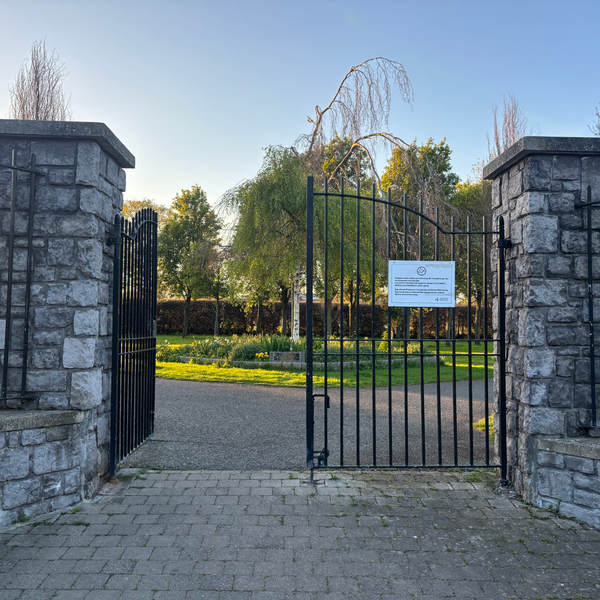
Now make your way towards the exit of the park gate and turn left. Continue walking towards the roundabout and I will tell you about the Bradog River.

[Pause in Audio]

As you walk towards the roundabout, this is the starting point of the Bradóg River. Imagine that beneath your feet, the river begins its journey underground. You may be wondering why you can’t see this river. The reason is that over the years, it has been completely covered over. This river once provided clean drinking water for both people and animals. It was also a popular fishing spot, which is likely where the river got its name, as Bradóg means “young salmon.”

In the late 1930s, when Cabra was being developed, the river was covered over and redirected underground. Over time, sections of it became part of Dublin’s drainage and wastewater system, which means the river still flows, but now mostly out of sight beneath the streets.

Even though we won’t be following its full route today, the Bradóg continues underground all the way to the River Liffey, where it meets the river at Ormond Quay. On its journey there, it flows beneath parts of the city you may already know, including the TUD’s Grangegorman Campus, Henrietta Street, and the old fruit market in Smitfield reminding us that this hidden river is still moving beneath the streets of modern day Dublin.

Today, the only visible sign of this underground river is a grated outlet on the walls of the Liffey at Ormond Quay.

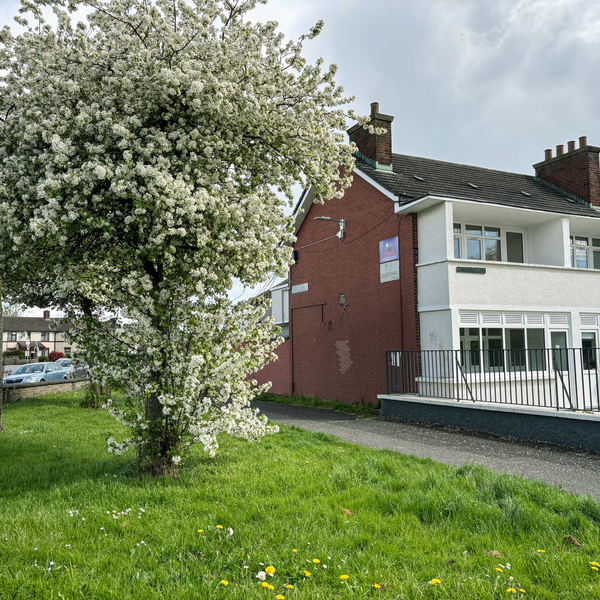
[Directions] Now, straight ahead of you across the roundabout, slightly to the right, you will see a set of white flats with a small path down the side. Make your way over there and stop at the green area beside these flats. Once you arrive there, the next story will begin. Take your time crossing the road here, as it can get quite busy.

[Music Refernce] Music: “Nature Documentary 2” by DELOSound (via Pixabay)

1 sound

3. The ‘Hanging Judge’ & Cabragh House.

[Narration] The ‘Hanging Judge’ & Cabragh House.

Now every good story needs a villain, and right now you are standing on the former site of Cabragh House and home to one of Ireland’s most notorious villains. But before we get to that, let me tell you a brief history of the old Cabragh House that once stood at this very spot.

Around the year 1598, Cabragh house was completed and it was first occupied by the Segrave family. The scale of the original house on this site is hard to imagine when looking at the flats that sit here today. This house had many gardens, orchards, stables and even a brewery. While the house itself had a grand hall and a parlour. By the late 1700s the Segrave family had left Cabra house and in the year 1791, the house was acquired by a man called John Toler, The Lord Norbury, but most commonly referred to as “THE HANGING JUDGE”.

The Hanging Judge had a huge amount of power in Ireland. One of his roles was Attorney General for Ireland, a job which put him in charge of sentencing following the 1798 rebellion. He was then given the role of Chief Justice of the Irish Common Pleas. The Hanging Judge was known for the sheer amount of hangings that he ordered. He was also known for mocking the people who came before him in court.

The Hanging Judge’s most infamous case was the 1803 trial of Robert Emmet. Emmet, as many of you will know, staged a rising in Dublin. This rising ultimately failed and he was arrested. Emmet was unfortunate enough to have the Hanging Judge in charge of his trial. The Hanging Judge is said to have abused and mocked Emmet throughout the trial before eventually sentencing him to death.

If you look up at the red brick wall you will see a plaque that was placed here in memory of one of Ireland’s great heroes Robert Emmet. For those of you who aren't 10 foot tall the plaque says the following

“Robert Emmet. 1778-1803. United Irish man, orator and revolutionary was executed on the 20th of September 1803, having been sentenced to death By Lord Norbury, who lived in this vicinity ”

While the Hanging Judge may have struck down one Irish hero. It was another Irish Hero who ended his career. After many failed attempts it was Daniel O’Connell’s petition to the British government that eventually led to ‘The Hanging Judges’ resignation.

Unfortunately, Cabra House is no longer standing as in 1939 Dublin Corporation demolished this Historic site. As lovely as the Canon Burke Flats in front of you are, it's a shame that such an important place in Cabra’s history is gone.

[Directions] Moving on from Cabra’s most notorious villain, let’s talk about some Cabra people who I promise you will like a bit more. While facing the Robert Emmet memorial plaque turn left and make your way past the shops and towards the church.

[Music Refernce] Music: “The Cave Dweller – Dark Ambient Soundscape” by Dream-Protocol (via Pixabay)

1 sound

4. The Arts: Lorraine Barry, Angeline Ball & Dickie Rock.

[Narration] The Arts.

Now, as I mentioned earlier, keep walking towards the church. As you walk, I can tell you about some of the people from Cabra who have shaped the arts and even thrown a few shapes on the ballroom floor.

One of them is Lorraine Barry, an internationally recognised ballroom dancer. She grew up in Cabra and went on to become one of the most successful dancers in competitive ballroom dancing. Barry won multiple international titles during her career. In 1993, she began dancing professionally with her partner Luca Baricchi, and together they became World Ballroom Dance Champions in 1999 and again in 2001. In later years, she became widely known to Irish audiences as the head judge on the television show Dancing with the Stars.

Another familiar name connected with Cabra West is Angeline Ball, an actress and singer who has appeared in a wide range of films, television shows, and theatre productions. One of her most memorable roles was in the Classic 1991 Dublin based film The Commitments, where she played the character Imelda Quirke. This film was nominated for Oscars, Golden Globes and even won four Baftas. Since then, Ball has become a well-known figure in the Irish arts scene, working across stage and screen. In 2021 Ball was nominated for two Irish Film & Tv awards in the same year for her roles as Ds Eimear Berry in the tv Show Hidden Assets and her role as Michelle in Deadly Cuts.

Perhaps the most well known Cabra Character associated with the arts is Dickie Rock. He was the leading man for the famous Miami showband. He grew up a stone's throw from here on Attracta Road. He had several Number 1 hits in Ireland both as a solo artist and as part of the Miami Showband. In 1966 he proudly represented Ireland in Eurovision coming in joint Fourth place with Belgium. Dickie Rock sadly passed away in 2024 at the great age of 88. The church across the road named Church of the Most Precious Blood was where the funeral service was held. Many cabra residents attended to pay their respects to a great cabra man often referred to as “The King of Cabra”.

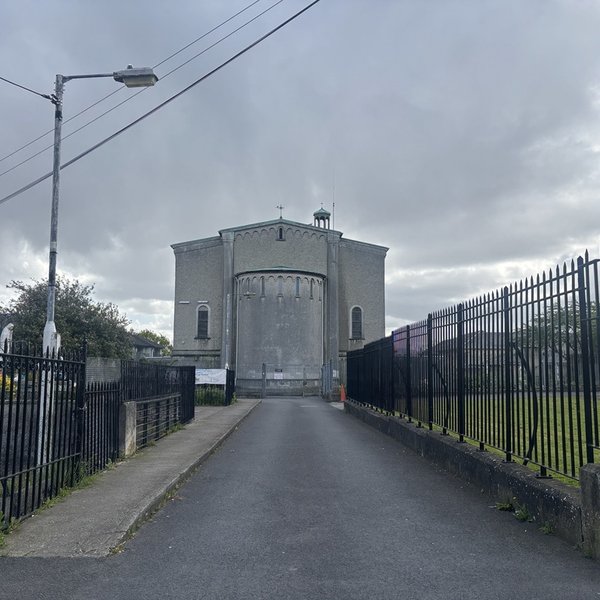
[Directions] Keep walking towards the church and cross over at the traffic lights and stop at the gates of the church and you will hear the next story play.

[Music Reference] Music: “Inspiring Documentary Cinematic Music” by Petrushkasound (via Pixabay)

1 sound

5. The Church of the Most Precious Blood.

[Narration] The Church of the Most Precious Blood.

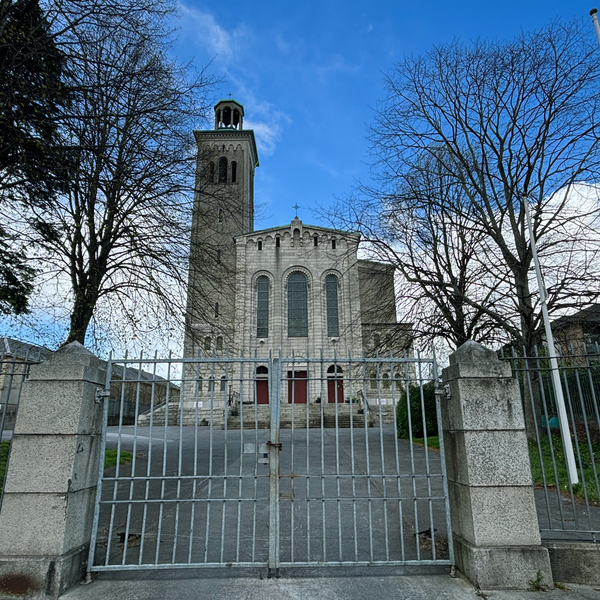
As you stand in front of Most Precious Blood Church, take a moment to notice its quiet presence and beautiful architecture.

At first glance, it might look like just another church… but in truth, you’re standing in the middle of a story that began in difficult times.

Let’s go back to the early 1940s.

Dublin was growing—but it was also struggling. Families were moving into Cabra West from overcrowded inner-city tenements, searching for a better life. At the time, people here had to travel across to Christ the King Church in Cabra East just to attend Mass.

That all changed in 1943.

A simple solution appeared a modest building known as the “Tin Church.”

It wasn’t grand, and it wasn’t permanent… but it was enough for the people of Cabra West. Located on Dunmanus Road, the Tin Church became the heart of a brand new parish. And in July 1943, Cabra West was officially recognised as a parish in its own right.

At the centre of it all was the first parish priest—Canon Valentine Burke.

Locals gave him a nickname: “The Toucher.” because he had an incredible ability to raise money. And that’s exactly what the parish needed.

For ten years, the Tin Church held the hopes of the community. But Canon Burke had a bigger vision—a permanent church for Cabra West.

So he got to work.

In 1947, he organised a huge event on the Navan Road—with stalls, games, music, and dancing. It brought the whole community together.

There was even a boxing tournament, organised with the help of local figures, featuring Irish champions and heavyweight fighters. Events like these weren’t just entertainment—they were essential. Every penny raised went towards building the church you see today.

And this was no easy task.

This was just after the Second World War—a time when money was scarce, and resources were limited. But the people of Cabra gave what they could.

And finally, in December 1953, it happened.

This church opened its doors.

Built at a cost of around £96,000. Which is the equivalent to 3.5 million in today’s money.

It was blessed by Archbishop Charles McQuaid, and many local people contributed to its interior. The high altar, the side altars, and the decorations were all funded by the community—men’s and women’s groups each playing their part.

And inside, one feature stood out above all—the organ.

So powerful and beautiful was its sound that, in 1955, it was broadcast on the radio by RTE.

But this church was never just about buildings or music.

It was about people.

Over time, it became more than a place for Mass, baptisms, weddings, and funerals—it became a social hub.

A place where people gathered, talked, supported one another… even over something as simple as a cup of tea.

That same spirit spread across the parish.

Sports clubs, community groups, and local organisations grew—built on volunteers and a strong sense of belonging. Places like the GAA club, football grounds, and community centres became full of life and energy.

One of the most loved traditions in Cabra was the Cabra Festival, a week-long celebration of music, quizzes, fashion shows, and community events.

In 1987, it began right here at Most Precious Blood Church with the celebration of the Ó Riada Mass.

After Mass, the newly crowned Queen of Cabra, Helen O’Hanlon, an 18-year-old from the area, stepped outside and released a flock of pigeons, marking the official start of the festival.

But the festival was about more than celebration. It raised funds to create opportunities for young people, organised by local groups like the Sancta Maria Women’s Club.

It was a true reflection of Cabra at its best, community, pride, and people coming together.

So as you stand here now, take a moment to imagine it all the Tin Church… the first families… the music of the organ… the laughter from community events… and the quiet conversations that built this place. Because this church isn’t just part of history.

It’s part of a living community.

And one of the most well-known figures in that story is Father Flash.

I’ll tell you all about him next story.

[Directions] As you’re facing the church, turn right and walk straight ahead until you reach the corner of the church grounds once you're here, turn left, continue straight and the next story will play.

If you’re unsure at any point, you can check the route on the Echoes app.

[Music Reference] Music: “Ambient” by Lunemare (via Pixabay)

1 sound

6. Father Flash.

[Directions] Now, take your time and head up towards the red brick school that you can see in the distance. When you reach the top of the road turn left and for now don't go any further than the back entrance of the church.

[Narration] Father Flash.

As you walk, let me tell you a little bit about one of the priests who served this church. His name was John Edward Kavanagh, but was known to locals as Father Flash Kavanagh.

You might be wondering why he was called this, he was given the nickname flash due to how quickly he celebrated mass. His masses were often over in 10-12 minutes. He had a friendly rivalry with Father Brown from the Christ the King Church over who can say mass the quickest.

Father Flash was a big fan of theatre and was known to attend many plays throughout the city. Father Flash is one of the people who is credited with bringing the theatre to Cabra.

Alongside Father Byrne,he played a major role in setting up the Verona Players who performed shows all around the country. However, where the Verona players were most familiar with performing was St. Finnbarr’s Hall.

Father Flash died very suddenly in 1960 which shocked the whole community. The attendance at father Flash’s funeral was huge with almost every family in Cabra attending. Even Eamonn De Valera sent his trusted aide Colonel(Curnell) Sean Brennan to represent him.

Another interesting character associated with this church is John McElroy who played the famous organ mentioned earlier. Impressively, John was also blind and had a shop called the Blind man’s shop on the nearby Carnlough road.

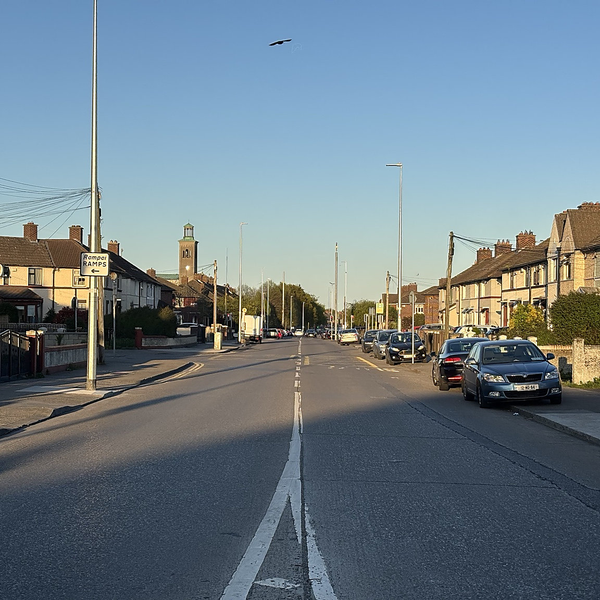
The road you’re walking along now is called the Dunmanus road and when you reach the top of this road you will walk along Kilkieran road. Both of these roads are named after beautiful bays around Ireland’s coastline, Kilkieran being in Galway and Dunmanus in Cork. This is a theme throughout Cabra West with the majority of roads being named after beautiful spots along the Irish coast, including Ventry in Kerry, Dingle in Kerry and Killala in Mayo.

[Directions] Just head straight and the next Story Will play.

[Music Reference] Music: “Background Ambient” by Lunemare (via Pixabay)
1 sound

7. Sports: Eddie tracy, Gerry Daly & Liam Whelan.

[DIRECTIONS] Now that you have reached the back entrance of the church, we are going to move on to another important aspect in the lives of people of Cabra. Keep walking straight ahead and I will tell you about some of Cabra’s sporting heroes.

[Narration] Sports

Cabra West has a lot in terms of sport, and Cabrionians have brought great sportsmanship and dedication to a wide range of activities. There are so many sporting heroes in Cabra, and here is the story of One of Cabra West’s most famous sports people, boxer Eddie Tracey, from Broombridge Road.

At the end of this road you will see Broombridge. The big brick building across the road is the St Finbarr’s primary school which he attended. Eddie took up boxing at the young age of ten.

Eddie was a member of the Avona and Arbour Hill Boxing Clubs. He rose through the ranks of Irish amateur boxing and in 1960 became a National Juvenile Champion. He later won the Leinster Junior title, the National Junior title, and the National Senior Bantamweight title.

He went on to achieve great success and was later selected to represent Ireland at the Mexico Olympic Games. At the Olympics, Eddie won his opening contest against Jamaica’s Errol West and finished among the leading featherweight boxers in the world.

He represented Ireland on approximately twenty five occasions, including three European Championships in East Berlin and Bucharest. Eddie retired from boxing in 1969. In the year he retired, he won the National Senior Lightweight Championship, defeating a French lightweight champion in an international contest.

His achievements placed him among the strongest amateur fighters ever produced in Cabra and helped build the reputation of the area as one of Dublin’s great boxing communities. His legacy remains an important part of Cabra’s sporting history and continues to inspire future generations of local athletes.

Cabra West has also produced footballers who represented their community on the international stage, including Gerry Daly, who was born in 1954.

Gerry loved to kick a ball around Quarry Road in Cabra and later played with local clubs including Young Elms and Villa United. In 1972, he signed for Bohemians at Dalymount Park and won a Leinster Senior Cup medal before being transferred to Manchester United for twelve thousand pounds.

At Manchester United he won a Division Two Championship medal and an FA Cup runners up medal. In 1976 he moved to Derby County, where he spent four successful years and famously scored twice against Real Madrid in European competition.

Gerry later played for several English clubs including Coventry City, Leicester City, Birmingham City, Shrewsbury Town and Doncaster Rovers before finishing his career as player manager with Telford United.

Gerry Daly married a Manchester girl named Sheela in the Church of the Most Precious Blood, the church we have just passed, in 1974. After his transfer to Manchester United he had reached hero status in Cabra, and crowds gathered to catch a glimpse of the football star on his big day.

Another great footballer Cabra has produced was Liam Whelan, who grew up on St Attracta Road.

Liam first developed his football skills playing locally in Cabra and quickly became known as a player of exceptional ability. His talent brought him to Manchester United, where he became part of the famous Busby Babes team under manager Matt Busby.

He went on to represent both Manchester United and the Republic of Ireland and was widely regarded as one of the most promising young footballers of his generation.

Tragically, Liam Whelan lost his life in the Munich Air Disaster in 1958 at just twenty two years of age. The Manchester United team had been travelling home after playing a European Cup match in Yugoslavia. The plane stopped in Munich to refuel, but during take off it crashed on the runway in heavy snow.

His death was deeply felt in Cabra and across the football world.

Today, Liam Whelan is remembered as one of Cabra’s greatest sporting figures. On the eighth of December 2006, the railway bridge at the Fassaugh Road and Dowth Avenue junction was renamed in his honour.

[Directions] If you are unsure where to go, please look at the highlighted blue shapes on the Echoes app and follow that route for the sound to play.

Keep walking straight ahead until you see the small block of flats in the distance. Once you reach them, turn right and walk straight, where the next story will begin.

[Music Reference] Music: “Cinematic Ambient” by The_Mountain (via Pixabay)

1 sound

8. Beano.

[Narration] Broombridge Road.

You have now reached the section of the tour about Broombridge.

As you continue walking along this road, you are following a route that has changed a lot over the years, but still holds many memories for Cabra West.

The road takes its name from Broombridge itself, which crosses the Royal Canal just ahead. You will see the canal at the end of this story.

The bridge and the road were named after William Broome, who was one of the directors of the Royal Canal Company, and the surrounding area also took its name from him.

Jaysus, you wouldn’t mind an area being named after you.

If you look around you now, it is hard to imagine how different this road looked in the late nineteenth century. At that time only a small number of houses stood here, including Broome Ville near Ventry Road and Broome Lodge near the junction of Carnlough Road.

Just across the bridge on the Finglas side once stood Broombridge House on the site where the Broombridge Industrial Estate stands today.

One of the most remembered local characters connected with this road was a man named Joe Mooney, known to many people in Cabra simply as Beano.

He lived at Tolka Park on several acres of farmland close to the canal.

Every summer, Beano organised groups of local children from Cabra to help him clear scrap metal that had been thrown into the Royal Canal.

He paid the children for what they collected, giving them some useful pocket money.

Later in the evening he gathered the scrap together and brought it into the city centre on his horse and cart, travelling along roads like the ones you are walking today.

Of course, there was always a bit of messing as well.

Some of the older youngfellas would sneak over Beano’s back garden wall, take pieces of scrap metal from his yard, dip them back into the canal, and sell them to him again the following day.

Very cheeky of them.

Stories like these help us imagine what life along the canal was like for children growing up in this area many years ago.

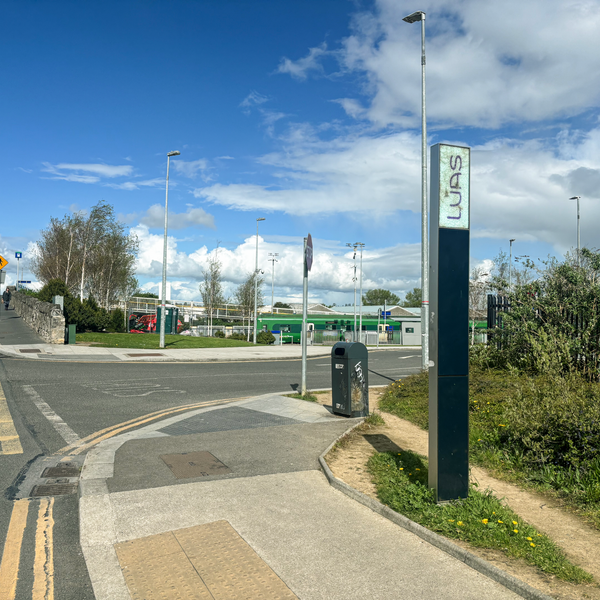
[Directions] Now keep walking and make your way over towards the entrance of the LUAS depo, where the next story will begin.

[Music Refernce] Music: “All of This and Nothing” by Ashot_Danielyan (via Pixabay)

1 sound

9. Cabra Baths Wars.

[Narration] Broombridge stop & Baths and cabra wars.

If you have made it this far, maybe your legs have walked off you, but we are nearly at the end.

You are now standing at Broombridge, one of the most important transport hubs in Cabra.

For many years, this area has been a place where different routes met, from railway lines to canal barges. Long before the LUAS arrived here, people were already travelling through Broombridge by canal and by rail.

This area was also an important place in Cabra West for leisure. Just over the bridge on the banks of the Tolka River were the Cabra Baths.

Imagine a sunny day in cabra in the 1940s, the sound of playing children splashing around in the summer sun.

These baths were built by the Dublin Corporation and were open to the public and included changing facilities.

When the baths first opened a local priest banned girls from using the baths. Instead they were forced to swim in the nearby Tolka River.

Every summer fights broke out between Cabra and Finglas over who had control over the baths. Known as the Cabra & Finglas Wars hundreds of people took part every year.

The wars were brought to an end in 1968 thanks to the work of the Ds Jim “Lugs” Brannigan. He was a former international boxer and head of the Garda riot Squad.

As indoor heated swimming pools started to pop up around Dublin the baths were closed and were filled in in 1979. In the years before the baths were filled in the baths were left derelict and were full of old bikes and beer cans.

What a shame that these outdoor swimming facilities were demolished.

[Directions] Make your way over the bridge and turn left at the traffic lights and stop under the bridge and the final story will play.

[Music Reference] Music: “Ambient Atmosphere” by AtlasAudio (via Pixabay)

1 sound

10. William Rowan Hamilton

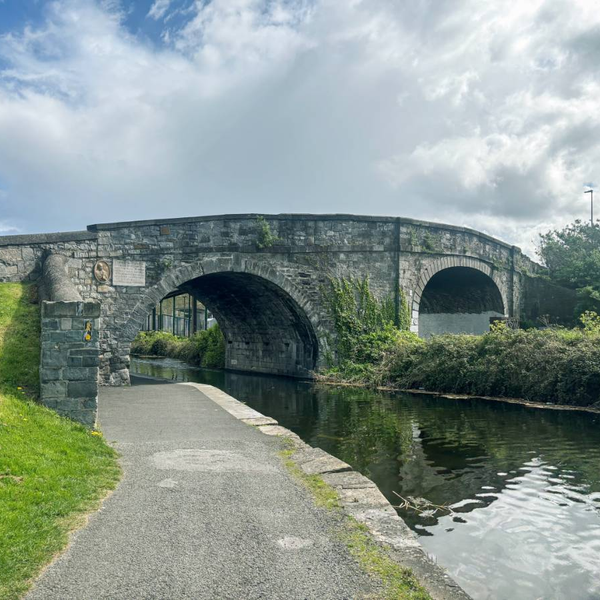
[Narration] Stand here for a moment and look at the bridge in front of you. Then look up at the plaque above.

Now, let’s jump back to 1843, when Sir William Rowan Hamilton was one of Ireland’s brilliant brain boxes. He was a mathematician, physicist, and astronomer, and worked at the Royal Astronomer of Ireland at Dunsink Observatory, where he spent most of his life.

For over a decade, Hamilton struggled to understand how numbers could work in three dimensions. He was working on a major problem in mathematics, basically how to describe rotations and directions in three-dimensional space using algebra.

Jaysus, that’s a long time to be confused for.

Anyway, Hamilton often walked along the Royal Canal here to think about his mathematical problems. One day in 1843, he was walking down the canal , from Dunsink Observatory towards the Royal Irish Academy with his wife, Helen.

Then...

Right there at Broom Bridge, he had a lightbulb moment.

A mathematician's moment.

What does he do? Stop and tell his wife?

No.

Then Hamilton pulled out a penknife and, he couldn't resist the urge and carved the equation on this bridge.

That formula became known as quaternions.

Later, he described the moment in a letter to his son, writing: “Nor could I resist the impulse, unphilosophical as it may have been to cut with a knife on a stone of Brougham Bridge as we passed it, the fundamental formula.”

While the original carving is no longer present. If you look up, there is a plaque remembering Hamilton’s discovery. It was placed by the Dublin Institute for Advanced Studies in 1958.

The impact of quaternions was huge. They opened up new ways of doing algebra that didn’t follow the usual rules of multiplication. These ideas later became essential in physics, navigation, computer graphics, and animation, especially for representing rotation in three-dimensional space.

This new number helped create modern CGI and computer graphics, aided navigation systems, and even helped put the first man on the moon.

In other words, quaternions help power modern CGI, video games, and even spacecraft tracking. So next time you’re watching an action movie packed with CGI. Just thank Hamilton himself.

Every year on October 16th, known as Hamilton Day, people walk from Dunsink Observatory to Broom Bridge to remember the brilliance of Hamilton, right here in Cabra west.

This brings us to the end of the tour. I would really like to thank you for participating in my final year project. If you enjoyed this tour, please feel free to share it with family and friends.

If you wish, there is also a feedback form available on the website where you can share your overall thoughts or suggest any improvements we could make to this project.

Thank you, Alex

[Music Refernce] Music: “Towards the Horizon” by Alexander Nakarada (via Pixabay)

1 sound

DOWNLOAD OUR APP TO DISCOVER THIS TOUR AND MANY OTHERS.

play-storeapp-store

Or start creating tours, treasure hunts, POI maps... Just let your imagination guide you.


Other walks nearby

National Botanical Gardens, Dublin Soundwalk

National Botanical Gardens, Dublin Soundwalk

Dublin
WALK DESCRIPTION This is a piece of music in 8 geolocated sections for location (field) recordings, synthesizers, and percussion. Between each section there is a short 'beat interlude'. It is experienced through the Echoes app and a pair of headphones. When you arrive at a specific location in the National Botanical Gardens, that location’s music will be triggered on the Echoes app. There is a suggested route by following each 'echo' and pathway; however, the sections can also be heard in any order. By taking in each of the eight locations, the total walk should last a little under an hour. SOUNDWALK INFORMATION Growing up close by, the National Botanic Gardens in Glasnevin have been foundational throughout my life. They were a place of exploration through my young childhood; a picturesque backdrop for photographing coming of age family events; a place of solace & escape through my teenage & young adult years; and throughout COVID-19 lockdown, it was one of the few places where it was possible to meet friends & family at a distance. Now as a father, it is a place of exploration once more, as I visit almost on a weekly basis with my young son. Moreover, it continues to be a place of solace & comfort. My dad is buried right next door in Glasnevin Cemetery, and when he died during strict lockdown in 2021, knowing that he was buried in such a beautiful place, surrounded by such an abundance of life, brought solace when we were robbed of the traditional grieving rituals that help us deal with such loss. On 27 January 2023, myself and my four-year-old son went exploring some of our favourite spots in the National Botanical Gardens, and by making location (field) recordings collected sounds that excited us. I have taken these location recordings home, and augmented or ornamented them by articulating the resonant frequencies found on the recordings on synthesizers and other instruments I have at home. The location recordings you can hear are the result of naively listening to not only the environment around us, but our place, and our impact within it. As a result, there is no attempt to edit or remove ourselves from the recordings, and at times you can hear myself and my son discussing things that we hear and see with wonder and appreciation. I hope you enjoy this little ornamented soundwalk guided by myself and a four-year-old, and enjoy exploring the beauty of the National Botanical Gardens. Feel free to follow the path that we took, or to make your own way around the different geolocations. I made this piece as preparatory research for an different work I'm currently writing for Plus Minus Ensemble as part of Zubin Kanga's Cyborg Soloists UKRI Future Leaders Fellowship at Royal Holloway University of London.
free

Are you a creator?

START HERE

Privacy & cookie policy / Terms and conditions

© ECHOES. All rights reserved / ECHOES.XYZ Limited is a company registered in England and Wales, Registered office at Merston Common Cottage, Merston, Chichester, West Sussex, PO20 1BE

v2.5.15 © ECHOES. All rights reserved.