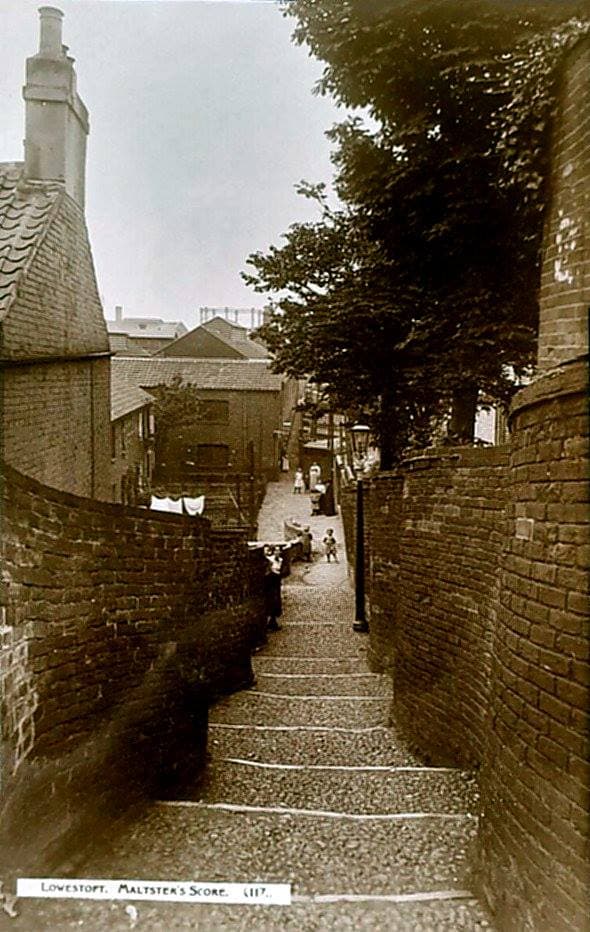
Maltster's Score

1 sound

Maltster's Score was also known at one time as Salter's Score.

From the High Street end, Maltster's Score is entered through a low tunnel opposite the Triangle Market, only a few steps from Spurgeon's Score. From its hidden entrance, it runs downhill for about 120 feet then a turning to the right and then another turning to the left it yet again faces the sea.

At one time the score was edged on both sides by a quaint and winding wall, known officially as a 'serpentine' wall, but called in this part of England a 'crinkle-crankle' wall. The only original part remains at the bottom of the south side.

Maltster's got its name from the maltings of which there were around two or three in the surrounding area including one at the bottom of the score itself.

During the Second World War this area sustained a lot of damage and many buildings were lost. When the score was thriving, it consisted of shops, houses and taverns. The taverns were very popular amongst the sailors and Maltster's Score was one of the busiest parts of town.


Part of this walk

The Scores of Lowestoft

The Scores of Lowestoft

Lowestoft, Suffolk, England, United Kingdom
Scores are unique to the eastern area of Suffolk, where many ‘beach’ families resided. The scores were believed to have ancient origins and were formed over many years by footsteps eroding paths into the soft sloping cliffs leading to the beach, eventually forming the footpaths, with steps added to some. Although the exact origin of the word score is unknown, it is thought it could be a corruption of ‘scour’ or possibly from the Old English ‘skor’, which means to make or cut a line. Over the centuries scores were established connecting the beach to the main road through the north end of town. The Beach Village (demolished in a slum clearance program from 1955 to 1960’s) consisted of tiny rows of 17th and 18th century fisherman’s cottages, smokehouses and net yards. The scores formed a vital link between the town and the beach village, which was built on a cliff and joined to the high street above the village by the series of steep scores. The village housed much of Lowestoft’s fishing communities through the centuries. The original town centre had large elegant 17th and 18th century merchants houses with terraced gardens known famously as the ‘hanging gardens’. Between the houses is where the pathways known as scores appeared. Since the decline of the beach village, the scores are not used so much. On this map are 11 of the scores that are still mostly complete and easy to access. Created by the Great Yarmouth Preservation Trust Scores Project. Funded through Making Waves Together – National Lottery Heritage Fund, Arts Council, Great Yarmouth Borough Council and East Suffolk Council. Words by Lesley M. Bunn. Map created by Catherine Allen.
free

Privacy & cookie policy / Terms and conditions

© ECHOES. All rights reserved / ECHOES.XYZ Limited is a company registered in England and Wales, Registered office at Merston Common Cottage, Merston, Chichester, West Sussex, PO20 1BE

v2.5.15 © ECHOES. All rights reserved.