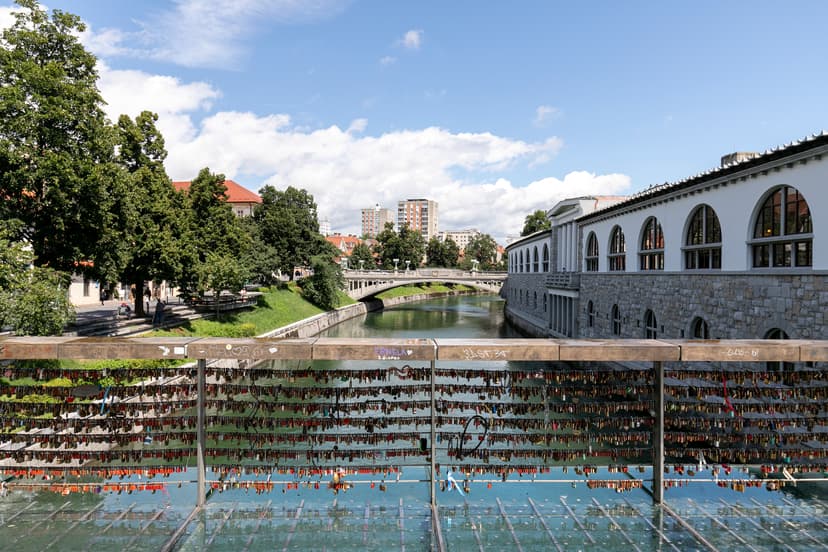
6. Butchers' Bridge
1 sound
And her we are, above the Ljubljanica river, which has been very important throughout the history of the city, both for the citizens and for the city itself; and it is no different today. Ljubljanica is a karst river. It comes to the surface from a number of springs in the area of Vrhnika, after flowing through several karst fields and disappearing in between. Such rivers are much more susceptible to pollution than rivers in a non karst rock base. Due to various processes and factors, the non-karst bedrock weathers so that the water flowing in these areas has greater self-cleaning abilities. This means that rivers naturally clean themselves faster than those in karst areas. This is especially true for aquifers, such as the one in Ljubljana. Especially in the period after the last Pleistocene glaciation, colloquially called the ice age, which ended about 12,000 years ago, the Sava river flooded the Ljubljana basin with various river deposits. Due to their filtering ability, they currently provide one of the highest quality sources of drinking water in Slovenia. The self cleaning capability of karst watercourses and groundwater, on the other hand, is nowhere near the same. The mechanical weathering of limestone is negligible, so rivers cannot create river deposits on the plains. There is mainly chemical weathering of the rock, which facilitates and accelerates the penetration of various substances, such as pesticides and fertilizers, into the underground. Karst rivers are therefore much more endangered in terms of pollution and the Ljubljanica is no exception.

