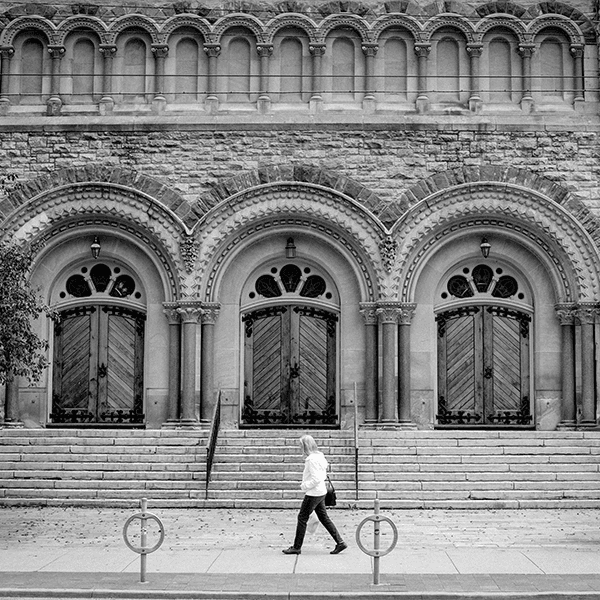
2. St. Andrews Church / Roy Thomson Hall - 73 Simcoe Street
1 sound
Take a look at St. Andrew’s Church on the corner. It was built in 1876 and designed by William George Storm, the architect also behind University and Victoria Colleges at the University of Toronto and the iron fence nearby at Osgoode Hall. Looking at the façade it’s obvious, with its sculptural elements, that tradespeople and artisans were an important part of the building process.
Though it was a modernist movement, the Bauhaus’s first director, Walter Gropius, wrote a manifesto in 1919 stating “The ultimate goal of all art is the building,” putting an image of a cathedral on the cover. It was a symbol of medieval craft and a statement that fine arts were indispensable to architecture. Gropius wanted to erase the artificial barrier between artists and craftspeople, feeling creativity and modern manufacturing were drifting apart. To this end, Avant Garde artists were enlisted to stimulate the creative process at the Bauhaus.
There was a tension here though. Bauhaus is known for its clean style with no ornamentation; a reaction to the mess of World War I and the symbols of royalty, nobility and the like that led to it. Looking at Roy Thomson Hall across the street, it’s a building that embodies the cleaner lines and transparency of the Bauhaus, but also a civic ethos that saw value in the arts. The City of Dessau financed the building of the Bauhaus school while Roy Thomson is city-owned and local business people raised funds for its construction in a civic effort.

