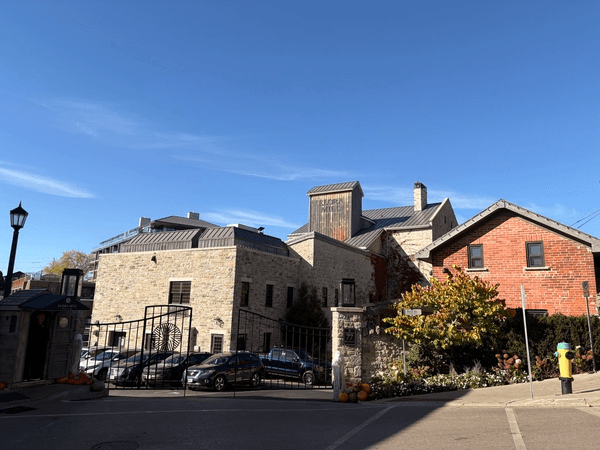
The Elora Mill & Mill Street West
1 sound
If you've wondered why the village of Elora grew here during European settlement, the river beside me is a good place to start. Long before Elora developed as a European settlement, Indigenous Peoples, including the Anishinaabe and Haudenosaunee, had longstanding relationships with the Grand River and the lands around it. As European settlement expanded during the nineteenth century, the river began to play a new role in the development of the village, particularly as a source of power for industry.
Elora's first sawmill was built here beside the Grand River in 1833. Water was a major economic resource at the time. The river could turn machinery, support manufacturing, and give early businesses access to the power they needed to operate. In the 1840s, a larger mill complex began developing here, and industry expanded along both sides of the river.
By the 1860s, shops were filling in along East and Mill Street West and Elora's business district was extending uphill along Metcalfe Street. The shape of downtown was taking form around industry. I've changed considerably since then. Major fires damaged and destroyed parts of the mill complex during the nineteenth century, including serious fires in 1859 and 1870. Each time, the site was rebuilt, enlarged, and adapted. Grain moved through here, machinery ran here, people worked here, and businesses grew around me because of it.
The river also supported an entire industrial landscape nearby, including woolen mills, foundries, furniture manufacturing, and other enterprises that once filled this part of Elora with workers, materials, and machinery. Much of that industry eventually disappeared, but the buildings and streets it helped create did not.
Look eastwards back along Mill Street West. The narrow roadway, limestone buildings, storefronts close to the sidewalk, and the mill at the end of the street create one of Elora's most recognizable view corridors. That relationship between buildings and street has been reinforced through more recent public investment.
When the Jack R. MacDonald pedestrian bridge was rebuilt, Mill Street West was improved alongside it. This extensive project included new paving and sidewalks, as well as pedestrian amenity areas with features such as landscaping, trees, and benches. Those details influence how a street works. A bench gives someone a reason to pause, wider or more comfortable sidewalk makes walking easier, trees and landscaping create shade, enclosure, and separation from traffic. Storefronts close to the sidewalk give people something to look at as they move through the street. Together, those individual elements shape the experience of a downtown.
This street has been adjusting to new uses for almost two centuries. Factories became shops, industrial buildings found new uses, and that vehicle bridge became a pedestrian connection. Spaces once organized around moving goods and machinery increasingly became places for people to experience; walking, shopping, gathering, and spending time beside the river.
The Grand River is still shaping Elora. Its role has changed, but the relationship between the river, the buildings around it, and the people who use this place remains one of the defining features of the community.
For our last few steps, head back along Mill Street West toward the Elora Mews on the north side. There's one final piece of Elora's commercial history waiting there.

