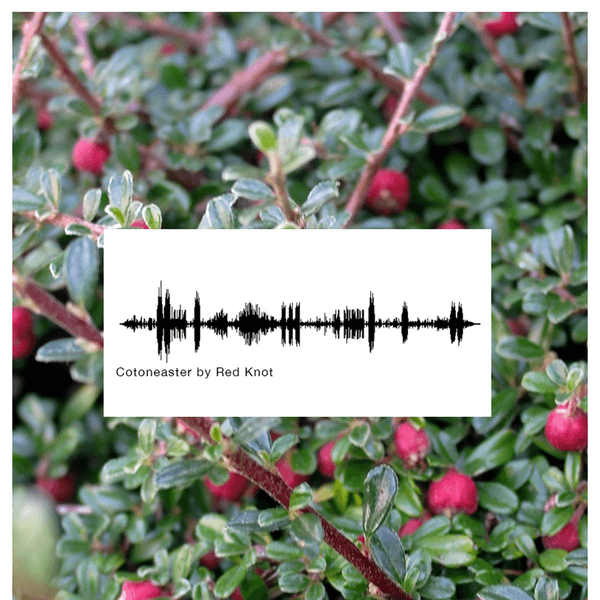
Cotoneaster by Red Knot
1 sound
Cotoneaster horizontalis Native to Himalayan regions from Afghanistan to Sichuan
The Cotoneaster is part of the Rosaceae (Rose) family, a hardy plant that can exist in temperatures down to -25C. The plant was introduced to Europe in 1824.
There are many types of Cotoneaster. Horizantalis is a popular variety but, due to its extensive root system and dense structure, most varieties are considered invasive. They are a particular problem on limestone cliffs and grasslands and are listed under Section 9 of the Wildlife and Countryside Act.
Cotoneaster is very often used as a ground cover shrub in urban areas and is a popular plant with birds and bees.
The berries are not edible but are not highly toxic either to humans or to cats and dogs.
Red Knot (Calidris canutus)
Knots are exclusively high Arctic breeders and make some of the longest non-stop migrations of any wader. Outside their breeding season Knots are wholly coastal, mollusc-feeding specialists, depending almost entirely on extensive mud and sandflats in large estuaries and embayments where they occur in dense flocks of many thousands of birds. They reach these by making flights of up to 5,000 km between very few staging areas.
During northward and southward migration, it stages in the Wadden sea en route to the wintering areas along the Atlantic coast of Africa from Mauritania to South Africa, with over 75% on the Banc d’Arguin in Mauritania.
Deducing the overall migration system require a flyway-scale analysis of Knot ring-recoveries. Knots may be a key indicator species for early warning of the impacts of climate change on migratory Arctic birds. Predicted changes in weather patterns, and increased storminess, will increase the need for emergency stopover sites if adverse headwinds increase in frequency, since otherwise Knots could be prevented from reaching the Arctic in sufficiently good condition to breed successfully.

