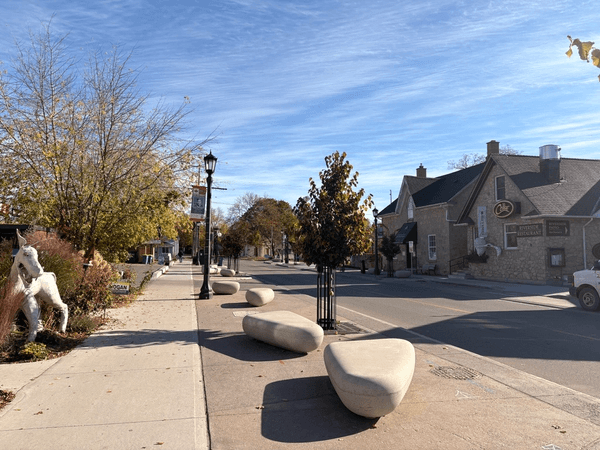
Mill Street East
1 sound
Walk with me for a minute. You already know that planning leaves traces in individual buildings. Now look at what happens when those buildings begin working together as a street.
Near Bissell Park, Mill Street East has a distinctly residential character. Homes sit back from the road behind lawns, gardens, and mature trees. Buildings have space around them, driveways lead into individual properties, and the street feels quieter and more open than the commercial blocks nearby.
One of the most recognizable examples of the residential character is 23 Mill Street East, the white home located on your left along this stretch. The 1.5 storey dwelling forms part of the older residential streetscape along Mill Street East, leading into the downtown area. Its modest scale, front setback, and residential character are quite different from the distinctive commercial area and mixed-use buildings located only a short distance ahead.
Keep walking west. Watch what happens as you approach the centre of the old village. Front yards begin to get smaller, buildings move closer to the sidewalk, detached houses start sharing the street with commercial buildings and other uses, entrances turn toward passing pedestrians, windows become part of storefronts, and buildings gradually sit closer together. The change happens gradually, which is exactly why this stretch of Mill Street East is interesting.
This brings us to an important idea in planning, called complete communities. A complete community is one where people can access many of the things they need in their daily lives, such as housing, jobs, shops, services, parks, and places to gather, without having to travel far. It doesn’t mean that every street needs to have everything. Instead, it’s about creating neighbourhoods where different uses and activities complement one another, and where people have choices in how they get around.
Think about the places you’ve passed on this walk so far. From Bissell Park, through this residential neighbourhood, and now toward the shops and services of downtown, many different parts of community everyday life are connected within a relatively short distance. That’s part of what makes complete communities so valuable. When homes, services, and public spaces are well connected, people have more opportunities to walk, cycle, and participate in community life.
Urban design guidelines play an important role in bringing these connections together. Things like sidewalks, building setbacks, landscaping, street trees, and the relationship between buildings and the street all influence how comfortable and inviting a place feels. As you continue toward downtown, notice how those details change around you. There isn't a gate marking the point where one neighbourhood ends and the downtown begins. Instead, you can see the transition taking place along the street itself. Keep following Mill Street East toward Geddes Street.

