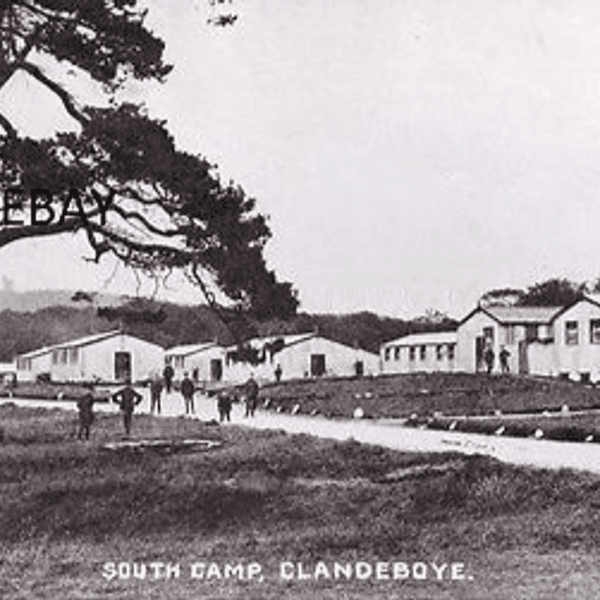
Clandeboye Camp
1 sound
If you had looked through a gap in this old estate wall in 1914 you would have seen the beginnings of the Ulster 36th Division’s Clandeboye Camp. It was first a tented camp, but as the war progressed, so did the scale of the camp, with the construction of dozens of wooden huts. Young men from across Ulster came here to train for war. Many had never been away from home before, and many would never return. The Somme was their primary destination, where, over the first two days of July 1916, they suffered 5,500 officers and enlisted men killed, wounded, or missing, with approximately 2,500 fatalities.
Many of these young men visited Helen’s Tower whilst they were here and signed their names in the visitors’ book.[1] I wonder if they included any of the nine soldiers who displayed extraordinary valor and were awarded the Victoria Cross during the Somme offensive and whose names are etched into history at the Ulster Tower, a replica of Helen’s Tower, built on the Somme in 1921 as a memorial to all of those who lost their lives over those two tragic days.
The tragedy of war also visited the Blackwood family, two of whom were lost forever in the fields of Belgium, under remarkably similar circumstances.
Robert Blackwood was uncle to Lord Dufferin, the 1st Marquess. He was born in 1788 and rose through the ranks in the army to the rank of Major. He was severely wounded at the battle of Badajoz in 1812. He returned home on sick leave and decided to from the army. However, on hearing of Napoleon’s escape from Elba, he changed his mind and clandestinely left Clandeboye with a pair of horses, heading for the continent. He arrived at Brussels on the night of 17th June 1815 and rode out early the next morning to Waterloo. He was looking for his regiment when, a General wishing to send a message, someone said “Oh here’s Blackwood; he’ll do”; but no sooner had he started out to deliver it that he was cut in two by a round shot, some say that it was the first shot of the battle.[2] There is a memorial to him in Clandeboye Chapel, as well as a stone urn in the gardens.
A little over a century later, Lord Dufferin’s third son, Basil, aged 47, was lost in no-man’s land near Ypres. He was also severely wounded, at the battle of Mons in 1914, but he did not enjoy his forced rest and returned to the front two years later as a Lieutenant. It was in preparation for the Battle of Ypres that he was sent out with a small reconnaissance party on 3rd July 1917. He never returned and his body was never recovered.[3] His is just one of the almost 55,000 names inscribed on the Menin gate at Ypres. He is also remembered on the large Celtic cross in the family burial ground beside the lake, together with his eldest brother, Archie, who died at the Siege of Ladysmith in South Africa in 1900.
[1] PRONI T3953/2
[2] PRONI D1071/H/W/1/27 Draft of Lord Dufferin’s Memoir, 73
[3] PRONI D1231/G/5

