3. Republic Square
1 sound
Republic Square is a place where most protests take place in Ljubljana. Before the coronavirus pandemic, it was also the site of Youth for Climate Justice protests which took place every Friday. They were small gatherings, but the intention of the young was to show up, regardless of the weather, time of year, or the current political leadership. In doing so, they pointed to the need for urgent action against the climate crisis and the inaction of political leaders. With the onset of the pandemic, the Friday protests moved online. You can follow them on Facebook and Instagram.
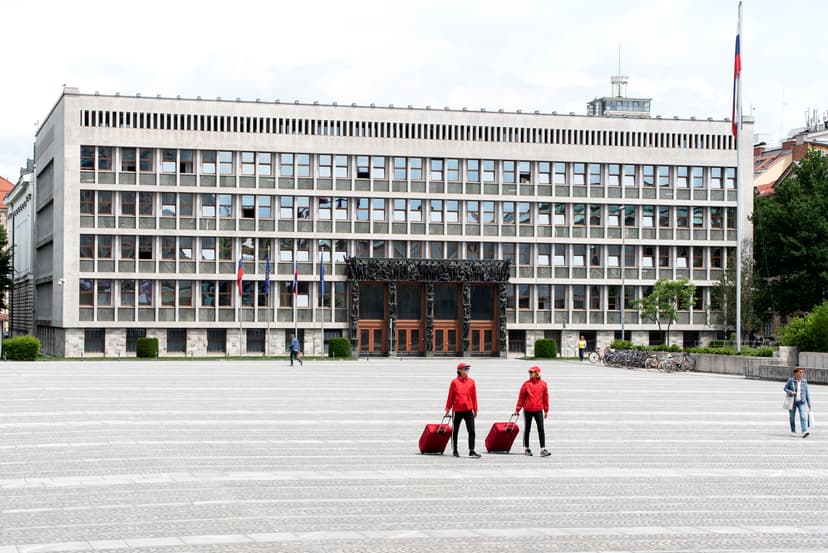
As we stand on this open concrete space, it’s hard to imagine that there was a giant garden here until the 1960s, full of mighty trees. Yes, this was the location of the Nun Garden, or the Ursuline Grove, as they used to call it. Namely, the garden was owned by the Ursuline Monastery, whose church bell can still be seen behind the Maxi building, looking in the direction of Ljubljana Castle. This green garden also included a children’s playground and an Ursuline kindergarten. Today, the only potential resemblance of the garden are the straight parallel lines stretching dully across the square like some kind of cement garden patches. The post war socialist regime decided that the centre of Ljubljana needs monumental bureaucratic architecture right here, with a huge parking lot and a shopping centre. The project was named The Revolution Square. Interesting, right? Because there is usually not much revolutionary spirit in office work, parked cars and supermarkets. Good thing that a 20-tonne Monument to the Revolution was also placed on the square to clear the confusion to some extent. The monument was made by Drago Tršar and was erected in 1975, on the thirtieth anniversary of the victory over fascism. With a bit of historical distance, one could argue that this concrete creation, which was renamed to Republic Square after Slovenia’s independence, is best suited for skating and protesting. The latter, protesting, is the only thing that is somewhat reminiscent of revolution today. Indeed, the square was the site of protests already during the socialist era, most notably in the winter of 1987 with the week long strike of the Litostroj factory workers. But there were many more protests after 1991. Most recently, the 2020 anti government protests, were certainly among the largest, and also had a strong environmental note. Namely, the coalition government of the time, led by the far right Prime Minister Janez Janša, adopted legislation that prevented all important national environmental organizations from participating in the supervision of the unsafe constructions in the natural environment.

