Blues and Gospel Records 1902–1942: John Godrich’s Groundbreaking Work
1 sound
John Godrich was a pioneering British discographer whose work transformed the study of early African American music. As co-author of Blues and Gospel Records: 1890–1943, his meticulous scholarship laid the foundation for generations of blues researchers, collectors, and musicians. Working entirely in the analogue era — long before the advent of digital archives — Godrich catalogued recordings using handwritten notes, postal correspondence, and reel-to-reel tape machines. His efforts represent one of the earliest and most dedicated attempts to document the voices of musicians who had long been marginalised in mainstream music history.
Jeff Towns, often known as "The Dylan Thomas Guy," is one of Wales’s most respected rare book dealers and literary scholars. While best known for his work on Dylan Thomas, Jeff has also played a key role in preserving Welsh cultural heritage more broadly. His friendship with John Godrich grew from shared interests in jazz, literature, and archival research. After Godrich’s passing, Jeff became the custodian of his extensive blues archive — a collection he later donated to Jazz Heritage Wales to ensure its preservation and accessibility for future generations.
Today, the Jazz Heritage Wales Archive, housed at the University of Wales Trinity Saint David, holds Godrich’s rare recordings, notes, and audio equipment. The collection offers a unique perspective on how global Black music traditions were studied, interpreted, and preserved from within Wales. It stands not only as a record of the music itself but as a valuable resource for understanding the role of private collectors and scholars in safeguarding cultural memory.
The music you are hearing in this section is a live performance of “Caravan”, recorded by the Iridium Collective. Originally composed in 1936 by Juan Tizol and Duke Ellington, with lyrics later added by Irving Mills, Caravan is one of the most enduring standards in jazz. The Iridium Collective brings their own improvisational energy to the piece, recorded during a live session that celebrates the lineage of jazz while honouring the spirit of collectors and historians like Godrich.
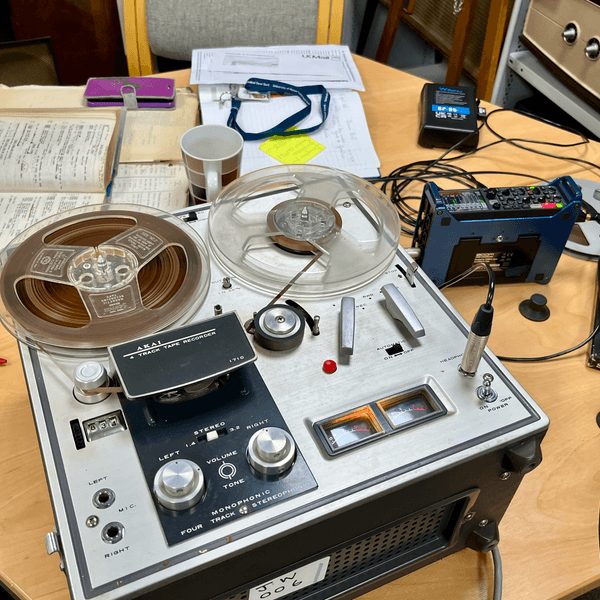
The image at this trigger point shows John Godrich’s Akai 4-track tape recorder — the very machine he used to document and listen to early blues and gospel records. Produced in the 1960s and 70s, this reel-to-reel recorder was known for its solid build, warm analogue sound, and multi-track playback features. For audio archivists like Godrich, it was an essential tool for preserving rare material in an era before digital technology.
This machine now forms part of the physical legacy of Godrich’s work, preserved in the Jazz Heritage Wales collection. It stands as a symbol of both his dedication and the tactile, hands-on nature of early jazz and blues scholarship.

