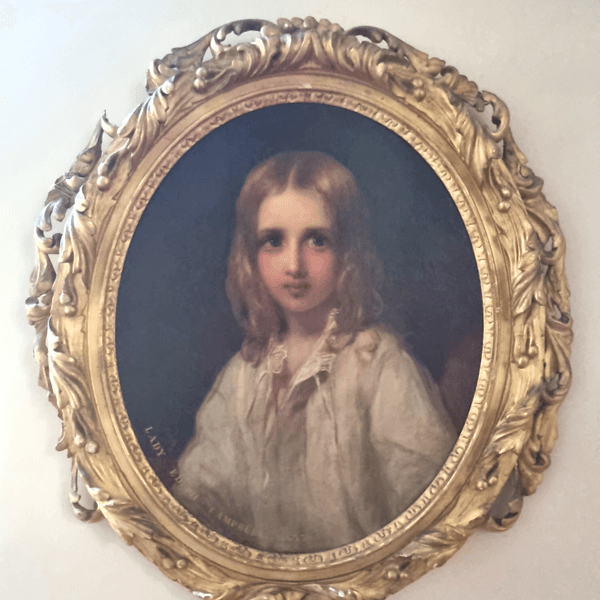
Edith of Lorne
1 sound
As you round this curve in the avenue, depending on which direction you are walking you will see a long straight road in one direction and the Red Bridge in the other. At one time this was the only route to the shore from the ancient road between Crawfordsburn and Holywood, now the Ballyrobert Road. In 1850, when Lord Dufferin walked to Grey Point with James Frazer, his landscape architect, “laying off ye avenue from ye sea to ye gate”[1] this road continued straight up the slope beside us to join the Ballyrobert Road. However, in order to create the avenue, Frazer re-aligned it towards a stream that ran under Ballyrobert road and built the bridge now before us, thus extending the new avenue under the road. But in the process the public road to the shore was cut off, so he made amends by laying out two new roads: Bridge Road and Craigdarragh Road.
On the other side of the avenue the Crawfordsburn river emerges through the woods from Edith of Lorne’s Glen and continues on its way towards the Crawfordsburn Country Park and the sea. But who was Edith of Lorne?
She may have been the Edith of Lorne from Sir Walter Scott’s poem “The Lord of the Isles,” in which Edith is betrothed to Lord Ronald, the Lord of the Isles, during Robert Bruce’s efforts to free Scotland from English rule (1307-1314). However, Ronald is in love with Bruce’s sister, Isabel. The story unfolds with Edith, disguised as a mute page, following Bruce and Ronald on their adventures and ultimately saving them from danger. Isabel discovers Edith’s true identity and gives her blessing to Edith’s union with Ronald.[2]
Or maybe he was referring to Edith, the daughter of the 8th Duke of Argyll. Her parents were close friends of Dufferin, who even commissioned the sculptor, Marochetti, to model the Duchess as the figure head for his yacht ‘Foam’ on his voyage to Spitzbergen in 1856. To quote from his diary, whilst in Stornoway before setting sail for high latitudes “Ashore looking for a blacksmith to put up our figure head. Great smell of fish. Wrote a letter to the Duchess of Argyll, little Edith’s picture opposite to me all the while.”[3] Although her title was Lady Edith Campbell, Lorne was a family name and her brother, the 1st Marquess of Lorne succeeded Dufferin as Governor General of Canada in 1878.
It's a difficult choice between his affection for his ‘little Edith’ Campbell and the Edith of his beloved Sir Walter Scott, about whom he wrote: “ I love Sir Walter Scott with all my heart; and my mother excepted, I think he has done more to form my character than any other influence; for he is the soul of purity, chivalry, respect for women and healthy religious feeling.”[4]
Perhaps I should just leave it to your imagination. [1] PRONI D1071/V/1/5 (26 October 1850) [2] Sir Walter Scott, The Lord of the Isles: A Poem in Six Cantos (1815) [3] PRONI D1071/V/1/13 (9 June 1856) [4] Andrew Gailey, The Lost Imperialist (London: John Murray, 2015), 24.

