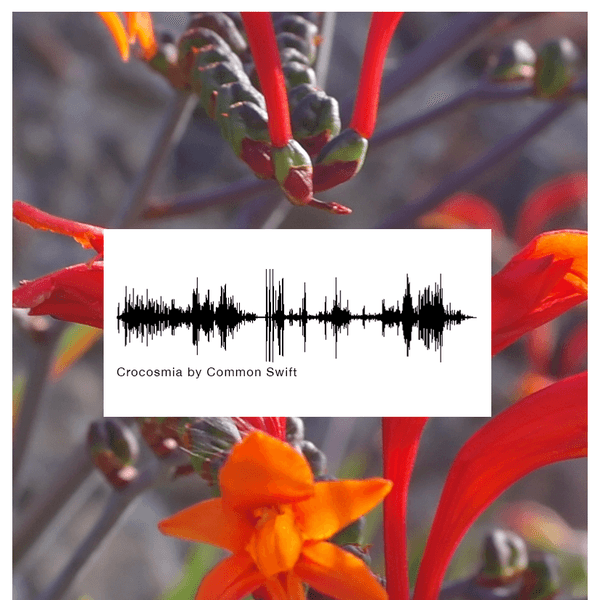
Crocosmia by Common Swift
1 sound
Crocosmia (Crocosmia-crocosmiiflora) Common name: Common Montbretia Native to: Grasslands of Southern and Eastern Africa
A deciduous cormous perennial (Iridaceae family) with sword like leaves. Red or orange flowers are grouped along tall stems in a line.
The plant first arrived in Europe around 1847. Victor Lemoine crossed Crocosmia aurea with Crocosmia pottsii to produce a variety known as ‘Montbretia’ in 1881. Many varieties are now available.
Crocosmia is classed in many countries as ‘invasive’. In the UK it is listed under Schedule 9 of the Wildlife and Countryside Act. Care should be taken not to allow it to escape from gardens.
Toxicity: Corms are mildly toxic to dogs and cats.
Common Swift (Apus apus)
The Common Swift is the most aerial of all our birds. Uniquely for a British and Irish bird, some of the non-breeders do not come to ground at night but “roost” on the wing; some birds may not even touch down at all during the whole summer. It is even possible that most Swifts spend the whole of the winter in Africa on the wing, since roosting sites have not been reported.
Historically, the Swift nested in holes high in large trees, often those made by woodpeckers; it still does so in a fewn places. However, in most areas it nowadays nests almost exclusively in buildings, usually those where the nest sites can be above about 6 m from the ground, allowing the bird easy access to the site.
Almost all Swifts winter in Africa, south of the Sahara, with larger numbers in tropical areas than in southern Africa. Small numbers of Swifts may winter in northern India and in Arabia, though these are presumably not from Britain and Ireland. The main wintering grounds of the nominate race are probably largely south of 4ºS in the Congo Basin, Angola, Tanzania and from Malawi to the Cape.
The is a potential for confusion with African Black Swift through much of the wintering range.Because they are long-lived, many Swifts make the return journey to Africa many time. In they lifetime, Swifts flight time is equivalent to a return trip to the moon five times.

