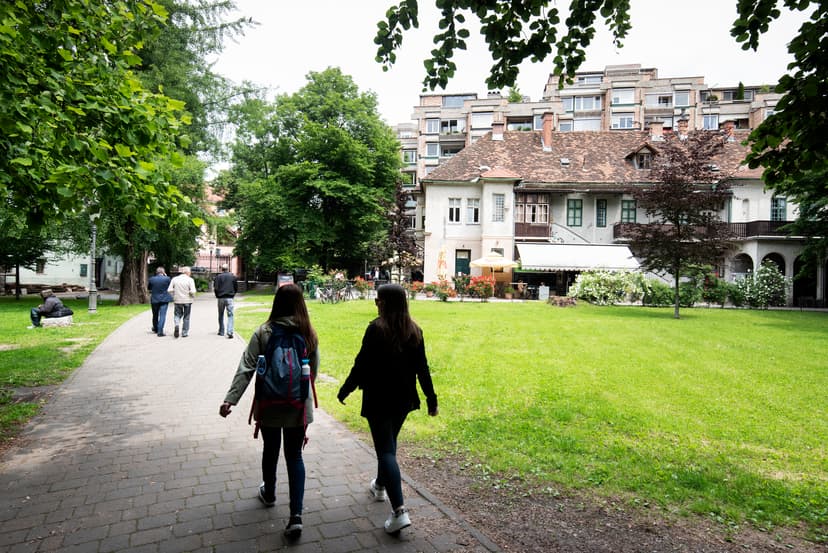
2. Park behind the Faculty of Arts
1 sound
What is your first association when you hear the words ‘environmental protection in Slovenia?
It all began with the first initiators of environmental protection in Slovenia, experts and artists, who founded the Society for Environmental Protection in the early 1970s. At the beginning, they opposed the planned construction of new hydroelectric power plants on the Soča river, which was the first opposition to the huge energy projects in the SFRY. In general, the environmentalists perceived Yugoslav socialism as unproblematic, which was unjustified. Many Yugoslav republics were underdeveloped by capitalist standards, so the federal state invested heavily in their development through large infrastructure projects, heavy industry, and increased production. All this, however, had negative consequences for the environment. By doing so, the state wanted to achieve economic growth comparable to capitalist economies. Thus, it could eventually beat the capitalist system in terms of the material prosperity it would provide to the people. However, socialism does not require economic growth, it can survive without it, while it is absolutely necessary for capitalism.
With economic development, the need for energy also increased, leading to new interventions in the environment, and with it, a true resurgence of the environmental scene in Slovenia in the 1980s. The main emphasis was on the Šoštanj Thermal Power Plant and air pollution with sulphur dioxide emissions. Today, thirty years later, the Šoštanj power plant is still causing quite a stir and emits a lot of greenhouse gases. It is one of the most controversial investments in Slovenia.
However, our predecessors dealt not only with the issue of thermal power plants; it turned out that all methods of producing electricity carry risks and cause damage to the environment. The Chernobyl accident in 1986 (justifiably or not) prompted the establishment of an anti-nuclear movement, which called for the closure of the Krško Nuclear Power Plant. And already back then, there was some opposition to the construction of hydroelectric power plants on the Mura river.
In the Yugoslav context, Slovenia was the republic with the strongest environmental movement, and environmentalists from other republics also came here to learn.
1968 was a turbulent year in many parts of the world. Slovenia was no exception.
Today, when we stand behind the Faculty of Arts rising above us with its brutalist architecture, it is hard to imagine the riots that took place here some fifty years ago. As mentioned, post war Yugoslavia witnessed rapid development. The cities grew, the population increased, and the standard of living rose. All of this, however, had unforeseen consequences that erupted in unrest at the transition from the 1960s to the 1970s. The 1968 unrest in Yugoslavia was the result of growing inequalities due to the introduction of capitalist elements and opening up to the West, poor accommodation and low capacity in study centres, poor accessibility to higher education for students from the periphery, and declining opportunities for the young. Discussions about these problems began. These issues were already discussed in 1964.
In 1968, the student movement focused primarily on housing issues. They managed to negotiate the construction of new student dormitories and prevented the introduction of changes that would make it harder for the students to stay in them. The next year, they founded Radio Študent, which provided students with new possibilities to communicate and organize, as well as to inform the public about current events. This was their first victory. Economic development also led to increased traffic. Back then, Aškerčeva street was Ljubljana’s main traffic artery, as there was no bypass at that time, and most of the traffic ran along it. Huge trucks and a growing number of motor vehicles caused an unbearable noise that echoed through the area around the road. For this reason, students of the surrounding faculties organized the first public protest against the noise on Aškerčeva street on April 14, 1971. They believed that the noise was detrimental to their health and ability to concentrate in class. They closed down Aškerčeva street. There was a festive atmosphere on the blocked road, students sang, played musical instruments, played cards, etc. The more radical among them set off towards the assembly, today's National Assembly Building, where they were stopped by a police corridor. This quelled the fire, but only for a short while. The protests continued with the occupation of the Faculty of Arts from May 26 to June 2 of the same year, following the prosecution of two students – Milan Jesih, who played an important role in the occupation of Aškerčeva street, and Adam Frank, who was arrested for “too much free expression”. In a way, the occupation of the Faculty of Arts was an artistic activist experiment. There were lectures, recitals, a disco with music, poetry, skits, theatre events, performances, an orchestra where students played instruments that they could not play … A kind of left wing criticism of the authorities was formed, which demanded, above all, that Yugoslavia return to its socialist origins, introduce student participation in the management of the university, and release the arrested students. The power and energy were short-lived, however. The occupation ended with the beginning of the university holidays.
Separate from these developments, the students of the Faculty of Architecture also took action, protesting against the felling of trees on Vegova street.

