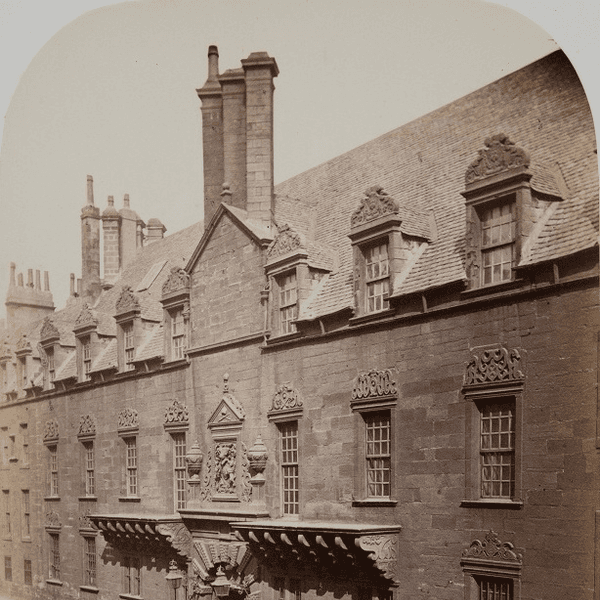
Stop 1: Pearce Lodge
1 sound
Hello & welcome to the Adam Smith Audio Trail at the University of Glasgow
I’m Pheona Matova a JMS Scholar with the Adam Smith Business School and I am here with Craig Smith, professor of the History of Political Thought at the University of Glasgow.
Why are we beginning under this archway you ask? Well, this arch here was once the entrance to the Old College Campus, moved here from its original location in the east end of Glasgow. That’s where Adam Smith would have studied and worked during his time at the University. That was almost 300 years ago, way back in the 1700s. Glasgow’s population was around 30,000 inhabitants – just 5% of the current population – but it was growing rapidly with an increasing focus on industry and plenty of provision for a burgeoning middle-class.
Adam Smith is the University of Glasgow’s most famous former student. He is known around the world as the founding father of modern economics and a great social science thinker - in part because his thinking went far beyond economic concerns. What was this great mind ultimately thinking about? Happiness. He understood that markets and morality are two sides of the same coin, and that they always need to be considered together. Look around and imagine yourself in Smith's shoes, walking into the University for the first time as a student in 1737.
It's easy to forget that before he was a world-renowned economist, he was a typical student - apologising to his mother for his lack of communication and asking if she could send him new socks. In one of his surviving letters to her, he writes: "I am quite inexcusable for not writing to you oftener. I think of you every day, but always defer writing till the post is just going, and then sometimes business or company, but oftener laziness, hinders me." “In my last Letter I desir'd you to send me some Stocking's, the sooner you send 'em the better!”
Funny how even though he was born 300 years ago he was not so different to you or I. Ok, let's pass through the archway and head up to the main building, we can keep talking as we go. So how did Adam Smith end up at the University of Glasgow?
Well Smith was born in the town of Kirkcaldy in Fife in 1723. His father, a customs officer, died before he was born. Smith was raised by his mother, Margaret, who came from a land-owning family.
You can tell from their letters that they had a close relationship!
Yes! Well, Smith came to the University of Glasgow in 1737, aged 14. He studied logic, metaphysics, maths and later Newtonian physics and moral philosophy under some of the leading scholars of the day.
14 seems young – but I suppose that was typical for the time.
Yes, not unusual at all. Smith's talent was quickly recognised by his school teacher at Kirkcaldy. Following study at Glasgow, Smith received a scholarship to continue his studies at Oxford University in 1740. It wasn’t plain sailing though, he left Oxford on the verge of a nervous breakdown! Upon his return to Scotland, he gave popular lectures on philosophy and literature and joined the clubs and societies of the Scottish Enlightenment alongside friends like the Philosopher David Hume.
And was it not the success of these lectures that led to him being appointed as lecturer at the University of Glasgow?
Yes that’s right, he was appointed as Professor of Logic, and then of Moral Philosophy, and taught at the University between 1751 and 1764. At this time Smith was able to see the rapid economic development happening around him - accelerated by the Atlantic slave trade - and he became fascinated by social and economic change. He learned about Glasgow's growing wealth from trading and manufacturing activities, then within his lectures reflected on what he saw as the related moral and economic challenges.
I think it's an important point to make here that although Smith was an abolitionist and against slavery on both ethical and economic grounds, he still indirectly benefited from the wealth and opportunities that slavery brought to the city of Glasgow. For example, a number of his students would have been the sons of those directly benefiting from slavery. There are roughly 60 Glasgow Street names with connections to the Atlantic Slave Trade, with a large chunk of them located in the Merchant City right next door to the Old College Campus.
That’s an interesting visual way of understanding the impact. The knowledge Smith gained from observing the moral and economic issues of the local merchants helped to establish his reputation as it was at this time that he published The Theory of Moral Sentiments. Published in 1759, the book is an attempt to understand everyday moral judgement. Instead of telling us what to think about morality, Smith tries to understand how people make moral decisions. He traces this to our feelings, the moral sentiments, and our relationships with others. Smith's most well-known and influential book, The Wealth of Nations, was published later on in 1776. But despite being relatively unknown in comparison, The Theory of Moral Sentiments provided the ethical, philosophical, economic, and methodological underpinnings to his later works.
So, if we want to find out how we can make people and nations prosperous in both an economic and moral sense - we should also be reading The Theory of Moral Sentiments.
Absolutely.
On your left should be the main building. Let’s go inside. I’ll meet you in the courtyard under the Cloisters – the pillared walkway in the centre. It will be the perfect place to discuss one of Smith’s key observations.

