Bissell Park
1 sound
It's probably difficult to picture now, but for much of the last century, you wouldn't have come here for a picnic, you would have come to work. Before I became Bissell Park, this stretch of the Grand River was occupied by a large industrial complex. A carpet factory had been built here in the 1870s, taking advantage of Elora's growing industrial economy and its relationship with the river.
By the end of the century, those factory buildings were sitting vacant. Then, in 1901, the Village of Elora made a deliberate investment in bringing industry back to the site. The municipality offered businessman T.E. Bissell a $5,000 interest free loan and transferred the former factory property to his company. Within months, machinery was running again.
The T.E. Bissell Company manufactured agricultural equipment here, beginning with horse-drawn disk harrows. Its products eventually reached customers across Canada, the United States, and overseas. At its peak under later ownership, the factory employed roughly 200 people.
Imagine the landscape around you then: large industrial buildings, machinery, workers arriving for their shifts, the sound of manufacturing, and the Grand River serving an economic purpose as well as a scenic one. Bissell even constructed a new dam and power plant here in 1909. The dam remains part of the river landscape today.
The factory's fortunes declined after the Second World War, and production ended in the 1950s. The empty industrial buildings survived for several more years before they were eventually demolished.
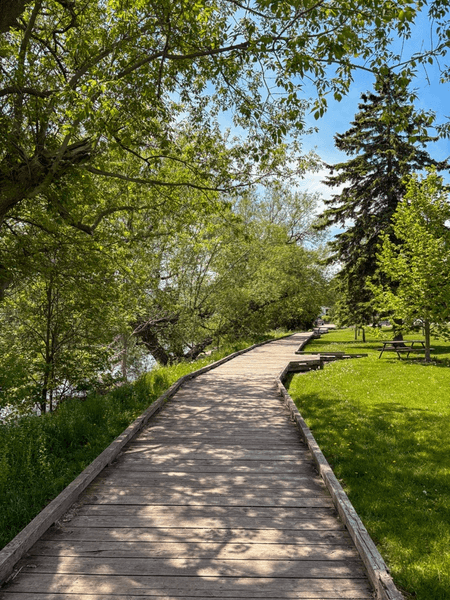
The land remained. And over time, its purpose changed completely. Today, this is municipal parkland; a place for walking, recreation, community events, gathering and access to the river. The park includes a multi-use recreation area and community facilities, and it continues to receive public investment as its use evolves.
That transformation is part of planning too. Land can carry the imprint of several very different eras. A site that once supported manufacturing and employment can later become part of a community's network of parks and public spaces, while remnants of its industrial past remain visible in the landscape.
Before you leave, take another look toward the river. More than a century ago, the water beside you helped power industry. Today, it forms part of the experience of being in a public park. When you're ready, begin walking west along Mill Street East toward downtown. For the next part of the tour, you don't need to stop immediately. Just pay attention to the street.

