African American Schools in Lake City
1 sound
The right to education has long stood at the epicenter of the battle for Civil Rights in America and is one in which African Americans have long fought for equality and access to education. Education has also been used as a tool to uphold racialized hierarchies in America. South Carolina was the first American colony to pass laws prohibiting slave education. In the aftermath of the Stono Rebellion in 1739, which killed twenty-five white people, South Carolina passed the comprehensive Negro Act of 1740. This legislation made it illegal to teach enslaved people to read or write and remained in effect until 1865. Shortly after the Civil War and abolition of slavery, South Carolina churches, charitable organizations, and particularly the Freedmen’s Bureau assumed the primary responsibility of educating newly freed slaves. However, the withdrawal of Union troops in 1877 and the ratification of the South Carolina Constitution of 1895 reversed many of the educational gains by African Americans and left education to white local school boards.
By 1922, 90 percent of educational funding went to white schools. The social and political reformist ideals of the Progressive era (1896-1918) inspired by prominent individuals such as Booker T. Washington and Julius Rosenwald, led to the creation of the Rosenwald Fund. This fund would build and improve educational facilities for Black students and incentivized states to partner in funding efforts for African American schools. This changed during the Great Depression though as the Rosenwald program curtailed its funding of new schools by 1930. During the 1930s, the Works Progress Administration (WPA) became increasingly involved with the building of schools including those for African Americans. One such school, Scranton Colored School, was built by the WPA in the 1930s serving black students in Scranton and nearby Lake City for 30 years. Built in the Rosenwald style, it featured a raised brick foundation, sash windows, two fireplaces, four rooms for instruction, and a central hallway.
In 1941, SC Governor Burnet Maybank established a legislative committee to study South Carolina’s public education. Part of the committee’s report focused on the inequalities in schooling between the races. For example, nineteen counties out of forty-six lacked high schools for blacks, and there were only eight school buses in the state to transport black children to school. The 1947 report, published in 1948, also found that SC education was inadequately funded compared to other southern states. Once again, the inequities between the races were staggering. For example, investment for whites waws approximately $221.00 per pupil, compared with $45.00 per pupil for Black students. These monies were over the entire school year and disparity amounted to a ration of 5:1
SC Governor James F. Byrnes (1951-1955) proposed a special tax to improve education for blacks, and, in 1951, the state passed a three-cent sales tax to fund a statewide program of school construction and finance the equalization program, which was designed to equalize white and black public schools.
In 1949, all black schools in Lake City were incorporated with Lake City Elementary and High Schools. These schools included the St. John Elementary School (1st to 7th grade) which was established in the early 1930s by Reverend Alva L. Wilson; Hickson Grove (school located at 4 1/2 341 West, North Green Road) whose principal was Bishop James S. Thomas; Gaskins Elementary School; Nineveh Elementary School; Liberty Elementary School; Glendale School; St. Luke Elementary School; Bethel Elementary School; McCutheon Elementary School; Scranton Elementary School; Olanta Trade School; High Hill Elementary School; And, Olive Grove Elementary School.
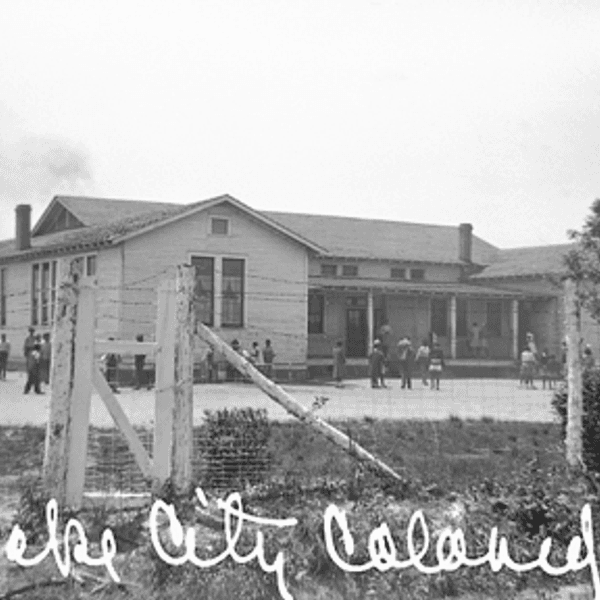
The building that we are standing in front of for this tour is currently known as the Lifelong Learning Center. However, before it was known as the Life Long Learning Center, it was the original site of the Lake City Colored Elementary and High School which served black students from the early 1930s to 1946. On August 4, 1929, the Florence Morning News, reported that bids were being taken to construct the Lake City High School Building which would be a “frame school building, built under the Rosenwald plan No. 6-A,” which included six rooms and an auditorium. “No plumbing or heating or boiler room, but” was to “be wired” and have “two six-hole sanitary privies built.” The building and materials had to conform to the Rosenwald plan and subject to their inspection and approval. This building would serve Lake City black students until it was destroyed by a fire in October of 1946. Because the school was outside of the city limits, and far from a hydrant, the Lake City Fire Department stood by as a precaution to other property but did not render any aid. The superintendent of Lake City Schools, J. Paul Truluck, claimed that the contents of the building that were lost was at least $30,000, but further investigation was needed to assess the total amount of damage.
According to Lake City historian, Kent Daniels, Lake City Colored Elementary and High School, was rebuilt on top of the original location and continued to serve Black students in the community until 1953, when Carver High School was built on Carver Street. Despite Lake City Colored Elementary and High School having served Black students for decades, it began to have difficulty accommodating so many students.
Carver High School would be built to help with such growth and was in response to SC Governor Byrnes’ “Equalization Program.” The equalization school program was intended to construct new black elementary and high schools across SC to circumvent a potential desegregation ruling by the US Supreme Court. The state of South Carolina would pass a $75,000.00 bond to equalize schools in South Carolina and Carver High School was built from these bonds as Lake City’s effort to equalize their white and Black schools. In response to SC’s Equalization of Schools Program, a lawsuit would be filed in neighboring Clarendon County under the name Briggs v. Elliott in 1950 which would challenge the constitutionality of “separate but equal” laws in education. A few months after Carver would open, the Supreme Court would make its ruling in May of 1954 that “Separate but Equal” was unconstitutional.
It is important to note that the current site that we are standing at is not the location of Carver High but can easily be found as today’s “McNair Middle School” off of Carver Street and Moore Streets. Carver High School would house grades ninth through twelfth and years later, the sixth, seventh, and eighth grades would be added to relieve the volume of students at the Lake City Colored Elementary School off of Graham Road. Carver High School, as it would become, was named for George Washington Carver, who was born into slavery. He became a world-renowned Agricultural Chemist, a humanitarian, and was one of the world’s most famous inventors. Hence, the very reason that the school was named in his honor. His photograph graced the wall of the school as a constant source of pride, inspiration and motivation.
One of the most notable alumni of Carver High School, and who is another prominent stop along this tour, is NASA astronaut and physicist, Ronald McNair, who died during the 1986 launch of the Challenger Mission. He graduated as valedictorian of Carver High School in 1967 and the school would later be renamed Ronald E. McNair High School in the 1980s, later McNair Middle School.

