Joseph Kamaru (KMRU): »falling dreams« [Soundspot]

1 sound

"[DE] Das Stück »falling dreams« von KMRU ist eine Langformkomposition, die unterschwellige Zustände von Klängen erforscht und Träume hörbar wieder ins Bewusstsein hinaufbeschwört. Mit nur einem Instrument hebt und senkt sich das Stück in einer nicht enden wollenden Abwärtsbewegung ... a falling dream.

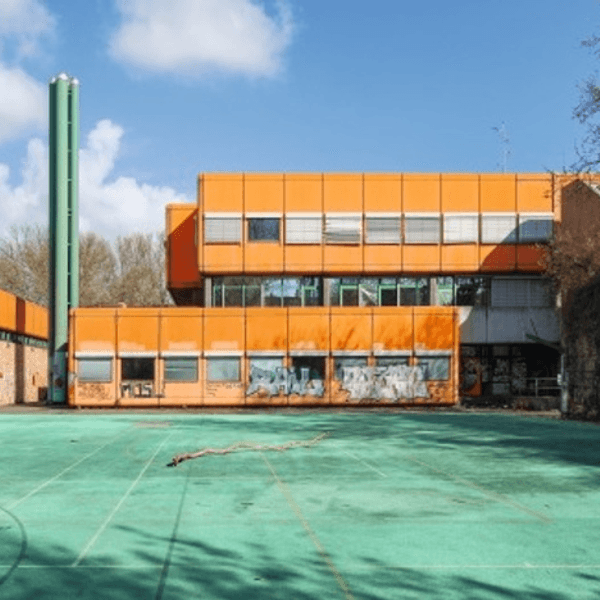
Hier stehen Sie nun von dem einstigen Oberstufenzentrum im ehemaligen West-Berlin in unmittelbarer Nähe zur Mauer, das damals einer Idee eines reformierten Schulwesens entsprechen sollte: Bildung für alle und mehr Chancengleichheit.

Der strukturalistische, modular aufgebaute Stahlskelettbau ist unverkennbar ein Kind seiner Zeit: die abgerundeten Fassadenpanele in Orange, die Rohre und Rahmen in Grün, die freistehenden Treppenhäuser, die geriffelten Betonwände, das Holzpflaster; ein nicht von allen geliebter, aber doch beredter Zeuge der Schularchitektur der siebziger Jahre. Es war das erste Oberstufenzentrum Berlins, und es ist eines der letzten, das noch steht; die anderen wurden wegen Asbestverseuchung abgerissen.

Dass dieses Areal noch nicht von privaten Investoren übernommen wurde, könnte man als eine späte Konsequenz der Kahlschlagsanierung in Berlin (West) bezeichnen: Ab 1961 wurden im Brunnenviertel, das dreiseitig von der Berliner Mauer umschlossen war, von knapp 15.000 Altbauwohnungen 9.000 beseitigt und das Gebiet durch spätmodernen Wohnungsbau und den Umbau der Swinemünder Straße zur Fußgängerzone in eine vorstädtische Siedlung verwandelt. Für die Gentrifizierung, wie sie in den angrenzenden Vierteln nach 1989 stattfand, war dieser Bestand bislang nicht attraktiv genug. Kulturelle und soziale Einrichtungen fehlen bis heute.


[EN] The composition ""falling dreams"" by KMRU is a listening invocation of dreams, a long-form composition exploring subliminal states of sounds. Using only one instrument, the piece ebbs and flows in an unending fall.. a falling dream.

Here you are now in front of the abandoned senior high school center in former West-Berlin in direct vicinity of the Berlin Wall that was once supposed to correspond to an idea of a reformed school system: Education for all and more equal opportunities.

The structuralist, modular steel skeleton building is unmistakably a child of its time: the rounded facade panels in orange, the pipes and frames in green, the free-standing staircases, the fluted concrete walls, the wooden paving; an eloquent witness to the school architecture of the seventies, though not loved by everyone. It was the first senior high school center in Berlin, and it is one of the last ones still standing; the others were demolished because of asbestos contamination. The fact that this area has not yet been taken over by private investors could be described as a late consequence of the clear-cut redevelopment in (West-)Berlin: Starting in 1961, 9,000 of nearly 15,000 old apartments in the ""Brunnenviertel,"" which was enclosed on three sides by the Berlin Wall, were demolished and the area was transformed into a suburban settlement through late-modern housing construction and the conversion of Swinemünder Strasse into a pedestrian zone. This stock has not been attractive enough for the gentrification that took place in the adjacent neighborhoods after 1989. Cultural and social facilities are still lacking today.

Joseph Kamaru (KMRU) is a field and sound artist, producer based in Nairobi, notable for his evocative electronic music. His works inject a dose of experimentation, using everything from gritty indigenous sounds to field recordings. Currently he is developing artistic based projects on radio art and artificial intelligence."


Part of this walk

Sound Walk Berlin | field notes

Sound Walk Berlin | field notes

Berlin
Hier geht es zum Download der DRIFTER App mit dem Sound Walk Berlin: (https://www.poligonal.de/drifter/ev296v9bdwJd85h7/) \[DE] Was macht die Stadt mit der Musik und umgekehrt die Musik mit ihr? Mit dem Sound Walk Berlin möchte die inm / field notes die Debatte über die soziale und politische Bedeutung der Musik im urbanen Raum und ihre Repräsentanz in der Stadt vertiefen, wobei auch der Klang der Stadt selbst in den Blick genommen wird. Mit dem Sound Walk Berlin erobert die zeitgenössische Musikszene den Stadtraum und macht die Straßen Berlins zur Bühne. Künstlerinnen, Ensembles und Bühnen der zeitgenössischen Musik haben für den Sound Walk diverse Orte in Berlin klanglich erweitert oder neu definiert. Die Sound- und Musikbeiträge interagieren mit den urbanen Klängen des Ortes aus Verkehr, Stimmen, Spielplätzen, U-Bahn und Baustellen und kommentieren dessen architektonische Beschaffenheit, Geschichte und Umgebung. Der Sound Walk Berlin lädt Bewohnerinnen und Besucherinnen dazu ein, die Stadt aus Perspektive der Künstlerinnen zu erfahren. Die persönlichen Hörerlebnisse sensibilisieren für den individuellen Klang unserer Wohn- und Lebensräume, schärfen den Blick bzw. das Gehör für die Verbindung von Klang und Stadt und regen vielfältige Diskussionen über den Klang der Stadt und zu Räumen für Musik an. Bei den Spaziergängen kann im selben Zug die Stadt und die zeitgenössische Musikszene (neu) entdeckt werden. Die inm – initiative neue musik berlin e.V. bündelt und vertritt als Dachverband der freien Szene der neuen Musik die Interessen der Akteur\*innen der Berliner Szene gegenüber Politik und Verwaltung. Sie ist als Sprachrohr und Partnerin im Dialog etabliert und als Förderinstitution ein wichtiger Bestandteil der Berliner Kulturlandschaft. Das field notes Programm ist seit 2016 die zentrale Informations- und Beratungsstelle für die zeitgenössische Musikszene Berlins der inm – initiative neue musik berlin e.V. Mit seinem breit aufgestellten Informationsangebot aus online Plattform www.field-notes.berlin und dem field notes Printmagazin trägt es zur Stärkung der Sichtbarkeit der zeitgenössischen Musik im Berliner Kulturleben bei. Zur Professionalisierung der Szene bietet das field notes Programm kostenfreie Beratungen, Workshops und Informationsveranstaltungen zu Fragen rund um die Arbeit in der Freien Szene an. Mit einer jährlichen Konferenz zur zeitgenössischen Musik im globalen Kontext regt es außerdem zur Reflexion über die Rolle der zeitgenössischen Musik in der heutigen Gesellschaft an und vernetzt Berliner Akteur\*innen mit einem Internationalen Fachpublikum. Als Querschnittsthema setzt sich das Programm bei all seinen Aktivitäten zum Ziel, die gesellschaftliche Vielfalt stärker im Programm, Personal, Publikum und bei den Partnern abzubilden und (strukturelle) Diskriminierung abzubauen. \[EN] What is the relationship between music and place? With the Sound Walk Berlin, inm / field notes aims to deepen the debate surrounding the social and political significance of music in urban space and its representation, while also observing the sound of the city itself. With the Sound Walk Berlin, the contemporary music scene is reclaiming its urban space and turning the streets of Berlin into a stage! Artists, ensembles and venues of the contemporary music scene expanded or redefined various places in Berlin in terms of sound. Sound and music interact with the existing urban sounds of a place (such as traffic, voices, playgrounds, subway and construction sites) or comment on its architecture, history and surroundings. With the Sound Walk Berlin, residents and visitors can experience the city from the perspective of the artists. These personal listening experiences sensitise the listener to the unique sounds of our living spaces, and to the connection between sound and city, and thus stimulate diverse discussions about the relationship between sounds of the city and spaces for music. On the walks, both the city and the contemporary music scene can be (re)discovered. The inm is an association of musicians, ensembles, composers, musicologists, cultural managers, and organizers who are active in the field of contemporary music. An aesthetically and structurally open institution, its main effort is to secure and improve the working and production conditions for New Music. field notes is a central resource of information and mentoring for the contemporary music scenes in Berlin provided by inm – the initiative neue musik berlin e.V. Its goals are to strengthen and improve production conditions for the independent contemporary music scenes in Berlin, and to raise public awareness of social relevance of the art form. By connecting and catalysing the rich potential of Berlin's contemporary music scene, field notes actively raises general interest in new music. It gathers information on events and developments in the contemporary music scene and presents them online at www.field-notes.berlin and in the bimonthly field notes magazine. Each year in September, the Month of Contemporary Music promotes current works by Berlin ensembles, artists and composers, in established concert halls as well as in independent venues. The festival’s focus is on today's music and attracting new audiences. To strengthen the scene itself, field notes offers free consultations, workshops and events. With an annual conference on contemporary music in a global context, it also encourages reflection on the role of contemporary music in today's society and connects Berlin-based actors with an international audience of experts. As a cross-cutting theme, the programme aims in all its activities to reflect social diversity in the programme, staff, audience and partners and to reduce (structural) discrimination.
free

Privacy & cookie policy / Terms and conditions

© ECHOES. All rights reserved / ECHOES.XYZ Limited is a company registered in England and Wales, Registered office at Merston Common Cottage, Merston, Chichester, West Sussex, PO20 1BE

v2.5.15 © ECHOES. All rights reserved.