Morning Drop Off (1:08)
1 sound
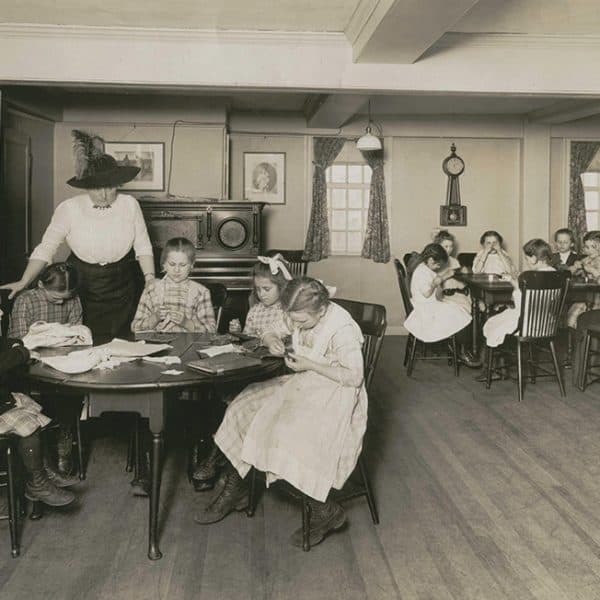
The following text box contains a series of excerpts (in quotations) from Caroline Emmerton: An Unbounded Vision by David Moffat, published by the House of the Seven Gables Settlement Association in 2016, with an addendum at the end by Kristin Harris (available in the Gift Shop at the House of the Seven Gables): According to local author David Moffat, “the first settlement house was founded in London in 1884. The American settlement house movement developed directly from the establishment of Toynbee Hall in London. In 1886 the first American settlement house-- The Neighborhood Guild-- opened on the Lower East Side of Manhattan. The Neighborhood Guild adopted the British model to have middle class social workers “settle” among the urban poor, learn about the effects of poverty, and provide services in response to their findings.” Other such settlement houses popped up all over urban cities in America, including the famous Hull House, started by Jane Addams and Ellen Gates Starr in Chicago in 1889. Moffat states that “by 1890, four years after the establishment of The Neighborhood Guild, there were 400 settlement houses in the United States. [...] In Salem, Massachusetts, the growth of textile manufacturing and the leather industry attracted waves of immigrants. Though not a large urban center, the need for a settlement house existed. [...]” Caroline Emmerton, whose family had been active in various public circles was on the committee for establishing a settlement house in Salem, and was successful in acquiring the Turner-Ingersoll mansion, now the House of the Seven Gables, and according to Moffat, “The House of the Seven Gables Settlement expanded its services after the restoration of the Turner-Ingersoll Mansion was completed in 1910. Settlement residents, the people who worked for the organization, lived on the second floor of the house. A kindergarten, part of an early slate of programs, evolved into a summer school. Offerings from 1915-1916 included gymnastics, bead-work, knitting, embroidery, basketry, woodworking, and gardening. Arts opportunities included dramatics clubs, a brass band, a stringed orchestra, a girls’ choir, and violin instruction.” While the settlement house movement aimed to use philanthropic ideals to aid immigrant communities, it should be noted also that the main goal was to “Americanize” immigrants to assimilate into our cultural practices and societal expectations, especially in major cities, which is why a majority of settlement houses ended up centering in New York, Chicago, and Boston. Settlement workers were very aware that by teaching certain skills and arts, they were creating an “ideal” immigrant in the vision of white Yankee culture. You can read more about Caroline Emmerton’s work in Moffatt’s book, as well as in several other selections available at the House of the Seven Gables gift shop, or by visiting their website. https://7gables.org

