Section 1: The Machair & Beach
1 sound
Orasaigh I
From the midsummer height of Càireasbhal, looking west over causewayed Dùn na Cille,
the sun has lit the townlands in the Gulf Stream’s evening zephyr.
In the pellucid ocean light, under the troposphere’s
argentine blue, everything comes into HD focus:
the blackland’s dikes and rickety fences,
rush-fledged forage of tussock and rock,
fleece-shedding sheep and rough, red-pelted shorthorns;
Boisdale’s straggle of crofts and cottages,
Nissen huts, tractors, jacked-up transits;
and the tracks beyond through the plain of barley,
to the sugar-sand crescent of Orasaigh Bagh.
Orasaigh, the double-humped tidal island
on the beach off the edge of the Boisdale machair,
still moored to her mother by the sand umbilicus
she fashions herself from the silts of the longshore drift.
She rises on her strand like a sagging frame tent,
Or the sunken withers of a sea-ware pony,
two shaggy rorquals, breaking the swell
from the Sound of Barra, frozen on the curve
towards Hirte and the Greenland seas.
The beach-stripping blitzkrieg of winter storms
and the rising tides of the gnawing Atlantic
have frayed, but not in centuries severed,
her squat tombolo’s hawser. She will not let go
of the land that birthed her and to which she still belongs.
Orasaigh II
I walk the track from Leth Meadhanachto the crossroads with the faded road
that runs from Pol a' Charra to the Ford.
A quarter-mile strip of rough and tumble grazing:
horsetails, juncus, clumps of yellow flag,
rocks breaching the turf like the hulks
of fossilised right whales. The isle lies flat
on the low horizon, crushed under the dome
of the huge Atlantic sky. Each crunching stride-length
lifts it taller, on the western skyline, the vistas
of my mind. I lift the loop on the five-bar gate
and pass between derelict lazybeds and a stand
of thin phragmites. Sheep scatter from the fences
at my bootscrapes. Greylags up their periscopes.
Redshank yammer from the trackside posts
and switchback lapwings puit and dive—a motorhome
rumbles down the track to the barbecue pits
and picnic tables of the Geàrraidh na Mònadh campsite.
Settling dust, crushed stone diminuendo:
corncrakes shorting from the eight-inch grass
under tremolo columns of larks;
ululating snipe traverse the argentinian blue.
The crossroads mark the blackland’s end
and the start of a furlong of sandy machair,
the ever-unravelling remnant of the miles-wide
Bronze Age plain. I set a course across the headlands,
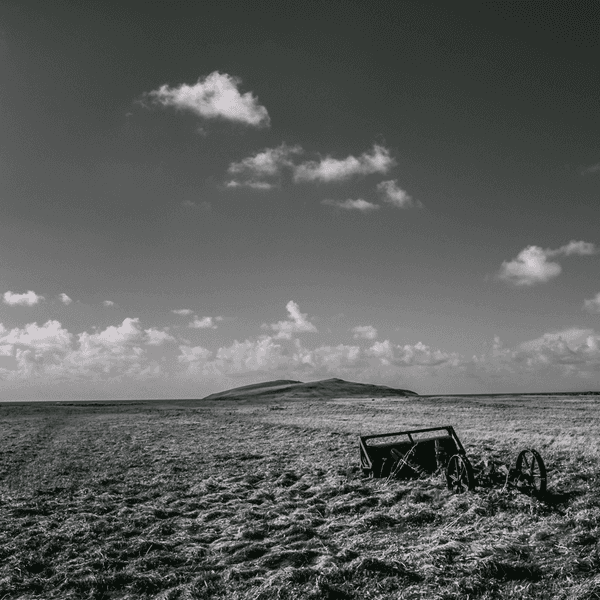
between rusty ploughs and abandoned rollers,
sunk axle-deep in the blown sand’s sod.
The patchwork of barley and needlework fallow
lays down its quilt before me, washed green silks
with crimson crewellings, stitched with cobalt,
silver and gold— orchids and cornflowers,
birds-foot trefoil, daisies, clover, corn marigold.
The scuts of conies vanish down sand-chutes
and dunlin drag disingenuous broken wings.
Quail crawl through the bent like whistling field mice.
From halfway across the machair—between the abandoned
burial ground and the gutted net station—
the island rises from the swell like Surt.
I can feel the shush and thump of ocean,
breathe the beach’s warm kelp breeze.
Patrolling herring gulls monitor my approach
and gannets plunge from the sky’s high tower—
then the wind’s in my face on the low dunes’ ridge,
and there, beyond the precarious, hop-across causeway,
the storm-ripped ruin of An Doirlinn and the crab boats’
wedge of white van landing—twin-papped, raven-crested
Orasaigh stands on its strand before me.
An Doirlinn IV
Surf breaks on Tràigh na Doirlinn and rushes up the beachface. Clockwork sanderling
switchback in the swash-zone like speeded up footage
from a silent film, picking tiny titbits
from the foam. They’re fuelling up for Iceland
and Franz Josef Land beyond, the ever-receding
Arctic edge of the Holocene interglacial.
A whippet flies in and the sanderling lift and scatter,
flashing twittering chevrons down the beach
towards the headland at Cille Pheadair.
Uprush wipes their footprints’ blurred cuneiform.
How many billion sanderling have stopped-off here,
since ice-melt stretched the north from Spain?
Where are their embalmed, mummified corpses,
their stelae in the foam’s wet sand?
Scorpion left his mark: his skull-crushing mace
and gibbet of lapwings. Gilgamesh cleared
the sacred groves from ocean to Euphrates.
He slew the lion, glorying in life, hyena,
stag and panther. All manner of small game.
He butchered the mighty Bull of Heaven
and fed its heart to Shamash. His swastika
wheels from Göbekli Tepe to the trenches
of the western ocean, its cargo of infinite dead.
A Sailor of the 1939-1945 War,
Merchant Navy. Buried 21st August, 1940.
The pharaohs of Cluny, Westminster, Wannsee.
The dead go into the Sun. Ice-melt washes
their genocides clean. Atlantic ripping away.

