Orasaigh

5 ECHOES

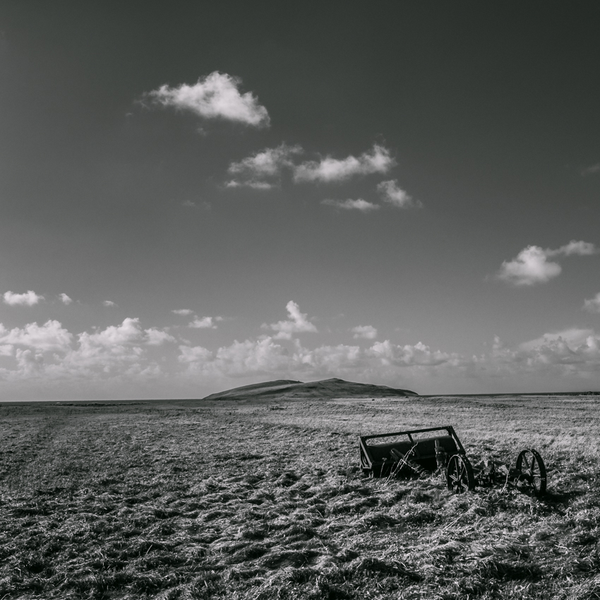
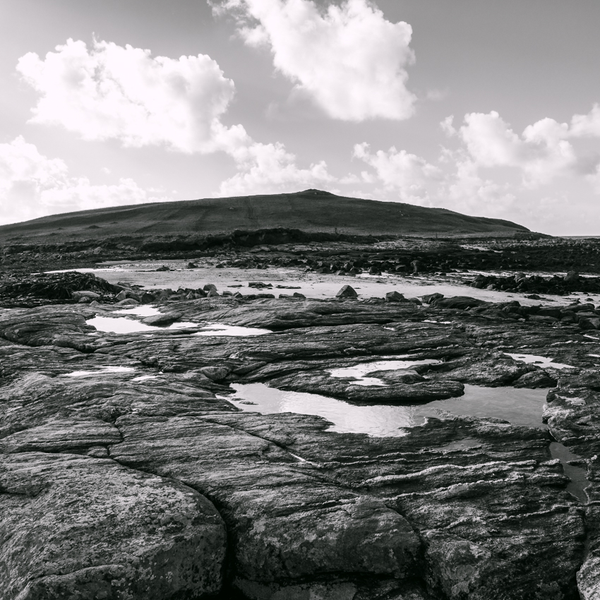
Orasaigh is a geolocative acousmatic soundwalk composition that was developed in 2023 as part of the exhibition 'Orasaigh', a collaboration between poet Steve Ely, photographer Michael Faint, and composer Duncan MacLeod. Commissioned by Taigh Chearsabhagh Museum and Arts Centre, the project draws upon the landscape around the tidal island of Orasaigh, located on the coast of South Uist at Boisdale.

Ely’s visionary poem, whilst always remaining anchored in the island, roams widely, exploring a range of themes related to Uist and the wider world – sea level rise, the crisis of the ‘sixth extinction’, history, culture, politics, conflict and class. Faint and MacLeod vividly capture the spirit of the place through their respective mediums, creating an independent yet complementary subjectivity.

As with Ely’s poem, the soundwalk is rooted in the landscape through the presence of soundscape compositions, utilising immersive field recordings captured on location. Elsewhere, material for bass clarinet and highland bagpipes, along with creative reimagining of archival sound recordings from Uist, draws upon the Isles' rich musical heritage through Gaelic song and pibroch (an art music genre associated with the great Highland Bagpipe).

The work of the three artists combines and interacts to produce a uniquely evocative response to a rich and resonant landscape that affirms the vitality and resilience of the human spirit. The island itself becomes a dual symbol of precarity and hope in the crisis of the Anthropocene.

Poem: Steve Ely
Narration: Steve Ely
Music & Soundscape compositions: Duncan MacLeod
Bass Clarinet: Charlotte Jolly
Environmental field recordings: Juraj Fajnor & Duncan MacLeod
Commissioned by Taigh Chearsabhagh Museum & Arts Centre, with funds from the Arts and Humanities Research Council

Section 1: The Machair & Beach

Orasaigh I

 From the midsummer height of Càireasbhal, 

looking west over causewayed Dùn na Cille, the sun has lit the townlands in the Gulf Stream’s evening zephyr. In the pellucid ocean light, under the troposphere’s argentine blue, everything comes into HD focus: the blackland’s dikes and rickety fences, rush-fledged forage of tussock and rock, fleece-shedding sheep and rough, red-pelted shorthorns; Boisdale’s straggle of crofts and cottages, Nissen huts, tractors, jacked-up transits; and the tracks beyond through the plain of barley, to the sugar-sand crescent of Orasaigh Bagh. Orasaigh, the double-humped tidal island on the beach off the edge of the Boisdale machair, still moored to her mother by the sand umbilicus she fashions herself from the silts of the longshore drift.
She rises on her strand like a sagging frame tent, Or the sunken withers of a sea-ware pony, two shaggy rorquals, breaking the swell from the Sound of Barra, frozen on the curve towards Hirte and the Greenland seas.
The beach-stripping blitzkrieg of winter storms and the rising tides of the gnawing Atlantic have frayed, but not in centuries severed, her squat tombolo’s hawser. She will not let go of the land that birthed her and to which she still belongs.

Orasaigh II

 I walk the track from Leth Meadhanach

to the crossroads with the faded road that runs from Pol a' Charra to the Ford.
A quarter-mile strip of rough and tumble grazing: horsetails, juncus, clumps of yellow flag, rocks breaching the turf like the hulks of fossilised right whales. The isle lies flat on the low horizon, crushed under the dome of the huge Atlantic sky. Each crunching stride-length lifts it taller, on the western skyline, the vistas of my mind. I lift the loop on the five-bar gate and pass between derelict lazybeds and a stand of thin phragmites. Sheep scatter from the fences at my bootscrapes. Greylags up their periscopes.
Redshank yammer from the trackside posts and switchback lapwings puit and dive—a motorhome rumbles down the track to the barbecue pits and picnic tables of the Geàrraidh na Mònadh campsite. Settling dust, crushed stone diminuendo: corncrakes shorting from the eight-inch grass under tremolo columns of larks; ululating snipe traverse the argentinian blue.
The crossroads mark the blackland’s end and the start of a furlong of sandy machair, the ever-unravelling remnant of the miles-wide Bronze Age plain. I set a course across the headlands, between rusty ploughs and abandoned rollers, sunk axle-deep in the blown sand’s sod.
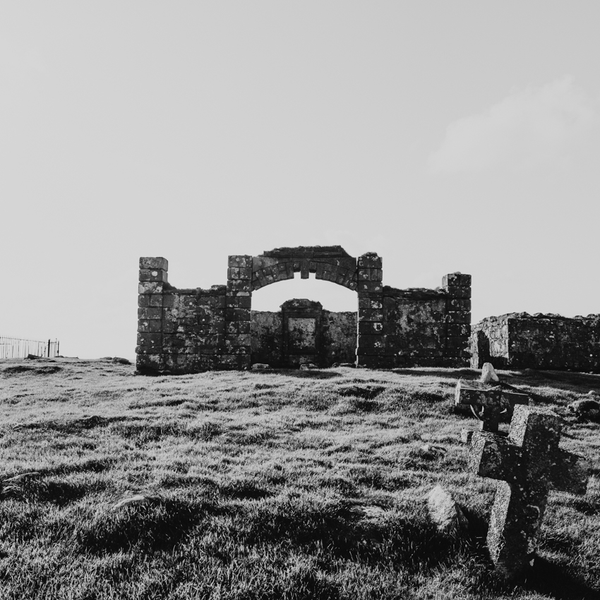
The patchwork of barley and needlework fallow lays down its quilt before me, washed green silks with crimson crewellings, stitched with cobalt, silver and gold— orchids and cornflowers, birds-foot trefoil, daisies, clover, corn marigold. The scuts of conies vanish down sand-chutes and dunlin drag disingenuous broken wings. Quail crawl through the bent like whistling field mice. From halfway across the machair—between the abandoned burial ground and the gutted net station— the island rises from the swell like Surt.
I can feel the shush and thump of ocean, breathe the beach’s warm kelp breeze.
Patrolling herring gulls monitor my approach and gannets plunge from the sky’s high tower—
then the wind’s in my face on the low dunes’ ridge, and there, beyond the precarious, hop-across causeway, the storm-ripped ruin of An Doirlinn and the crab boats’ wedge of white van landing—twin-papped, raven-crested Orasaigh stands on its strand before me.

An Doirlinn IV

 Surf breaks on Tràigh na Doirlinn and rushes 

up the beachface. Clockwork sanderling
switchback in the swash-zone like speeded up footage from a silent film, picking tiny titbits from the foam. They’re fuelling up for Iceland and Franz Josef Land beyond, the ever-receding Arctic edge of the Holocene interglacial.
A whippet flies in and the sanderling lift and scatter, flashing twittering chevrons down the beach towards the headland at Cille Pheadair.
Uprush wipes their footprints’ blurred cuneiform.
How many billion sanderling have stopped-off here, since ice-melt stretched the north from Spain? Where are their embalmed, mummified corpses, their stelae in the foam’s wet sand?
Scorpion left his mark: his skull-crushing mace and gibbet of lapwings. Gilgamesh cleared the sacred groves from ocean to Euphrates.
He slew the lion, glorying in life, hyena, stag and panther. All manner of small game. He butchered the mighty Bull of Heaven and fed its heart to Shamash. His swastika wheels from Göbekli Tepe to the trenches of the western ocean, its cargo of infinite dead.
A Sailor of the 1939-1945 War, Merchant Navy. Buried 21st August, 1940.
The pharaohs of Cluny, Westminster, Wannsee.
The dead go into the Sun. Ice-melt washes their genocides clean. Atlantic ripping away.
Section 2: Across the causeway

Orasaigh III

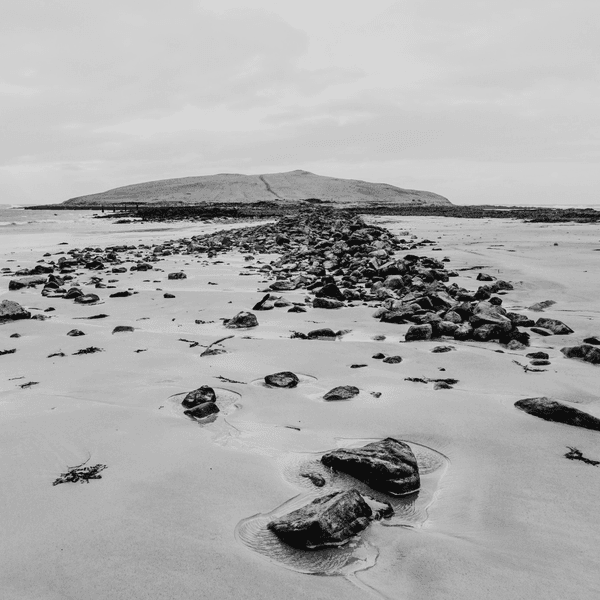
 Low tide. I pick my way between wrack-matted boulders

and banks of rotting kelp to the storm-gouged gate to the island. Turf sags above the sand-cliff, the edge of collapse. A brace of shelduck bob out on the heave, ducklings strung like rosary beads between them. Weather-wrecked stump posts, damp plateau of cotton-grass, silverweed, bent. Corncrake crexing from the iris beds, scissor-billed oystercatchers bombing and screaming.
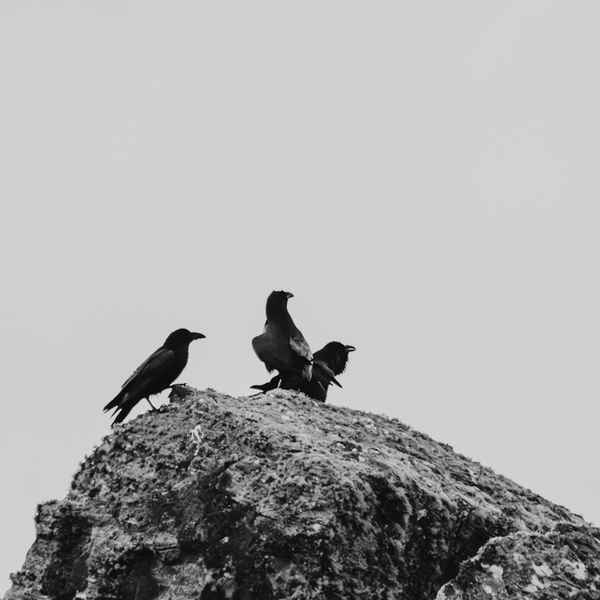
Neolithic, Bronze Age or Pictish stones rise from the turf like curious seals and note my bold approach. I climb the slope to the Big Top summit in the stripes of the evening sun’s relief: sheep paths, turf-sunk boundary walls, run-rig shadows of long-abandoned plough. Great black-backed gulls and ravens, circling overhead; one predatory, the other wary. Cronk. Twin peaks, a rushy cleft between. Exposed gneiss, a tumbled fank (or dun, or bothy). Each peak is crowned by a wild-stone menhir: to the south a summit-slipped altar stone reclines on the wind-cropped turf;
the dorsal fin of a great white shark breaks the moat of the north peak’s sacred pool— agitated pipits, windy crescendos of towering larks.
The high ground’s wide panopticon—due west, four thousand miles of ocean, the calves of Saglek Bay.
To the east, the cloud-capped, herded hills of Stùlabhal, Easabhal, Chionnich.
The toytown townlands spread before me along the Viking shore—Cille Pheadair, Baghasdail, Leth Meadhanach, Smercleit, Geàrraidh na Mònadh; white horses of Eriskay, blue hills of Barra beyond. The back of the island slopes down to its hunkered cliffs.
Wave-hewn riprap, tide-heaved tethers of kelp.
Great northern divers ride the waves, on their summer cruise to Iceland. Cormorants, mocking the crucifixion.
On the topmost ledge of a storm-gouged cove, a shit-fligged heap of kelp; a family of ravens, aloft above the menhirs. Fulmars cut the sunlit slope’s bright spindrift—one summer I fell asleep here, and had to wade to land: otter breaking from its flounder, disbelieving. I drop to the path above the rocks looking north along Tràigh na Doirlinn. Jewels glinting in the grass: primrose, violet, tormentil.
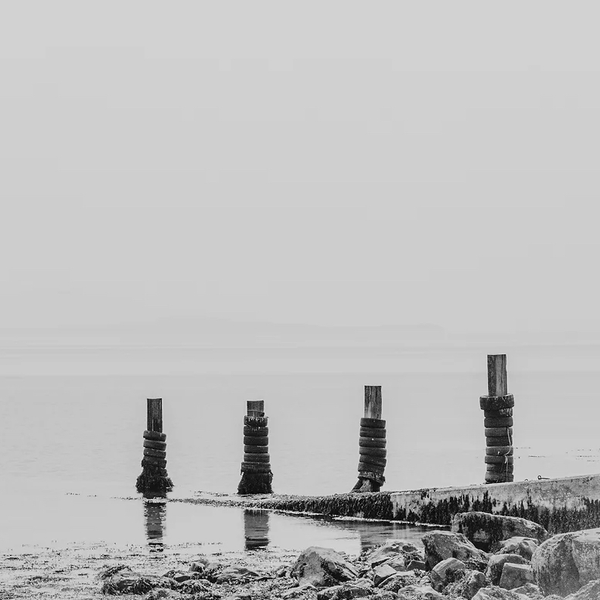
Sentinel oystercatchers, incessant and ubiquitous, their piping alarums ripped off on incessant, ubiquitous wind. Crab boat anchored in the headland’s lee, where the Northmen dragged their longboats up on to the sandy haven. Ringed plover tight on the driftwood strandline. Wind-wrecked fence post.
Turf sags above the sand-cliff. I pick my way between wrack-matted boulders and banks of rotting kelp to the storm-gouged gate to the island.

Section 3: The Island loop

Section 4: Return across the causeway

Section 5: Return back to the burial ground

The Burial Ground

DOWNLOAD OUR APP TO DISCOVER THIS TOUR AND MANY OTHERS.

play-storeapp-store

Or start creating tours, treasure hunts, POI maps... Just let your imagination guide you.


Other walks nearby


Are you a creator?

START HERE

Privacy & cookie policy / Terms and conditions

© ECHOES. All rights reserved / ECHOES.XYZ Limited is a company registered in England and Wales, Registered office at Merston Common Cottage, Merston, Chichester, West Sussex, PO20 1BE

v2.5.11 © ECHOES. All rights reserved.