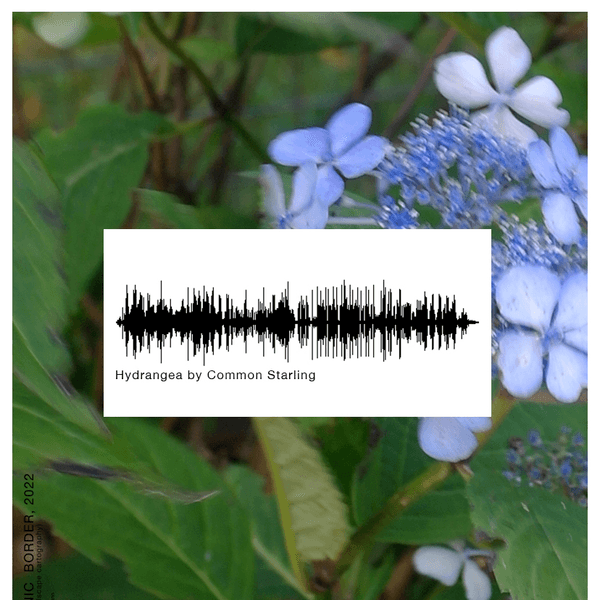
Hydrangea by Common Starling
1 sound
Hydrangea (serrata) Native name: Ajisai Native to Japan, China and Korea.
Alternate name for some varieties in Japan (H. macrophylla and H. serrata) – Nanahenge meaning ‘seven transformations’. This is due to the properties of some species which change colour according to the soil conditions. Acidic soil produces more blue flowers, alkaline soil more red or pink. This deciduous flowering shrub is happy in sun or part shade.
The first varieties were brought to Europe in the 18th Century. Samples were difficult to move (smuggle) out of secure Japanese conditions. Carl Peter Thunberg is credited as taking back the first plants which have been cultivated in Japan since the 8th century.
Other hydrangea species, such as H. arborescens and H. quercifolia originate from North America.
Toxic: to people, cats and dogs.
Common Starling (Stumus vulgaris)
The Starlings is one of most familiar and widely birds. It is at home in towns, gardens and the wider countryside, and yet the numbers of this highly adaptable species have declined over the two decades.
The resident breeding population is augmented in winter by immigrants from northwest continental Europe, the arrival of which can present a moving sight to watchers on the east coast of Britain in late October and early November. Once here, their aerial manoeuvres as they prepare to alight in their night roost present one of the most exciting spectacles of ornithology.
In addition to this natural range, Starlings have become successfully established, after introduction by Man, in southern Australia, New Zealand, South Africa and North America.
In summer, adults tend to remain near their breeding areas, but large flocks of juveniles are found feeding on coastal salt marshes, moorland and in cherry orchards, suggesting a divergence in the habitants used by adults and young at this time of year.

