Robin Hayward: »Stop Time« [Soundspot]

1 sound

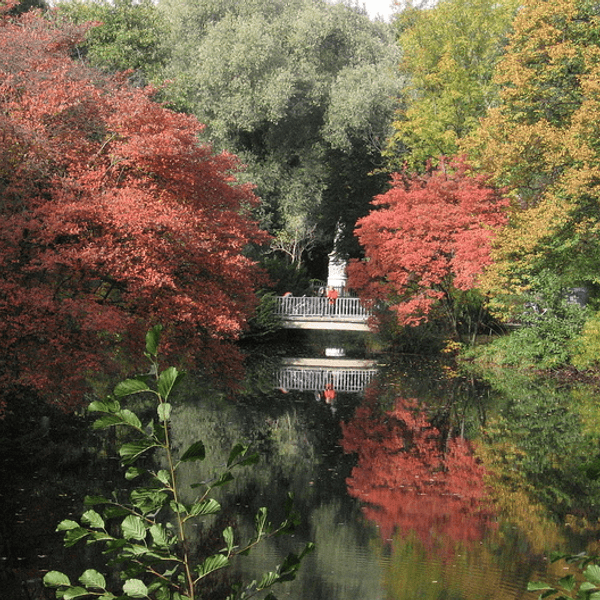
"[DE] Die Luiseninsel befindet sich auf dem Areal des Schloss Charlottenburg zwischen dem Mausoleum und dem großen Wasserbecken. Der landschaftliche Ausbau wurde 1799 von König Friedrich Wilhelm III. in Auftrag gegeben. Königin Luise soll gerne auf einer einfachen Bank auf der Südspitze der Insel gesessen haben. An der Stelle steht auch heute noch eine schlichte Holzbank.

Dort lädt Robin Hayward dazu ein, Platz zu nehmen und sein Stück »Stop Time« zu hören. Dieses bietet ebenso wie dieser friedliche Ort eine Zuflucht vor dem geschäftigen Stadtleben. Das Stück erforscht den harmonischen Raum, parallel zur Erkundung des physischen Raums durch die Klangspaziergänge des Sound Walk Berlin.

»Stop Time« wurde für das gleichnamige Festival in Leuven 2013 in Auftrag gegeben. Es ist das erste Stück, das einen Teil des dreidimensionalen physischen Prototyps der »Hayward Tuning Vine « als Partitur verwendet. Vier Würfel des harmonischen Raums innerhalb des Tuning Vines werden von den akustischen Instrumenten erkundet und dann aus den Richtungen rund um den Aufführungsraum wiedergegeben, die den harmonischen Positionen innerhalb des Systems entsprechen. Der harmonische Raum wird auf den physischen Raum projiziert, wodurch die Zeit angehalten wird.

Der Tubist und Komponist Robin Hayward wurde 1969 in Brighton/England geboren und lebt seit 1998 in Berlin. In seinem Schaffen hat er radikale Innovationen im Bereich der Spieltechniken von Blechblasinstrumenten eingeleitet, zuerst durch die Entdeckung des „Geräusch-Ventils“ und später durch die Entwicklung der ersten völlig mikrotonalen Tuba im Jahr 2009. 2012 erfand er das Hayward Tuning Vine, welches ursprünglich aus dem Wunsch resultierte, den in der mikrotonalen Tuba enthaltenen harmonischen Raum darzustellen. 2005 gründete er das Ensemble Zinc & Copper, um die Möglichkeiten von Blechblasinstrumenten aus der Perspektive der experimentellen Musik zu erforschen.


[EN]

Luiseninsel is located on the grounds of Schloss Charlottenburg between the mausoleum and the large water basin. The landscaped development was commissioned by King Frederick William III in 1799. Queen Luise is said to have enjoyed sitting on a simple bench on the southern tip of the island. A plain wooden bench still stands on the spot today. There Robin Hayward invites you to take a seat and listen to his piece ""Stop Time"".

Both the place and ""Stop Time"" by Robin Hayward offer a refuge from busy city life through their peaceful atmospheres. The piece explores harmonic space, in parallel to the exploration of physical space through the Sound Walk Berlin.

»Stop Time« was commissioned for a festival of the same name taking place in Leuven in 2013. It is the first piece to use a subset of the three-dimensional physical prototype of the Hayward Tuning Vine as a musical score. Four cubes of harmonic space within the tuning vine are explored by the acoustic instruments, and then played back from directions around the performance area corresponding to their harmonic positions within the vine. Harmonic space is projected onto physical space, thus 'stopping time’.

The tuba player and composer Robin Hayward, born in Brighton, England in 1969, has been based in Berlin since 1998. He has introduced revolutionary playing techniques to brass instruments, initially through the discovery of the ‘noise-valve’, and later through the development of the first fully microtonal tuba in 2009. In 2012 he invented the Hayward Tuning Vine, partly as a visualization of the harmonic space implicit within the microtonal tuba. In 2005 he founded the ensemble Zinc & Copper to explore brass chamber music from an experimental music perspective."


Part of this walk

Sound Walk Berlin | field notes

Sound Walk Berlin | field notes

Berlin
Hier geht es zum Download der DRIFTER App mit dem Sound Walk Berlin: (https://www.poligonal.de/drifter/ev296v9bdwJd85h7/) \[DE] Was macht die Stadt mit der Musik und umgekehrt die Musik mit ihr? Mit dem Sound Walk Berlin möchte die inm / field notes die Debatte über die soziale und politische Bedeutung der Musik im urbanen Raum und ihre Repräsentanz in der Stadt vertiefen, wobei auch der Klang der Stadt selbst in den Blick genommen wird. Mit dem Sound Walk Berlin erobert die zeitgenössische Musikszene den Stadtraum und macht die Straßen Berlins zur Bühne. Künstlerinnen, Ensembles und Bühnen der zeitgenössischen Musik haben für den Sound Walk diverse Orte in Berlin klanglich erweitert oder neu definiert. Die Sound- und Musikbeiträge interagieren mit den urbanen Klängen des Ortes aus Verkehr, Stimmen, Spielplätzen, U-Bahn und Baustellen und kommentieren dessen architektonische Beschaffenheit, Geschichte und Umgebung. Der Sound Walk Berlin lädt Bewohnerinnen und Besucherinnen dazu ein, die Stadt aus Perspektive der Künstlerinnen zu erfahren. Die persönlichen Hörerlebnisse sensibilisieren für den individuellen Klang unserer Wohn- und Lebensräume, schärfen den Blick bzw. das Gehör für die Verbindung von Klang und Stadt und regen vielfältige Diskussionen über den Klang der Stadt und zu Räumen für Musik an. Bei den Spaziergängen kann im selben Zug die Stadt und die zeitgenössische Musikszene (neu) entdeckt werden. Die inm – initiative neue musik berlin e.V. bündelt und vertritt als Dachverband der freien Szene der neuen Musik die Interessen der Akteur\*innen der Berliner Szene gegenüber Politik und Verwaltung. Sie ist als Sprachrohr und Partnerin im Dialog etabliert und als Förderinstitution ein wichtiger Bestandteil der Berliner Kulturlandschaft. Das field notes Programm ist seit 2016 die zentrale Informations- und Beratungsstelle für die zeitgenössische Musikszene Berlins der inm – initiative neue musik berlin e.V. Mit seinem breit aufgestellten Informationsangebot aus online Plattform www.field-notes.berlin und dem field notes Printmagazin trägt es zur Stärkung der Sichtbarkeit der zeitgenössischen Musik im Berliner Kulturleben bei. Zur Professionalisierung der Szene bietet das field notes Programm kostenfreie Beratungen, Workshops und Informationsveranstaltungen zu Fragen rund um die Arbeit in der Freien Szene an. Mit einer jährlichen Konferenz zur zeitgenössischen Musik im globalen Kontext regt es außerdem zur Reflexion über die Rolle der zeitgenössischen Musik in der heutigen Gesellschaft an und vernetzt Berliner Akteur\*innen mit einem Internationalen Fachpublikum. Als Querschnittsthema setzt sich das Programm bei all seinen Aktivitäten zum Ziel, die gesellschaftliche Vielfalt stärker im Programm, Personal, Publikum und bei den Partnern abzubilden und (strukturelle) Diskriminierung abzubauen. \[EN] What is the relationship between music and place? With the Sound Walk Berlin, inm / field notes aims to deepen the debate surrounding the social and political significance of music in urban space and its representation, while also observing the sound of the city itself. With the Sound Walk Berlin, the contemporary music scene is reclaiming its urban space and turning the streets of Berlin into a stage! Artists, ensembles and venues of the contemporary music scene expanded or redefined various places in Berlin in terms of sound. Sound and music interact with the existing urban sounds of a place (such as traffic, voices, playgrounds, subway and construction sites) or comment on its architecture, history and surroundings. With the Sound Walk Berlin, residents and visitors can experience the city from the perspective of the artists. These personal listening experiences sensitise the listener to the unique sounds of our living spaces, and to the connection between sound and city, and thus stimulate diverse discussions about the relationship between sounds of the city and spaces for music. On the walks, both the city and the contemporary music scene can be (re)discovered. The inm is an association of musicians, ensembles, composers, musicologists, cultural managers, and organizers who are active in the field of contemporary music. An aesthetically and structurally open institution, its main effort is to secure and improve the working and production conditions for New Music. field notes is a central resource of information and mentoring for the contemporary music scenes in Berlin provided by inm – the initiative neue musik berlin e.V. Its goals are to strengthen and improve production conditions for the independent contemporary music scenes in Berlin, and to raise public awareness of social relevance of the art form. By connecting and catalysing the rich potential of Berlin's contemporary music scene, field notes actively raises general interest in new music. It gathers information on events and developments in the contemporary music scene and presents them online at www.field-notes.berlin and in the bimonthly field notes magazine. Each year in September, the Month of Contemporary Music promotes current works by Berlin ensembles, artists and composers, in established concert halls as well as in independent venues. The festival’s focus is on today's music and attracting new audiences. To strengthen the scene itself, field notes offers free consultations, workshops and events. With an annual conference on contemporary music in a global context, it also encourages reflection on the role of contemporary music in today's society and connects Berlin-based actors with an international audience of experts. As a cross-cutting theme, the programme aims in all its activities to reflect social diversity in the programme, staff, audience and partners and to reduce (structural) discrimination.
free

Privacy & cookie policy / Terms and conditions

© ECHOES. All rights reserved / ECHOES.XYZ Limited is a company registered in England and Wales, Registered office at Merston Common Cottage, Merston, Chichester, West Sussex, PO20 1BE

v2.5.15 © ECHOES. All rights reserved.