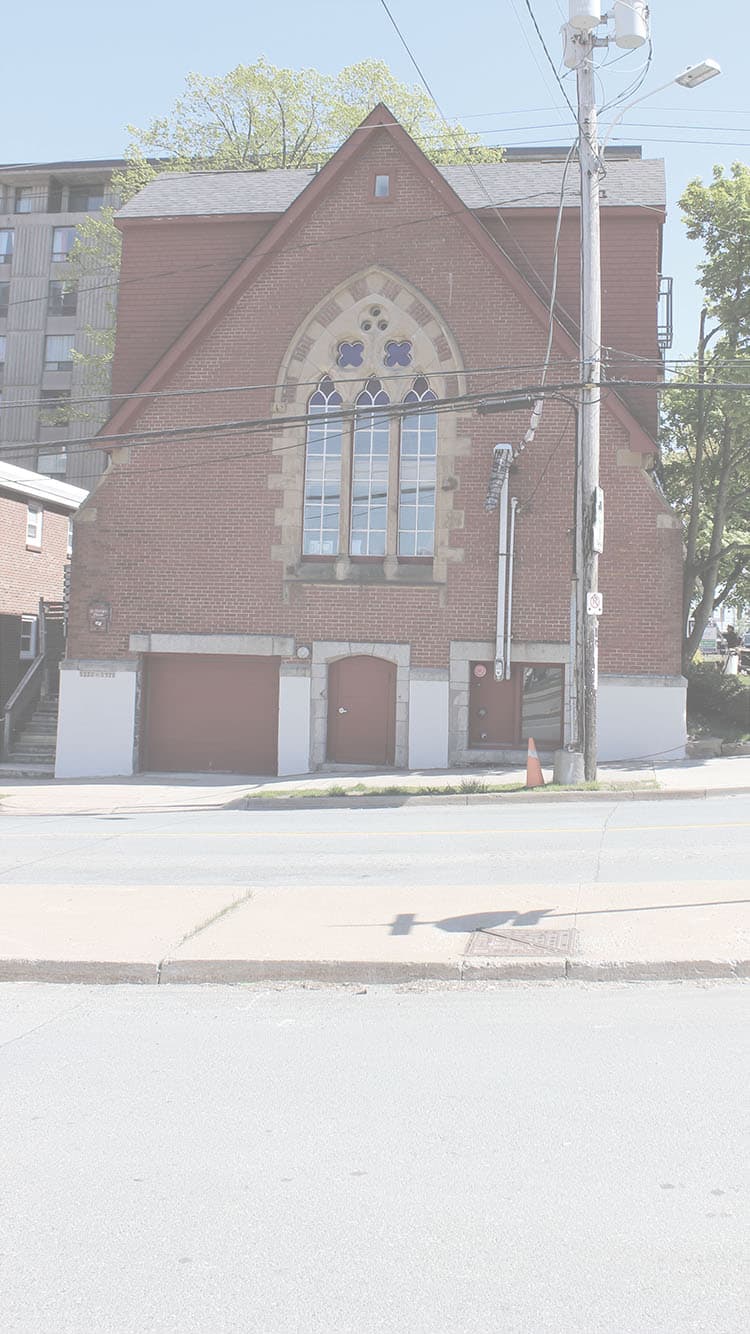
3. Morris St.
1 sound
Based on personal narratives collected by Archibald MacMechan after the disaster, the news of the collision appears to have spread quickly. The Mont-Blanc burned for 20 minutes, and it can be assumed some in the south end of the city were aware of the fire, if not the impending explosion.
Those who were not in the immediate vicinity of the blast reported feeling the shock of the blast through the ground before hearing it or getting hit by the air blast it produced. Others heard nothing at all.
-
It took two or three seconds for the blast to reach the area of St. Mary’s Basilica, and up to ten to reach as far as Victoria General Hospital: “I had just risen to my feet from saying the first prayers and was beginning the psalms, when I felt a strong vibration. … Two or three seconds passed away and suddenly there came a terrific roar. The building trembled and the glass began to fall in showers from the windows of the north side and of the two ends of the structure.” (See: Statement re explosion at Halifax, J.P.D. Lloyd, # 168, MG1 vol 2124, Archibald MacMechan fonds, Nova Scotia Archives, Halifax, Nova Scotia, Canada.)
Even in the South end, well away from ground zero, many windows were either cracked or entirely smashed.
We know the moment the blast took place in part because the shock of the blast stopped watches and clocks across the city. (See: a watch from the explosion in the Maritime Museum of the Atlantic’s Halifax Explosion exhibit.)
This was a common suspicion. Even some who had seen the ship on fire believed they had been hit by a bomb dropped from a German zeppelin. For days afterwards newspapers continued reporting that the blast was in some way arranged by enemy forces. Some still believe German involvement was possible. This is unlikely.
The Mont-Blanc was carrying nearly 3000 tons of fuel and explosives, including picric acid, TNT, gun cotton, and benzol. When she exploded the hull was torn apart. You can see parts of Mont Blanc in the Maritime Museum of the Atlantic’s Halifax Explosion exhibit.
--
While the events depicted in this walk are true, and we have endeavoured to represent them as factually as possible, it is important to note that the characters are fictional. As such, small details about their personal lives may not be accurate. These characters have been created from the remembrances of real people, and drawn from the communities present in Halifax in December of 1917.

