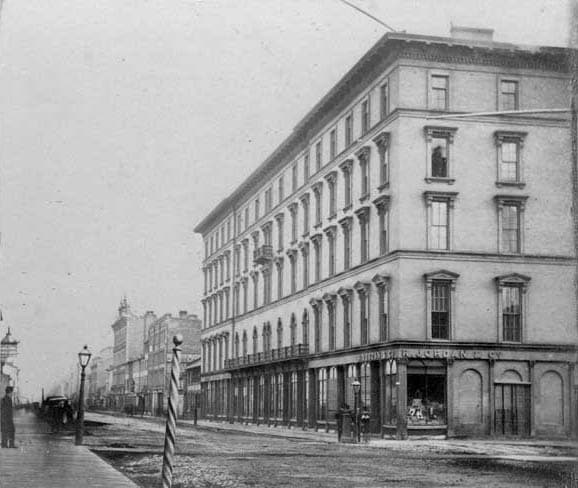
The Rossin House Hotel

1 sound

https://www.blogto.com/city/2012/02/a_brief_history_of_the_rossin_house_hotel/

In the 1850s, despite two brief terms as capital of the Province of Canada, the fledgling town of York was really just a collection of medium-sized businesses and homes with big ambitions. What many felt the community lacked at this stage in its development was a first class, luxury hotel to cater for visitors with money to spare.

Often described as "palace hotels", most North American cities had at least one well appointed, oppulant accommodation decked out with the latest comforts. At the time, the Sword's Hotel and American Hotel on Front Street were the most popular choice for visitors with the money to be looked after.

In February 1855, Charles and Marcus Rossin, successful jewellers and land speculators, bought a plot of land on the southeast corner of King and York with plans to build a truly palatial hotel worthy of the town's up and coming status.

When York's official surveyor and engineer, John George Howard, declined to design the building the Rossins held a competition to find a stylish look for their new business. Open to American and Canadian architects, designs were submitted from as far away as New York and Baltimore but the winning entry came from Buffalo and a Mr. Otis.

Rossin House Hotel Advert Opening

Started during a building boom, construction began slowly on the Rossin House Hotel due to a lack of builders in the city. By the time shovels broke ground a new designer, William Kauffman of Rochester, had taken over the project and added many fire safety features to the plans. Kauffman had included cast iron exterior details and a special load bearing system to the building when the hotel was completed and opened in May 1857.

Built to include an interior courtyard with lush gardens and a babbling fountain, the hotel's main rooms with tall windows and nineteen-foot ceilings were on the second floor above the stores facing King and York streets. Several deluxe suites and drawing rooms were also included in the floor plan for society's crème de la crème to entertain.

All guests of the Rossin House Hotel, deluxe suite or otherwise, could expect to sleep in well-ventilated, heated comfort with access to both hot and cold water (it's amazing what constituted luxury back in the day). In the dining room, thanks to a surviving menu, we know hearty staples like cold tongue, corned beef, ham and mutton were on offer alongside more exotic dishes like "Oyster Patties-French Style" and "Veal Currie-East India Style."

The wine and spirit list boasted pricey bottles of Moët & Chandon Green Seal and Roederer's Carte Blanche for guests prepared to splash the cash.

Rossin House Hotel Postcard Interior

Prior to its completion, the hotel, one of the tallest in York, was used to take the first panoramic photograph of the city. The low-rise, residential community in the pictures is practically unrecognisable as Toronto save for the presence of Osgoode and St. Lawrence Halls. For this reason the series, taken by Armstrong, Beere and Hime, provides one of the best glimpses at our humble beginnings and is available in its entirety in the City of Toronto Archives.

In November 1862, just five years after the hotel's grand opening, William Kauffman's fire safety additions paid dividends when the building was completely gutted, leaving only the exterior walls standing. All but one of the guests and staff managed to escape the building safely, a testimony to the multitude of stairways and dedicated cold water supply for firefighters available on the site.

With the Rossin House a smouldering wreck, the Rossins abandoned their hotel business and ownership of the site fell to James G. Chewett who embarked on a slow rebuilding process through 1863 and 1864. William Kauffman, who was retained as the designer, made very few changes to his original plans and the restored hotel opened again on the 1st August, 1867.

Rossin House Hotel Engraving Burning Fire

Over the next sixty years the Rossin House gradually lost its appeal as a luxury destination, slowly falling behind the times in terms of features compared to the newer Royal York and King Edward hotels.

In the early 1900s the Rossin House was sold and renamed the Prince George. It saw various uses until it was demolished in 1969. Were it still standing today, the Rossin House would be on the site of the Standard Life Centre opposite Exchange Tower.


Part of this walk

The First Panorama of Toronto

The First Panorama of Toronto

Every aspect of the story behind the series of photographs that make up the 1857 Panorama unravels an intriguing thread. From the three Irish man who photographed them (and then went on to the frontlines of British colonization) to the building from whose roof they was photographed, to the very reason they were taken in the first place. I came across these photographs while searching the Archives of Toronto for panoramic views of the city. I wanted to find images of landscapes that no longer exist and to overlay them over the current view. This was how I discovered the very first photographs of Toronto, taken in 1857, were actually a panorama. They were commissioned by the city from a newly-formed photography firm called Armstrong, Beere & Hime as part of a bid by the city’s government to the British crown to make Toronto the capital of what would become Canada. Other cities, such as Kingston, Ottawa, Quebec City and Montreal also submitted bids but none had impressive photographs to accompany the documents they sent to Queen Victoria. For unknown reasons, she never actually got to see the panorama, which some speculate contributed to her decision to choose Ottawa instead of Toronto. More than 120 years after it was photographed, the panorama was accidentally found by archivist Joan Schwartz in 1979. After the images were “discovered,” England officially gifted them back to Toronto on its sesquicentennial anniversary. The three men behind Armstrong, Beere & Hime were all born in Ireland but neither died there. After immigrating to what would become Canada and briefly working together, they went their separate ways. One joined his brother who was heading a white militia in New Zealand. Sponsored by the British crown, the soldiers were promised land in exchange for expelling and fighting off the indigenous Maori. Along with helping his brother fight, Beere took impressive photographs that can be seen on the site of the New Zealand public library. Meanwhile, Hime joined a Canadian expansionist movement and along with a University of Toronto geology professor named Henry Youle Hind, set off on an expedition in 1858. Its purpose was to prove that colonizing Canada westward was possible. It was on this expedition that Hime would take the photographs that would inscribe his name in Canadian history. You can read more about him in the Canadian Encyclopedia. The third, William Armstrong, joined a different colonial mission - the Wolseley expedition - a military force authorized by Sir John A. Macdonald to confront and subdue the Red River Rebellion of Louis Riel and the Métis in 1870 which also helped settle the Red River Colony in what is now Manitoba. He then returned to Toronto and became a teacher of what can be best described as mediocre landscape paintings. He died in his home on Augusta Street, in Kensington Market. But back to the winter of 1857. As the architectural historian William Dendy wrote in his 1979 book Lost Toronto, in January or February, the three men dragged their photography equipment up to the roof of the yet-to-be finished Rossin House Hotel, which at the time was effectively the tallest building in Toronto (at a whopping six floors). On its roof, over a course of a few days, the men took a series of photographs, with each one panning their camera slightly to the right to make a nearly full 360 view of Toronto, as it looked in the middle of the 19th century. A few months later, the upscale Rossin House Hotel opened its doors but five years after burned to a crisp in the infamous fire of 1862 that left much of the city in ruins. As I was digging through the Toronto City Archives I came across a number of such devastating fires, and was shocked at the extent of the destruction. Though the hotel was rebuilt and reopened, it slowly fell from first place on the city’s list of luxurious “palace hotels” and was demolished in 1969. You can still see the hideous skyscraper that replaced it on the southeast corner of York and King Streets. If you were to go up to the floor just above the lobby (the equivalent of the roof of the Rossin House Hotel) you can see the panorama, as photographed by Armstrong, Beere & Hime and discover how much the city changed since 1857.
free

Privacy & cookie policy / Terms and conditions

© ECHOES. All rights reserved / ECHOES.XYZ Limited is a company registered in England and Wales, Registered office at Merston Common Cottage, Merston, Chichester, West Sussex, PO20 1BE

v2.5.15 © ECHOES. All rights reserved.