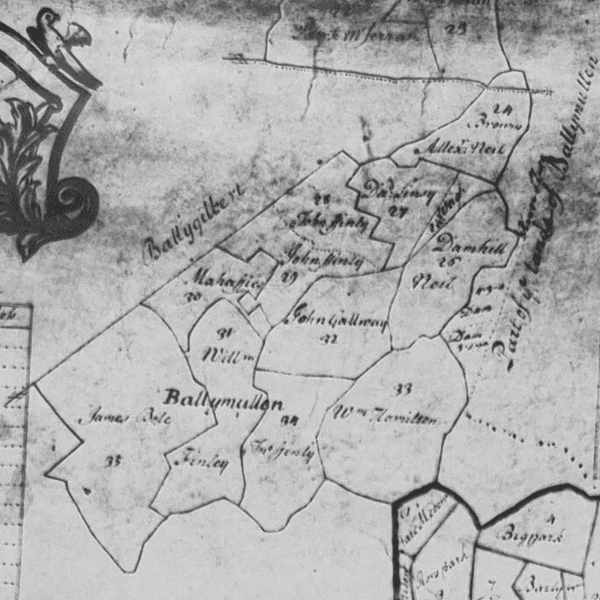
Ballymullan Townland
1 sound
It was usual for ancient townland boundaries to follow watercourses, but here we have an exception. This lane marks the boundary between Ballymullan and Ballygilbert. It is clearly marked in Thomas Raven’s map of 1626[1] , although Ballymullan is not specifically named. Rather, it is divided into areas marked with the then occupier’s family names. The land adjacent to the Bangor side of the lane, and running all the way down to Crawfordsburn, was occupied by Danie Adams, and beyond that, as far as the Cootehall Road was occupied by Edward Baily. By 1712, these two parcels of land were possessed by the Blackwood family as shown on Sloane’s contemporary estate map.[2]
Of the three hundred and eighty-one acres occupied in 1712, eighty acres had been part of the original 1674 purchase of land by John Blackwood from Henry and Alice Hamilton, the Earl and Countess of Clanbrassil. The land purchase included the townland of Ballyleidy, now occupied by Clandeboye house and parklands.
The Blackwoods were merchants, and probably came from Scotland with the Hamiltons when they were granted a large part of what had been Con O’Neil’s land before the plantation of Ulster at the start of the reign of James VI &I. We know that John’s father was Provost of Bangor and, judging by his gravestone epitaph, well thought of. The family must have prospered because they were able to buy a large tract of land from the Hamiltons and build a comparatively large house with its own park. The first big house on today’s gold coast.
The purchase was just one part of the breakup of the Hamilton estate, the reason being most intriguing, and described in some detail in the Hamilton manuscripts, which I will draw on heavily.[3] It appears that Henry was not the marrying type, so when he was betrothed to Alice, Countess of Drogheda the family were delighted. However, she was particularly pretty and had extravagant tastes, that began to drain Henry’s resources. Things did not improve when she went to the court of Charles II, where there were rumours that she was tripping on Nel Gwynn’s heels.
Having miscarried their child and knowing that Henry had made provision in his will to leave his estate to his nephews if he should die without an heir, Alice prevailed on him to write a new will in her favour on the understanding that she would look after his estate and duly pass it on. He complied with her suggestion, despite his mother’s prophetic warning that if he signed it he would join his forebears in the family mausoleum within three months. The new will was signed on 27th March 1674, the land was sold to Blackwood on 22nd July 1674 and Henry died in suspicious circumstances on 12th January 1675.
Hardly surprisingly, the plot thickened, and hopefully I will find the opportunity in another narrative to explain how half of the Hamilton estate eventually ended up in the ownership of the Blackwood family.
[1] On display in the North Down Museum [2] PRONI T3666/1 [3] Lowry T E, The Hamilton Manuscripts (1867).

