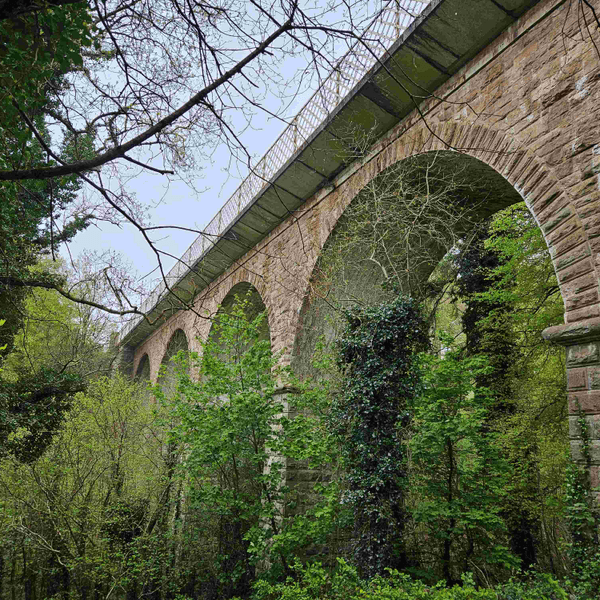
The Viaduct
1 sound
You might assume that the sheer scale of the railway viaduct is testament to the level of support by the Sharman Crawford family for the Holywood to Bangor line. However, a letter to Lord Dufferin from his agent in the summer of 1862 hints at a different state of affairs when he wrote that the Crawfords may be interested in selling, and that “the railway company may purchase the whole estate and then sell off what is not used for the railway”.[1] Perhaps it was just rumour because work started on the line that year and by 1863 construction had started on the viaduct, with the ceremonial laying of the foundation stone by Major Crawford. He also deposited in a cavity a sealed bottle containing copies of the Belfast newspapers and some coins. These were removed for safekeeping by the park authorities in 1990 – still in good condition.[2]
Despite Sharman Crawford’s apparent enthusiasm for the new line and Lord Dufferin’s indifference, it is perhaps ironic that it was Dufferin who gained a station. Charles Lanyon, who designed the viaduct, intended to call it Crawfordsburn station, but Dufferin had other ideas and prevailed on him to call it Clandeboye station.[3] It was only later renamed Helen’s Bay station, as the village began to take shape. Crawfordsburn finally got a wooden halt in 1965, to serve what had become Crawfordsburn Hospital, but it closed again in 1997.
80 feet below the viaduct runs the burn after which the village is named. It was once valued as a source of power, with mills drawn on Thomas Raven’s 1626 map, both above the village and downstream of here. The first ordnance survey map of 1834 also shows ruined mills in the ravine at the foot of the waterfall. Although the Crawford estate may have owned the mills, the water catchment was in the Clandeboye estate, where there were also then two flax mills on the upper reaches, one on today’s Millbrook Lane in Ballysallagh and another that disappeared under Fraser’s parkland in the 1850s.
In 1899, Lord Dufferin was turning his attention to creating a piped drinking water supply to Clandeboye House and Helen’s Bay and had his eye on this burn as we can see from a diary entry: “In the afternoon Colonel Sharman Crawford came, and I walked with him to see the place from which we are going to take the water for the house, in order that he might see that we were not infringing his rights.” He then went a little further, hoping to increase the flow of water into his lake: “Also consulted with him as to whether he would object to our placing a dam in order to give us some of the water which runs from the cut down the Ballysallagh stream into the head of our river”.[4]
Luckily, they were good friends, to the extent that they even exchanged land to round off each other’s estate boundaries.
[1] PRONI D1071/A/K/1/B/11/1 (20 June 1862)
[2] Masefield. Robin, 'Be Careful, Don't Rush' (Bayburn Historical Society, 2015), 137.
[3] PRONI D1071/A/K/1/B/15/1 (25 March 1865)
[4] PRONI D1071/H/V/1/34 (28 April 1899)

