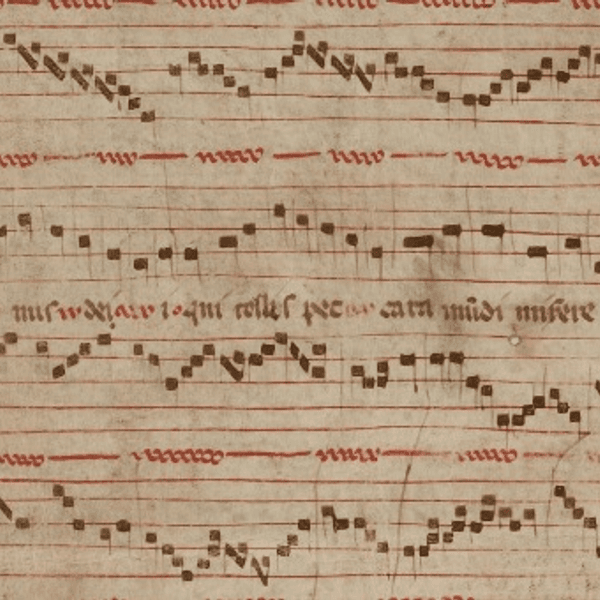
Paris, Bibliothèque nationale de France, Latin 11411 (Fragmentarium: F-lu2g)
1 sound
This fragment comes from a pair of leaves taken from a book of very early polyphony, as it would have been sung in northern France, especially Paris, in the 1280s and 1290s. It uses the whole width of the parchment leaf to line up three different voice-parts, vertically one on top of the other. The lowest of the three voices carries the text, which would have been sung by all three voices. In reading this, remember that the music is therefore grouped in three lines of music together, thrice. In this case, we have the text for the ‘Agnus Dei’ chant repeated three times, which is still a staple of the Latin Mass today, sung during the preparation of the Bread and Wine of Communion. The way the square note-heads are grouped here indicate the presence of particular rhythmic rules that tell the singer which notes are ‘short’ and which are ‘long’. This is called ‘mensural notation’ – the first way medieval singers sought to encode a sense of measured time into the look of musical notes on the page. With three different people, all singing at the same time, the necessity of keeping them all in synch with each other seems to have been the mother of graphic invention. Even though the use of time signatures would still be generations away, the lilting pattern of this Agnus Dei hold the three voices together in intricate and fast-moving harmony. - Kate Helsen

