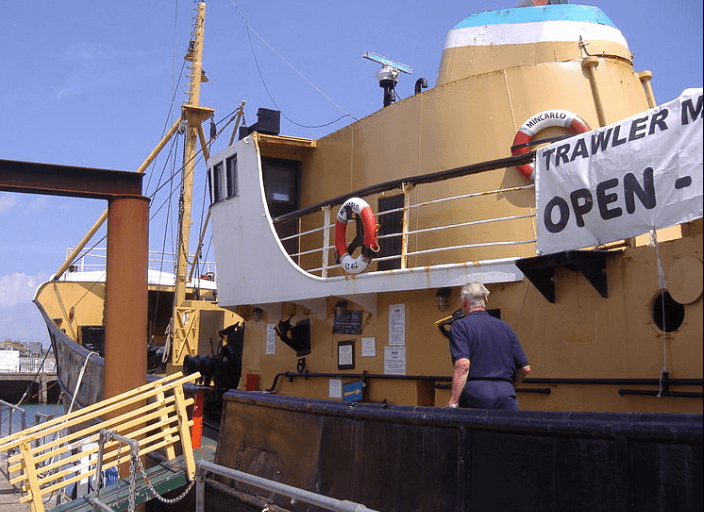
Mincarlo, LT412

1 sound

The Mincarlo is the last surviving sidewinder fishing trawler of the Lowestoft fishing fleet and the last surviving fishing vessel built in Lowestoft, with an engine made in the town.

You're welcome to come aboard and see how an operating trawler works. Often you'll be guided around the ship by retired fishermen who can give you a personal glimpse into a bygone era.

The Mincarlo was the type of trawler known as a sidewinder or side trawler. On sidewinders, the trawl nets are deployed over the side with the trawl warps passed through blocks suspended from two gallows. Until the late sixties, sidewinders were the most common deep sea boat used in North Atlantic fisheries.

Mincarlo, built in 1961, was part of the 50 to 60 strong Lowestoft fishing fleet. During her 13 years as a working trawler, her catches of cod, haddock, plaice, skate and sole put her in the top 6 trawlers of the fleet.

Mincarlo is now owned by the Lydia Eva and Mincarlo Charitable Trust Ltd, a registered charity, which also owns the preserved herring drifter Lydia Eva.

Admission is FREE, but any donations to keep this wonderful example of our fishing heritage are gratefully accepted.


Part of this walk

Lowestoft, The South Pier and Royal Plain

Lowestoft, The South Pier and Royal Plain

Before the Harbour and the cut to Lake Lothing was created, there was no real harbour here but a wide shingle beach. You could walk across from Kirkley to Lowestoft. If the tide was high sometimes men would carry people on their backs through knee-deep water. Lake Lothing, in Oulton Broad, was a freshwater lake completely divorced from the sea. In the 1830's and 40's a group of men wanted to create a way to get merchant boats up to Norwich without having to pass through (and pay the tolls to) Great Yarmouth and so created a series of cuts and canals through the Broads and by way of Lake Lothing that linked Lowestoft to Norwich. Then they went bankrupt. Good idea. Bad accounting. Sir Morton Peto saw the potential of turning Lowestoft from a sleepy fishing village to a major port and stepped to in finish dredging, build a proper harbour and lay down the most easterly rail line in Britain. Within the space of 15 years, Lowestoft changed completely. The town went from pastoral to posh in the space of a generation. The Royal Plain and the South Pier were two early tourist developments and were immediately ringed with grand hotels, a promenades and soon, a bustling town with trendy shops and fancy houses. A bridge was built, the first of several, linking this part of Peto's new development with the old High Street and the fishermen's beach village and soon 1850's Lowestoft was one long, narrow town stretching from the High Light to Carlton Road. This area was the gateway to the south part of Lowestoft and has grown, changed, been demolished and rebuilt along with each phase of the town's development.
free

Privacy & cookie policy / Terms and conditions

© ECHOES. All rights reserved / ECHOES.XYZ Limited is a company registered in England and Wales, Registered office at Merston Common Cottage, Merston, Chichester, West Sussex, PO20 1BE

v2.5.15 © ECHOES. All rights reserved.