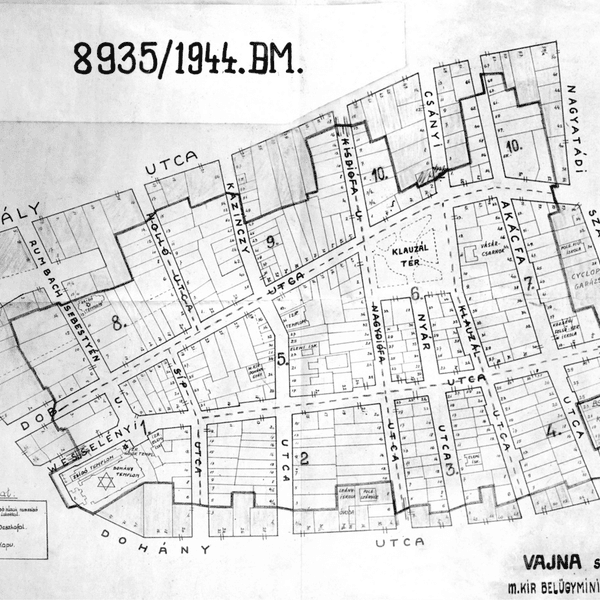
Látod? (2. rész, dokumentum hangséta a pesti gettóban)

13 ECHOES

Location: Budapest, Hungary

Tom Lantos Institute
The Tom Lantos Institute (TLI) is an independent Budapest-based human and minority rights organisation focusing on Jewish and Roma communities, Hungarian minorities, and other ethnic, national, linguistic, and religious minorities. A Tom Lantos Intézet (TLI) egy független, budapesti székhelyű emberi és kisebbségi jogi szervezet, amely kiemelten foglalkozik a zsidó és roma közösségekkel, a magyar kisebbségekkel, valamint más etnikai, nemzeti, nyelvi és vallási kisebbségekkel.

Szöveg, koncepció, dramaturgia:

KissPál Szabolcs és Prokob Boróka

Női hang - Prokob Boróka Férfi hang - Erlich Gábor

Készült a Tom Lantos Intézet felkérésére 2025-ben, Budapesten.

Források: Perczel Anna: Védtelen örökség / Randolph L. Braham: A népirtás politikája / Ungvári Krisztián-Tabajdi Gábor - Budapest a diktatúrák árnyékában / A zsidó Budapest, szerkesztő: Komoróczy Géza / Dr. Ságvári Ágnes: Let us remember the victimsHolocaust of the Jewish community in Budapest1994 / Magyar Zsidó Múzeum és Levéltár / Veszprémy László Bernát: Sorstársainknak árulói? / Munkácsi Ernő: Hogyan történt? / Szita Szabolcs: A pesti gettó küzdelme a túlélésért / Tim Cole: Holocaust city / A budapesti gettó emlékezete,szerkesztő: Dombi Gábor https://www.csillagoshazak.hu/

16. megálló - Utolsó vízcsap

Rumbach utca 11-13, Zsinagóga


A Gozsdu-udvar egy román ügyvédről, Gozsdu Manóról kapta a nevét, aki híres volt arról, hogy vagyona nagy részét ingatlanokba fektette. Ő hozta létre a Gozsdu Alapítványt, melynek köszönhetően a főváros leghosszabb átjáróházas épületegyüttese épülhetett fel. A róla elnevezett komplexum Czigler Győző építész tervei alapján készült el 1902-ben: Pest zsidó negyedében a 7 épületből, illetve az azokat összekötő hat udvarból álló ház lényege az volt, hogy az átjáróházas megoldással elkerülhető az egyenlőtlenség, vagyis minden lakás egyenrangú, a belső terekről, udvarokról minden lakás közel egyenlő fényhez jut. Az épület annak idején komoly szerepet játszott a helyi zsidó közösség életében. Itt alakultak az első zsidó imaközpontok, kiskereskedelmi üzletek, ékszer- valamint textilboltok.

Sok minden változott azóta, és bár a Gozsdu-udvar eredetileg egyáltalán nem a szórakozni vágyó fiataloknak épült, ma már szórakoztatókomplexumként működik, ezért már minden budapesti, nem budapesti, valamint turista hallott róla. (Welovebudapest) - - A régi Gozsdu-udvar jól tükrözte a békebeli Magyarország többnemzetiségű életét: a magyar főváros közepén román alapítványi bérházba főként zsidók költöztek. A nagyméretű, négy-öt szobás polgári lakásokat a környék jómódú zsidó középosztálybeli családjai bérelték, a földszinti üzletekben pedig sajátos világ alakult ki: egymást érték az ötvösök, vésnökök, és különös módon a fodrászok. https://architextura.hu/budapesti_atjarohazak_a_gozsdu_udvar.html

1 sound

00:00--:--

DOWNLOAD OUR APP TO DISCOVER THIS TOUR AND MANY OTHERS.

play-storeapp-store

Or start creating tours, treasure hunts, POI maps... Just let your imagination guide you.


Other walks nearby

Pavilion Field Budapest - II. János Pál pápa tér (Pope John Paul II Square)

Pavilion Field Budapest - II. János Pál pápa tér (Pope John Paul II Square)

Budapest
An Open Form Pavilion of Air is a suspended acoustic architecture, triggered by GPS and accessed via a smartphone, headphones and the echoes.xyz app. The Open Form Pavilion of Air series is made up of 15 of these audioworks across 9 countries, each offers a playful renewal and reframing of public space as an essential engagement for the community. The series of audioworks draws its name from Polish architects Oskar & Zofia Hansen’s “Open Form” architecture (1959) and their work in that period in Poland developing social housing and renewing public space. Pavilion Field Budapest is a collection of 9 audioworks from the Open Form Pavilion of Air series across the 6.25 hectares (250m x 250m) of II. János Pál pápa tér (Pope John Paul II Square), Budapest. Each Pavilion audiowork is in a unique tuning system, the many sounds forming these acoustic architectures create the effect for listeners of physically changing how they hear the location and the surrounding sounds – profoundly reshaping spatial experience. Each of the 9 Pavilion audioworks present a different way to experience the Square’s audiosphere, its context. Pavilion Field Budapest has no visible presence outside the app and can only be accessed and enjoyed at the Square. Using your smartphone, echoes.xyz app and headphones, visitors become participatory listeners – by traversing the Square, the choreography of your movements combines and changes sounds via the app, creating a unique composition. Made from many overlapping zones ('echoes'), each Pavilion is an invisible acoustic structure accessible via the app. Each zone’s sound draws on shapes informed by modernist architectural structures, like Xennakis’ 1958 Philips Pavilion and Budapest’s new Ethnographic Museum’s use of hyperbolic paraboloids. Together, in Pavilion Field Budapest, these shapes describe sonic forms - a porous acoustic architecture rather than a solid structure - creating an effect which subtly reframes your experience of the Square. Traversing Pope John Paul II Square gives a constantly shifting series of audio experiences specific to each Pavilion's sonic footprint, similar to walking through a series of adjacent Big Top marquees – together they describe a constellation of impossible architectures, a fantastical architectural canopy of sound. Pavilion Field Budapest recalls Oskar and Zofia Hansen’s proposed Pavilion of Music design for Warsaw Autumn’s 1958 Festival. Their design would stretch across a public park in a unique way, incorporating speakers that allowed visitors to create personal spatial compositions as they moved through its Open Form architecture. Pavilion Field Budapest echoes the Hansens’ desire (as described at link 1 below) for people to “move through the space, listening to the music with a heightened awareness of the natural setting beyond it”. Another writer (at link 2 below) concluded their Pavilion of Music’s use of “open forms had the potential to remind audiences of the fact of their own embodied being… \[to] experiment with the ‘spatiality of music’… \[to] shape their environment in meaningful ways… integrating sound with the listeners’ movements as well as with the trees and clouds’. Hansen’s aim was not the stimulation of sensation but of the imagination.” See info at https://www.recordedfields.net/installations/pavilion-field-budapest/ This RTÉ Culture primer on the Pavilion series gives additional details https://www.rte.ie/culture/2023/0327/1366079-new-music-dublin-welcomes-you-to-the-open-form-pavilion-of-air/ Link 1 - https://kadebeem.wordpress.com/wp-content/uploads/2016/02/caroline\_claus\_urban\_sound\_design\_process.pdf#page=11 Link 2 - https://monoskop.org/images/2/21/Crowley\_David\_Muzyczuk\_Daniel\_Sounding\_the\_Body\_Electric\_Experiments\_in\_Art\_and\_Music\_in\_Eastern\_Europe\_1957-1984.pdf#page=29
free

Are you a creator?

START HERE

Privacy & cookie policy / Terms and conditions

© ECHOES. All rights reserved / ECHOES.XYZ Limited is a company registered in England and Wales, Registered office at Merston Common Cottage, Merston, Chichester, West Sussex, PO20 1BE

v2.5.15 © ECHOES. All rights reserved.