W tym miejscu | In This Place

53 ECHOES

Location: Kraków, Lesser Poland Voivodeship, Poland

Projekt "W tym miejscu" skupia się przede wszystkim na obrzeżach dawnego terenu KL Plaszow: w okolicach ul. Jerozolimskiej (lokalizacja 1) oraz w pobliżu ul. Swoszowickiej (lokalizacja 2).

Spacery w tych dwóch lokalizacjach ilustrują, jak na przestrzeni czasu zmieniała się zabudowa terenu, jego audiosfera i urbanistyczne przeznaczenie oraz stosunek do symbolicznego znaczenia tego miejsca.

Lokalizacja 1: Ludzkie głosy – wypowiedzi mieszkańców, badaczek, przewodników, potomkiń, decydentów; osób, które na różne sposoby obcujących z tą przestrzenią i przypisują jej różne znaczenia.

Wybór pierwszej z lokalizacji ukazuje, w jak w bliskim sąsiedztwie przestrzeni poobozowej funkcjonuje na co dzień lokalna społeczność. Do jakiego stopnia współczesna tkanka miejsca oraz infrastruktura mieszkaniowowo-usługowa przenikają się z miejscem przemocy.

Lokalizacja 2: Elementy dźwiękowe i nagrania odnoszące się do sprawczości przyrody i poza-ludzkich aktorów.

Wybór drugiej lokalizacji podyktowany jest chęcią zwrócenia uwagi na stanowiącą niezwykle istotny element tego terenu naturę – jej pamięć i podmiotowość – roślinność oraz sposób ukształtowania terenu. Ale także: na najbliższe otoczenie tego krańca dawnego obozu, gwałtownie zmieniające się w wyniku rozwoju miasta i wpływające na jego dzisiejszą percepcję.

Aby przemieścić się z jednego do drugiego punktu spaceru, konieczne jest przejście przez centralną, zajmującą najrozleglejszy obszar, część poobozową. Nie zakotwiczamy w niej żadnych zewnętrznych dźwięków – chcemy umożliwić osobom spacerującym obcowanie z tą audiosferą w jej obecnej formie.

Artyści: Marcin Dymiter, Ludomir Franczak

Ze względu na wielozmysłowy charakter doświadczenia, podczas korzystania z aplikacji Echoes zalecana jest szczególna ostrożność i uważność na otoczenie – zwłaszcza w pobliżu przejść dla pieszych, ruchliwych ulic czy skrzyżowań oraz terenu budowy.

Projekt finansowany w ramach Krajowego Planu Odbudowy i Zwiększania Odporności (KPO), wspieranego przez Unię Europejską w ramach funduszu NextGenerationEU, sieci Thinking Through the Museum i Stowarzyszenia Żydowski Instytut Historyczny w Polsce.

///

The project "In This Place" focuses primarily on the outskirts of the former KL Plaszow area: around Jerozolimska Street (location 1) and near Swoszowicka Street (location 2).

The walks in these two locations illustrate how, over time, the area’s development, its audiosphere, urban planning, and its symbolic significance have changed.

Location 1: Human voices – statements from residents, researchers, guides, descendants, decision-makers; individuals who interact with this space in various ways and assign different meanings to it.

The choice of the first location shows how closely the local community operates in proximity to the post-camp space. It explores the extent to which the modern fabric of the area, as well as its residential and service infrastructure, intertwine with the space of violence.

Location 2: Sound elements and recordings relating to the agency of nature and non-human actors.

The choice of the second location is driven by the desire to highlight the nature of this area – its memory and subjectivity, the vegetation, and the way the land is shaped. It also draws attention to the immediate surroundings of this edge of the former camp, which has changed dramatically due to urban development, influencing how it is perceived today.

To move from one point to the other, it is necessary to pass through the central part of the post-camp area, which occupies the largest space. No external sounds are anchored here – the aim is to allow walkers to experience the audiosphere in its current form.

Artists: Marcin Dymiter, Ludomir Franczak

Due to the multisensory nature of the experience, it is advised to exercise special caution and awareness of the surroundings while using the Echoes application, especially near pedestrian crossings, busy streets, intersections, and construction areas.

The project is funded under the National Recovery and Resilience Plan (KPO), supported by the European Union through the NextGenerationEU fund, the Thinking Through the Museum network, and the Association of the Jewish Historical Institute of Poland.
wiewiórka | squirrel

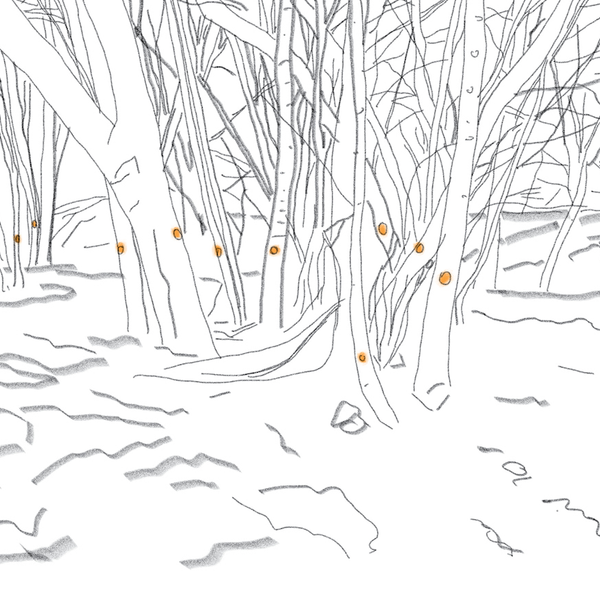
Wypowiedź Potomkini osób pochowanych na przedwojennym cmentarzu żydowskim, który włączono w obszar KL Plaszow, dotycząca spotkania z wiewiórką, zakotwiczona w pobliżu fragmentu ulicy Heltmana.

SQUIRREL
[A statement from a descendant of individuals buried in the pre-war Jewish cemetery, which was incorporated into the KL Plaszow area, regarding an encounter with a squirrel, anchored near a section of Heltmana Street.] Descendant: “I must say that I had quite an extraordinary experience there two years ago when I had my little son, who was very small—he's not so little now, but back then, he was tiny, only two months old. I went for a walk in Płaszów, which was a medicinal plant walk, if I may say so—‘Healing Plants of Płaszów’. I went on this walk, and there came a moment when my son got hungry; he was so small, only two months old, and it was a heatwave, it was August. I had to stop to feed him. So, I sat under a Płaszów shrub, and the tour group continued, while my son and I stayed there, and he drank his milk. I had such a deeply moving experience there. First of all, it was an experience very close to nature, because we were in a very intimate situation—breastfeeding is quite intimate—and I was enjoying that. At one point, a tiny squirrel came up to us and sat right next to us. It was such an incredibly touching experience, and it stayed with me for a long time, somehow working through me. And I had this sense that the nature there now is so wonderfully alive in contrast to the history.”

1 sound

historia poza-ludzka | non-human history

Fragmenty książki Robin Wall Kimmerer, Pieśń Ziemi. Rdzenna mądrość, wiedza naukowa i lekcje płynące z natury, przeł. Monika Bukowska, Znak Literanova, Kraków 2020.

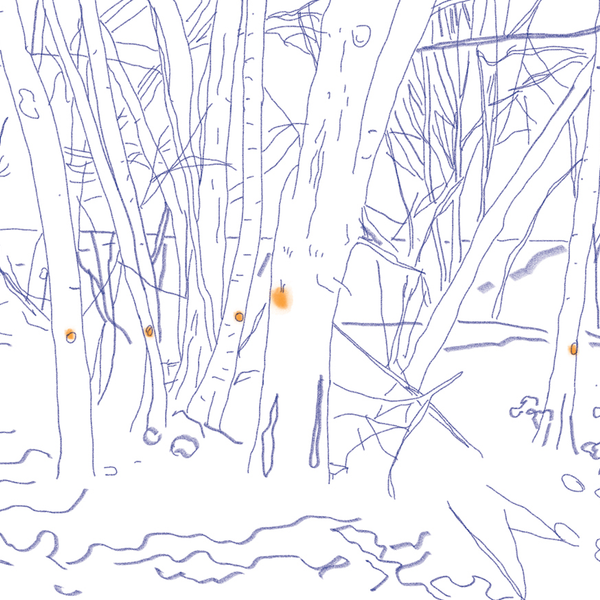
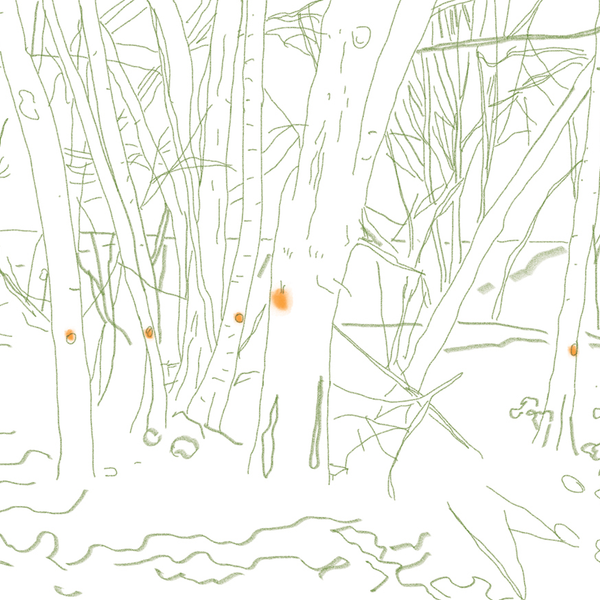
NON-HUMAN HISTORY [Excerpts from the book Robin Wall Kimmerer, Braiding Sweetgrass: Indigenous Wisdom, Scientific Knowledge and the Teachings of Plants. Minneapolis: Milkweed Editions, 2013.] The ground is uneven, hiding pits, remnants of foundations, and post-war water pipeline excavations. For 80 years, a forest has grown in this place, herbs and berries have sprouted, and the earth has been covered with moss and grass. However, before that happened, for several years, almost nothing grew here. All the seeds were trampled into the ground by hundreds of feet. The constant human movement prevented the growth of non-human beings. The grass turned to mud, the landscape was leveled, crisscrossed with roads, avenues, and stone paths. When human movement ceased, a barren, scarred space was revealed. Yet on the leveled terrain, everything changes: suddenly, the sun appears. [...] Forest ecosystems have tools for dealing with massive disturbance, evolved from a history of blowdown, landslide, and fire. The early successional plant species arrive immediately and get to work on damage control. These plants—known as opportunistic, or pioneer, species—have adaptations that allow them to thrive after disturbance. Because resources like light and space are plentiful, they grow quickly. A patch of bare ground around here can disappear in a few weeks. Their goal is to grow and reproduce as fast as possible, so they don’t bother themselves with making trunks but rather madly invest in leaves, leaves, and more leaves borne on the flimsiest of stems.

1 sound

DOWNLOAD OUR APP TO DISCOVER THIS TOUR AND MANY OTHERS.

play-storeapp-store

Or start creating tours, treasure hunts, POI maps... Just let your imagination guide you.


Other walks nearby

In This Place

In This Place

Kraków
The project "In This Place" focuses primarily on the outskirts of the former KL Plaszow area: around Jerozolimska Street (location 1) and near Swoszowicka Street (location 2). The walks in these two locations illustrate how, over time, the area’s development, its audiosphere, urban planning, and its symbolic significance have changed. Location 1: Human voices – statements from residents, researchers, guides, descendants, decision-makers; individuals who interact with this space in various ways and assign different meanings to it. The choice of the first location shows how closely the local community operates in proximity to the post-camp space. It explores the extent to which the modern fabric of the area, as well as its residential and service infrastructure, intertwine with the space of violence. Location 2: Sound elements and recordings relating to the agency of nature and non-human actors. The choice of the second location is driven by the desire to highlight the nature of this area – its memory and subjectivity, the vegetation, and the way the land is shaped. It also draws attention to the immediate surroundings of this edge of the former camp, which has changed dramatically due to urban development, influencing how it is perceived today. To move from one point to the other, it is necessary to pass through the central part of the post-camp area, which occupies the largest space. No external sounds are anchored here – the aim is to allow walkers to experience the audiosphere in its current form. Artists: Marcin Dymiter, Ludomir Franczak Due to the multisensory nature of the experience, it is advised to exercise special caution and awareness of the surroundings while using the Echoes application, especially near pedestrian crossings, busy streets, intersections, and construction areas. The project is funded under the National Recovery and Resilience Plan (KPO), supported by the European Union through the NextGenerationEU fund, the Thinking Through the Museum network, and the Association of the Jewish Historical Institute of Poland.
free

Are you a creator?

START HERE

Privacy & cookie policy / Terms and conditions

© ECHOES. All rights reserved / ECHOES.XYZ Limited is a company registered in England and Wales, Registered office at Merston Common Cottage, Merston, Chichester, West Sussex, PO20 1BE

v2.5.15 © ECHOES. All rights reserved.