Historic Hoddesdon - town centre walk

11 ECHOES

John Griffiths
John Griffiths

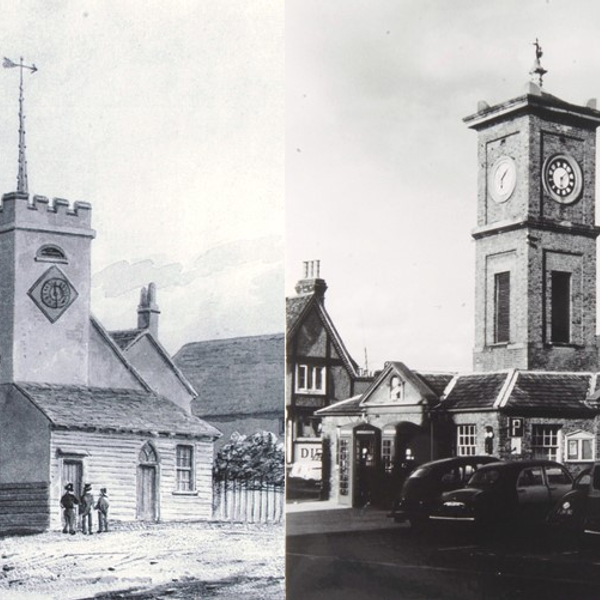
A circular walk of just under ¾mile, starting at the Clock Tower. Provided by the Friends of Lowewood House.

The walk looks at some of Hoddesdon’s buildings through the centuries and gives glimpses of some of the people who lived and worked in them. This walk does not include information on Hoddesdon’s historic town centre inns or the brewery as they are covered in the Hoddesdon Inns walk.

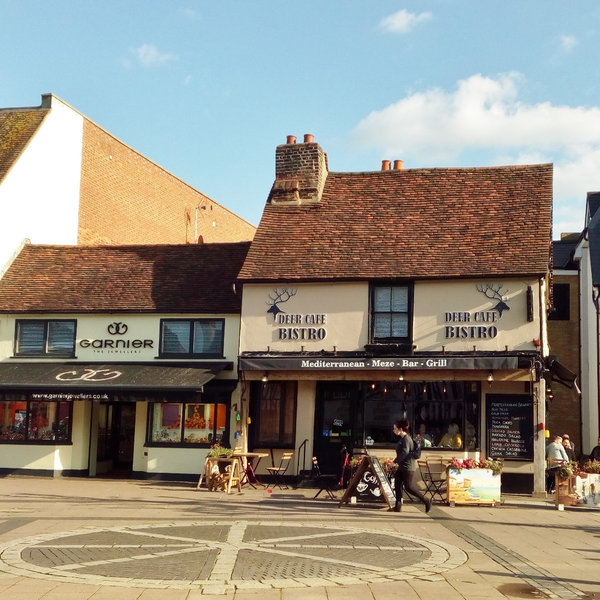
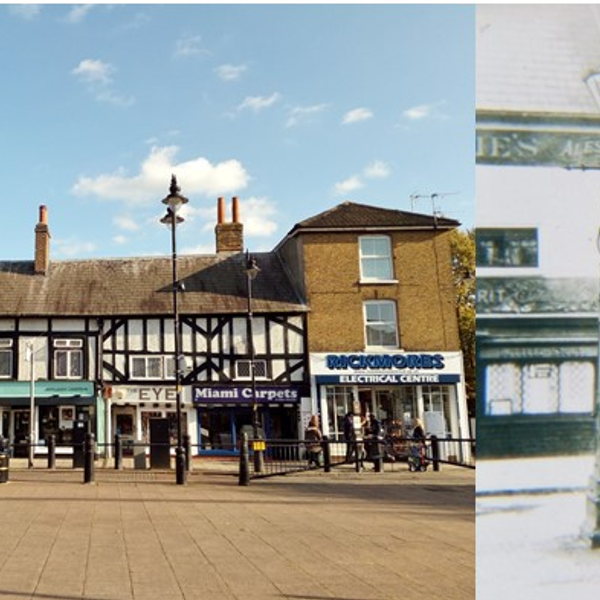
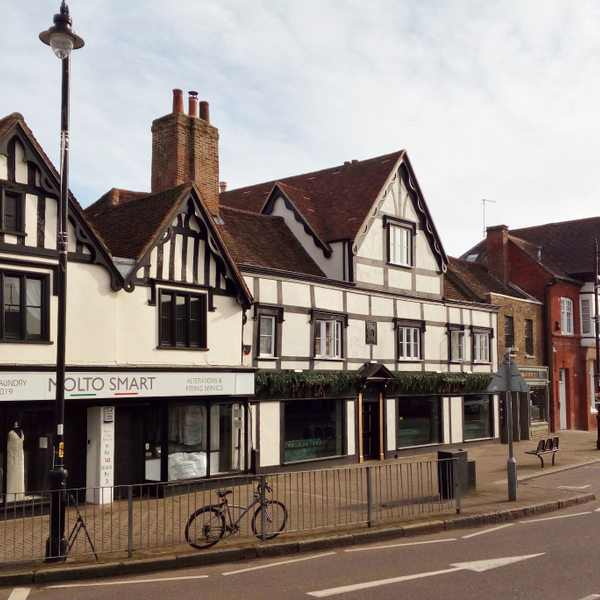
78-64 High Street – photo of buildings 78-66 High Street

The first building south of Conduit Lane dates from the 16th century. For many years it was a hardware shop, Hawards. It was run by W J Haward, a local entrepreneur in the mid 20th century, who had so many different interests in the town’s affairs that he was known as ‘Mr Hoddesdon’.

The next building is Stanboroughs, which was built in the early 17th century. The north wing, from evidence of dated rainwater heads, was added in 1637. Stanboroughs was the home of the Conservative Club from the early 20th century. In 2012 work started on archaeological investigations prior to the building a new clubhouse at the rear and conversion of the building to flats and a restaurant.

The red brick building with a white gable was purpose-built as a Post Office in 1893 by the local building firm, Hunts. Its architect was John Tregelles. He wrote the town’s first local history book called ‘A History of Hoddesdon’, in 1908. The Post Office closed here in 2018 and was re-situated to the Library.

Montague House, no. 68 High Street, red brick with white stone window frames and integral columns, was built in the early 18th century, with no. 70 next door added a little later. Care was taken to use similar materials and architectural features, making an almost symmetrical frontage. John Loudon McAdam, the road-building pioneer, lived at Montague House from 1827 until his death in 1836. There is a blue plaque commemorating him on the building.

The yellow brick house, no. 66, is late 18th century, and is owned by the chef, Gino D’Acampo. The next building, Hogges Hall, contains some remains – shaped beams and a doorway – of a 15th century hall. The name, surviving from an earlier time, may be a corruption of a Saxon or Danish personal name. One suggestion of the origin of the name Hoddesdon is that the first element may be a corruption of Hogge. From the mid-19th century Hogges Hall was the home of the Hunt family, who ran a very successful building business. Their local work included St. Catharine’s Estate in Broxbourne and St Cuthbert’s Church in Rye Park. One member of the family left Hoddesdon to run a stained glass company which produced work nationally, including some local commissions. Examples of their work can be seen in St Catherine & St Paul’s Church and in Hogges Hall itself. The upper lights of the middle landing windows are a set of small stained glass windows called ‘The Heads of Time’.

Continue to the last building before the junction of High Street and Charlton Way.

1 sound

93 High Street to Myddleton House, no 113-119 High Street

The building on the north corner of Lord Street was built in 1882 by members of the Warner family as a coffee tavern. The Warners were Quakers and they supported the Temperance movement. Coffee taverns gave out tokens which could be exchanged for soup or coffee in the hope of encouraging would-be drinkers away from the town’s many pubs. The building later became a temperance hotel. Vents from the kitchens can still be seen in the wall facing Lord Street.

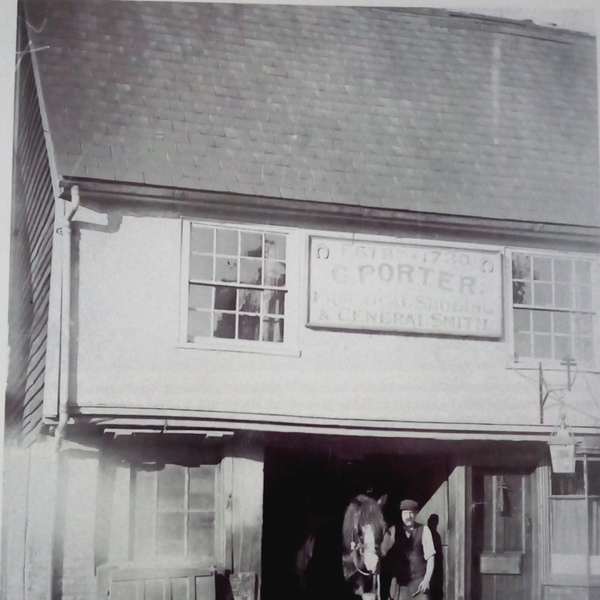
Continue past the White Swan to the white-fronted building comprising 3 shops which has internal timber framing dating from the 16th century. In front of no. 99, Ripleys Butchers shop, is a cobbled forecourt. The premises had been a smithy for over 200 years up to the mid-20th century. The cobbles gave extra purchase for the horses’ hooves.

Walk past The Star and on to Myddleton House (nos. 113-116 High Street), which was built about 1600. It may have been the home of William Myddleton, a relative of Sir Hugh Myddleton who built the New River, but it does not seem that Sir Hugh himself lived in Hoddesdon. The building was an inn for a period and in the late 19th century was the home of Charles Augustus Christie, one of the sons of the owner of Christie’s brewery which stood opposite. Myddleton House became the home and surgery of GPs Dr Love and then Dr West, who eventually re-located to Rathmore House. Used as shops from the 1930s, Myddleton House was extended to the north in about 2000.

Continue north and turn left into Paul’s Lane. Walk up Paul’s Lane for about 30 yards and cross towards the church.

1 sound

St Catherine and St Pauls

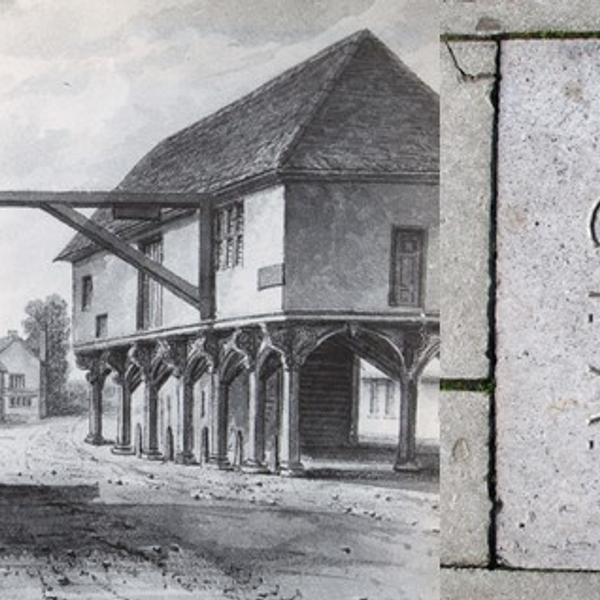
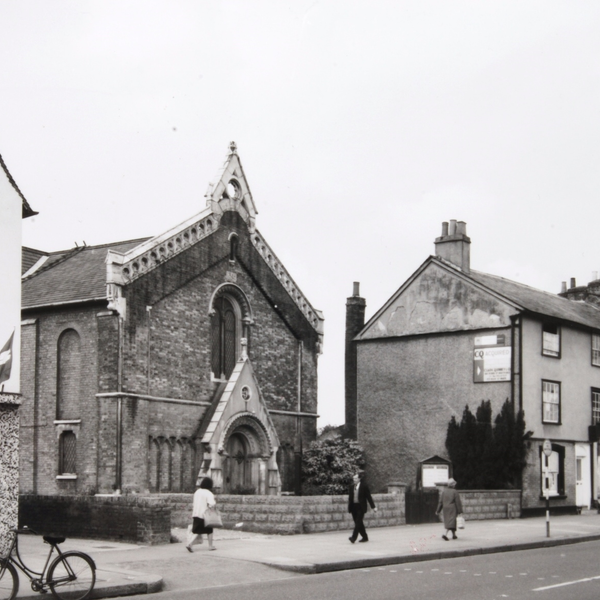
On the left, a large rectangular stone lies in the grass. It is a copy of the foundation stone of the Girls’ National School which stood in the vicinity. National Schools were Church of England charity schools. This school was erected in 1858, and Hoddesdon’s first charity school, Mrs Easter Jones’ girls’ school in Amwell Street, founded in 1818, was moved here. The building was demolished in the 1970s. Beyond the foundation stone is one of the church halls, which was originally the Infants’ National School.
The church of St Catherine & St Paul has been built in different stages. The eastern end, which faces Amwell Street, is 19th century; the western end was constructed as a private chapel in 1732. When Hoddesdon became a parish in the mid-19th century, this chapel was adopted as the parish church. The church was enlarged in 1865, and the tower was added in 1887. Originally known as St Catherine’s, it was dedicated to St. Paul in 1901, and re-dedicated to St. Catherine & St Paul in 1976.

Follow the path half-right past the western, older, end of the church to the exit leading to Hanover Court. On the right is a raised grave with an embossed cross on the top. This is the grave of Harriet Auber, who died in 1882. She wrote many hymns, the best known of which, ‘Our Blest Redeemer’, was, for lack of writing materials to hand, first scratched on to a window pane of her home in Amwell Street, which stood opposite the church. Retrace your steps past the west end of the church, walk between the church halls into Paul’s Lane, and turn right.

1 sound

DOWNLOAD OUR APP TO DISCOVER THIS TOUR AND MANY OTHERS.

play-storeapp-store

Or start creating tours, treasure hunts, POI maps... Just let your imagination guide you.


Other walks nearby

Haileybury Remembers "11 November 2020"

Haileybury Remembers "11 November 2020"

Hertford, Hertfordshire, England, United Kingdom
More than 1,100 Haileyburians were killed in both of the World Wars, and more have died in other conflicts since then. List of poems: In Memoriam by Anna Akhmatova (read by Freddie Baylis, Anastasia Tikhturova and Francesca Arici) The Messages by Wilfrid Wilson Gibson (read by Cagla Eriuce) On Seeing a Poet of the First World War at Abbeville, Charles Causley (read by Lilibet Philpott and Hadrien Moortgat) Since they have died (1917) by May Wedderburn Cannnan (read by Pia Ganske) August 1914 , Isaac Rosenberg (read by Stuart Cuff) The Last Post by Louie Carvacho (memory of 2017 Remembrance Ceremony) Exposure by Wilfred Owen (read by Maria Giles) “There will come soft rains” by Sara Teasdale (read by Franziska Friedrich and Aniek Blok) The Soldier by Ruper Brooke (read by Alessio Yu) ‘Going Over’ by Charles G.D. Roberts (read by Honor Harding) To Germany by Charles Hamilton Sorley read by Dr. Lucy Johnson Setting out by Ernst Stadler read by Alex Ritter von Kempski In Flanders Fields by John McCrae(1915) read by Rosanna Parry Easter Monday (1917) by Eleanor Farjeon read by Costanza Lorini The Gift of India, Sarojini Naidu read by Hannah Koon Tristes Guerras by Miguel Hernandez read by Mr. José Martinez Fragment by Rupert Brooke read by Zara Kolberg In Flanders Fields, John McCrae read by Mr. Fergus Hardy There will come soft rains by Sara Teasdale read by Giorgia Cocumelli and Karolin Vocke Easter Monday, Eleanor Farjeon read by Flora Salzer Death of Harry Patch by Andrew Motion read by Luca Baumgardt Fratelli by Giuseppe Ungaretti read by Guendalina Spigarelli Para la Libertad by Miguel Hernandez read by Mr. José Martinez To one dead by Francis Ledwidge read by Carolin Luisa Lange A Century Later by Imtiaz Dharker read by Elena Coppola Picnic (1917) by Rose Macaulay read by Amelie Garnies Last Post by Carol Ann Duffy read by Dr. Alan Bates
free

Are you a creator?

START HERE

Privacy & cookie policy / Terms and conditions

© ECHOES. All rights reserved / ECHOES.XYZ Limited is a company registered in England and Wales, Registered office at Merston Common Cottage, Merston, Chichester, West Sussex, PO20 1BE

v2.5.15 © ECHOES. All rights reserved.