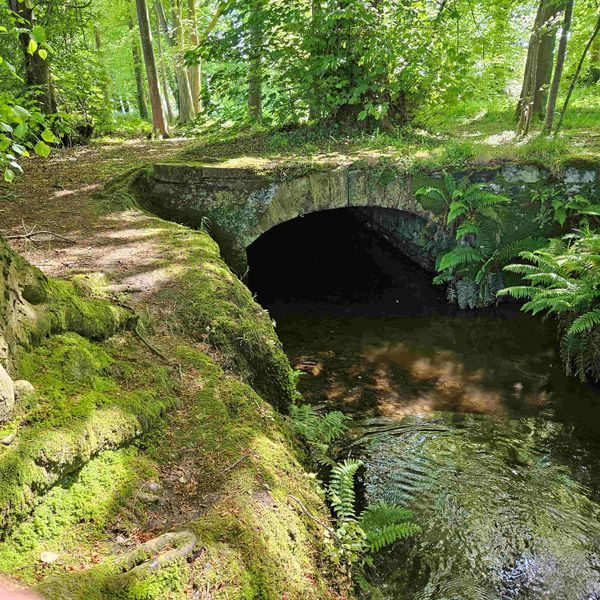
You will need a lot of patience to play poo sticks here. This beautifully built tunnel that carries the Mill Brook below us was just a small part of the civil engineering works employed to create the Clandeboye Avenue.
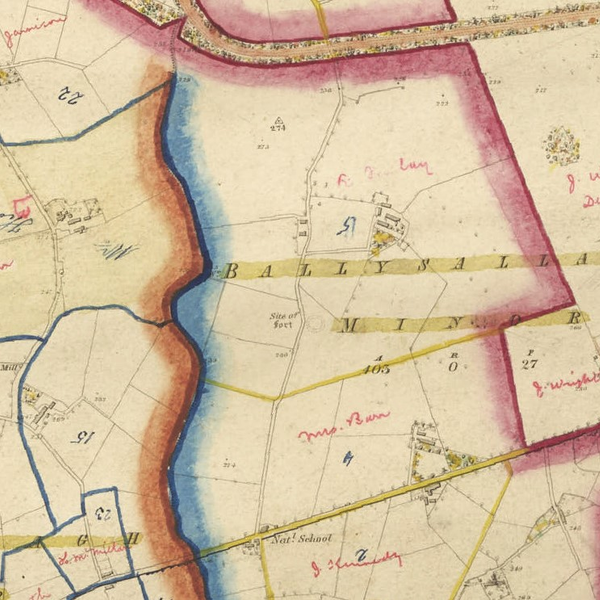
The Mill Brook rises in the hills around the Cairn Wood, from where a number of streams now feed into the Ballysallagh reservoirs before continuing their journey to the sea in the Crawfordsburn Country Park.
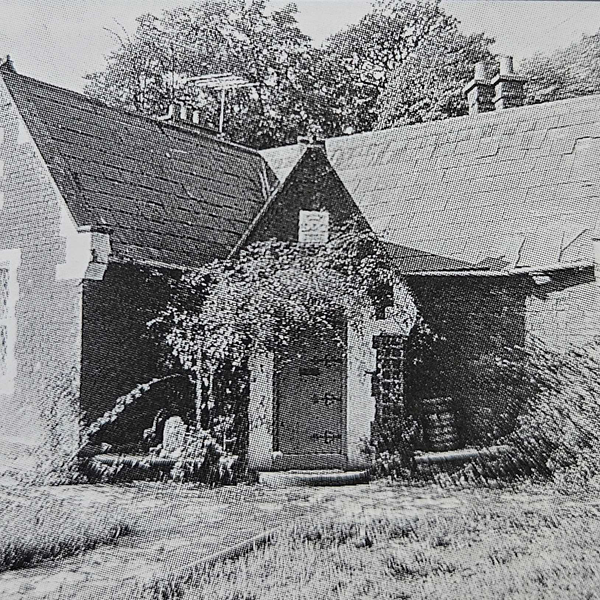
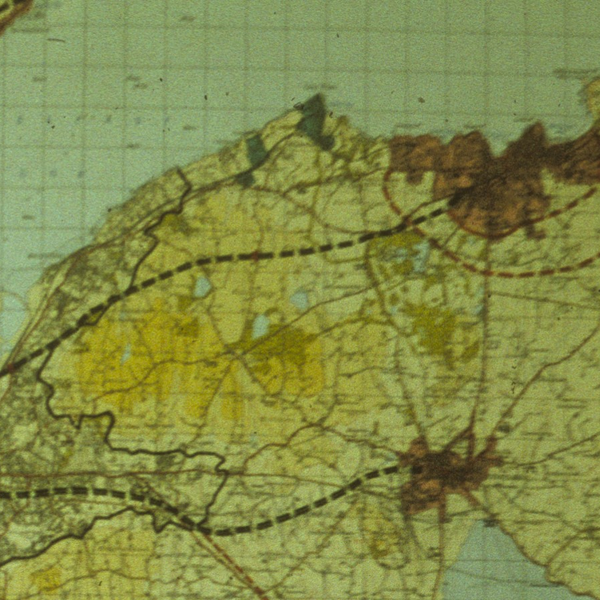
Prior to its use as a water supply to North Down, this was an important source of power. There were two flax mills on the estate section, one upstream and one downstream of here. The upstream mill, on Millbrook Lane, was marked on the first edition of the OS map in 1834, but was gone by the 3rd edition in 1904. The other mill, just downstream of here, did not survive until the 1862 edition and was probably a casualty of James Frazer’s 1850 landscape plans. There was a third mill on the land of Craigdarragh House, by Helen’s Bay, which Lord Dufferin purchased from Mr Gordon in 1861,[1] however it was dismantled in 1865 and re-assembled at Carrickmannon.[2] We must therefore assume that the manager that Lord Dufferin appointed in 1865 would have been for the Millbrook mill.[3]
Growing flax was obviously a precarious business, as evidenced by Dufferin’s agent, Mortimer Thompson, in a letter to him in 1853, saying “it is nothing more than a gambling transaction with our farmers”.[4] However, by this time Ulster’s linen industry had grown so large that much of the flax was imported, mainly from Russia. The rise of the linen industry grew from the demise of cotton after the Napoleonic wars, but the defining moment was on 10th June 1828 when Thomas Mulholland’s York Street cotton mill was burnt to the ground. He rebuilt it, not for spinning cotton, but flax, using a system of wet spinning, developed at their Francis Street mill. The new factory had three steam engines, driving 15,300 spindles.[5]
The irony of this story lies in Lord Dufferin’s excessive landscaping schemes, including this avenue, for by 1872 it was none other than John Mulholland who had lent him £120,000 of his eye watering £299,000 debts, and who was not willing to reduce the interest below 4%.[6] Dufferin was almost insolvent and was even willing to sell Clandeboye to clear his debts, but eventually sold only his outlying estates around Killyleagh and on the Ards peninsula, leaving him with 5,000 of his 18,000 acres. Luckily for him, Mulholland obtained the Ards estate, which was adjacent to his own country seat, Ballywalter Park, the ownership of which obviously obviated any social need for him to buy Clandeboye House and its demesne.[7] It was indeed a close-run thing.
[1] PRONI D1071/H/V/1/19 (17 November 1861)
[2] PRONI D1071/A/K/1/B/14/1 (30 January 1865)
[3] PRONI D1071/H/B/M/341/2
[4] PRONI D1071/A/K/3/B/1 (19 June 1853)
[5] Jonathan Bardon, A History of Ulster (Blackstaff Press, 1992), 261.
[6] Annie Tindley, Lord Dufferin, Ireland and the British Empire, C. 1820-1900 (Routledge, 2021),
39.
[7] PRONI D1167