Mount Stewart Lake Trail

7 ECHOES

Location: Newtownards, Ards and North Down, Northern Ireland, United Kingdom

Nothofagus Dombeyi

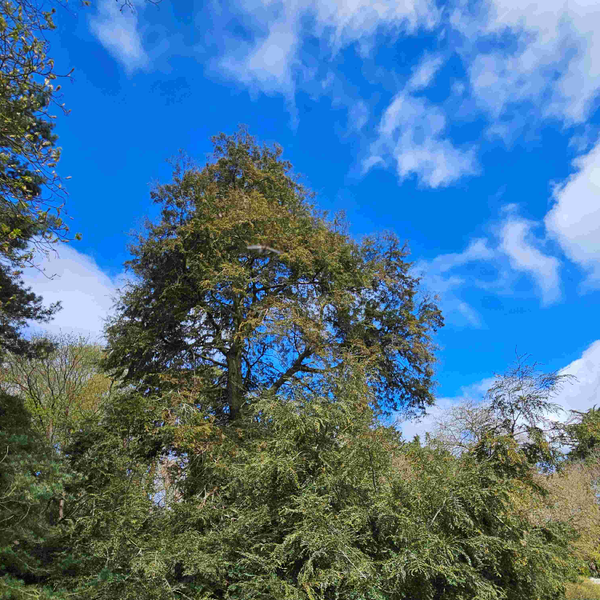
John You can hardly miss the huge evergreen tree beside the path here, rippling with shiny green small leaves. It is Nothogus Dombeyi, one of the great southern beeches of Patagonia. The first European to collect it was Joseph Dombey, hence the name. A French botanist who explored Chile in the seventeen eighties. He never crossed into what is now Argentina, yet the species he gathered grows naturally on both sides of the Andes, making it as much an Argentinian tree as a Chilean one. His specimens survive storms, political interference, even confiscation, before finally reaching Europe in seventeen eighty-five. Recently, I met up with Alicia, who is from Argentina, to explore the deeper stories of the species. So, Alicia, tell me a little bit about your experience with this amazing tree.

Alicia What if I told you we have this tree to thank for lager beer?

John What?

Alicia It's an amazing, extraordinary mystery. The brewers were making lager, but they didn't know where one of the two yeasts that make the lager came from. They just had never identified it biologically until twenty eleven, when an Argentine microbiologist called Doctor Diego Liebkind found the missing parent, which is called Saccharomyces Eubayanus. It was living in Patagonia’s Nothofagus forests. We don't actually know how it got to Bavaria. What we do know is that when trees travel, they can carry microscopic communities on their bark and around their roots. Maybe it came with one of the trees that was imported. So, the two yeasts met and like microbial twin flames, one was brilliant at turning sugar into alcohol and the other could survive in the cold. So, the two cells recognized each other, fused and combined their DNA, and the result was a new hybrid yeast with the strength of both. This is the yeast that became the ancestor of modern lager.

John That's extraordinary.

Alicia Brought to us by nature. Yes. Isn't that cool? So that's the most fascinating insight that I found. But the most common sort of historical link of this tree is these other kinds of mushrooms that grow on its knobby joints. They are orange, the size of tennis balls, and they've been eaten as fruit over many years by the Mapuche, the indigenous people of the area. They're called Xiao Xiao, which also means sweet, sweet. I didn't know this about the tree or the fruit, but I did know Xiao Xiao, the very famous hotel of Patagonia. It's in Bariloche, surrounded by the Andes and the lakes. And it's one of the most beautiful hotels in the world. And most people would know the hotel, but would not know that it comes from the local mushroom. But when you think about it, whether the tree in Mount Stewart has brought with it all of that mycelium, it's unlikely. But you could have a look around and see what new relationships it's developed with the local mycelium.

John Yes. But the Nothofagus is millions of years old. I was in Australia looking at Nothofagus, which are cousins of the Nothofagus in South America, because once the two continents were joined. And in Australia they call it the Gondwana tree; because it's that old.

Alicia Amazing!

1 sound

Western Redcedar

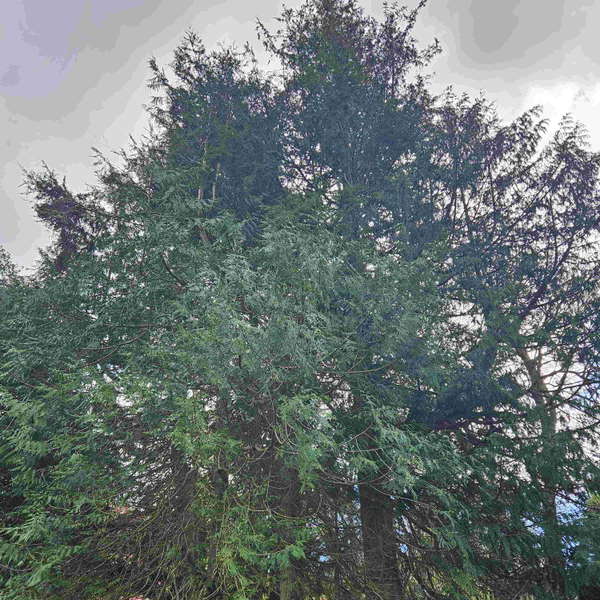
Western Redcedar John This little group of elegant evergreen trees are Western Redcedars. Their native range is in the temperate rainforests of the American Pacific Northwest, where they can live for centuries and become giants of the forest. The tree is a major keystone species of the wet coastal forests, but it is also deeply interwoven with the lives, cultures and technologies of the First Nations people who have for millennia worked with Redcedar as a living relative as much as a resource. They even refer to it as the Tree of Life. To help understand the importance of Western Redcedar I spoke to Briony Penn, a naturalist, writer, and educator whose work is rooted in the forests and coastal ecosystems of British Columbia.

Briony Well, it's the Tree of Life, as many of the First Nations up and down the coast call it in their languages. The bark, which you can peel off the tree without killing it, provided their clothing and their mats, provided planks off the tree, and then they would make canoes out of the tree, which was their main form of transport up and down the coast.

John So, could they make the canoes without felling the tree as well?

Briony The only reason they would fell them was for canoes. The tree could provide everything and still live. You can literally take planks off by inserting little yew wedges in. They're very, very long lived; they can grow up to two plus thousand years old. They would also fell them for poles. John Totem poles?

Briony Heraldic poles is more an accurate description of them, because they were poles for very many different purposes. They could have been mortuary poles, potlatch celebration poles, describing lineages. The beautiful thing about that is that when a pole was erected, you know, it was a cause for a lot of celebration and a lot of what all the craftsmen would learn their trade. When it fell, it was always left; and then it was time to, you know, commission the next pole. So that pole would simply become back to the forest, and another one would be created. They grow in lowland coastal swamps. They often grow in association with Bigleaf Maple, which is one of the largest maples in Canada. And these beautiful things called skunk cabbages. And they form a very, very rich black organic soil. So, we lost a lot of our Western Redcedar to agricultural land. So what they're doing on my island, for example, they've just done a huge Western Redcedar restoration project. Old drainage tiles are all being ripped up. They're creating hundreds of wetlands and then planting Redcedar.

John And is this in order to get back to the original ecosystems, but also in terms of carbon sequestration?

Briony Yeah, they're the biggest carbon sequesters in the world, more than tropical forests, because it's a temperate rain forest. The First Nations are leading the way in building conservation economies based on building carbon instead of extracting it. Without cedar, a lot of the elders will say there is no culture because we were so dependent on it for everything. Our food; because the salmon and the cedar are completely intertwined. They can't live without one another. So, there's really a huge push to protect these big estuaries, restore them because so many of them have been clear cut. You cannot talk about the history of this part of the coast without talking about Western Redcedar.

1 sound

Cedar of Lebanon

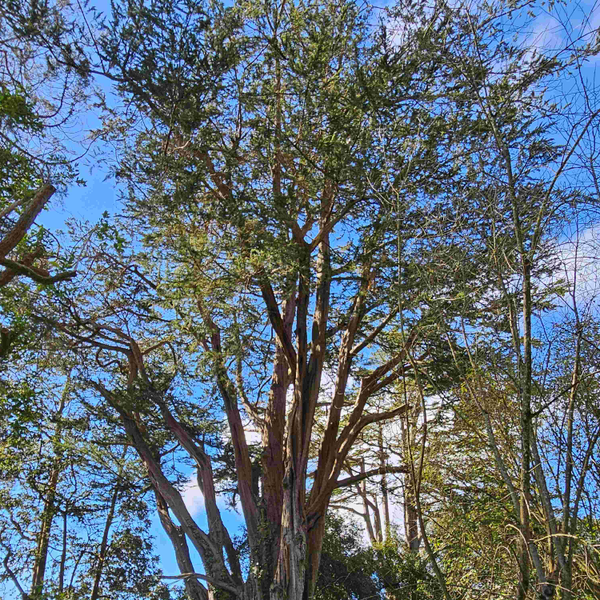
John On the bank above the path is a huge cedar of Lebanon. It has suffered in recent storms, but it is still a magnificent specimen, just like the huge cedar at Highclere Castle that frames the house in the opening sequence of Downton Abbey. Cedars are historically connected to Mount Lebanon, where a small number have survived the millennia since the Phoenicians, Egyptians, Assyrians and Babylonians exploited the timber for its durability and aromatic qualities. The Phoenicians, renowned seafarers, used cedar timber to build their ships, enabling expansive trade across the Mediterranean. Cedar wood was also transported to ancient Egypt, where it was used for temple construction and even in the embalming process, due to its preservative properties. The Cedar of Lebanon is mentioned repeatedly in ancient scriptures, symbolising strength, nobility, and endurance. Its towering presence and longevity make it a metaphor for power and divine blessing. I recently met up with Mustafa, who knows Lebanon well, and we discussed the importance of the tree in the national identity of his country.

Mustafa Maybe it's nice to think about the story that every little kid will take when they start learning about the tree. So generally, you're a little kid at school and your most important art project would start as you're drawing the Lebanese flag. You eventually grow to think about it. It's just like, this represents the resilience of the country that when it goes through hardships, it always goes back. It looks at the strength of the tree; and that reflects in a way the people think about their country.

John So, does that mean that as the kids grow up, they actually want to see the trees?

Mustafa You see schools taking their students down to where the groves are, just to visit the trees and see that. I happened also to go with my parents as well, and that was very special for me because that was the first time I owned a piece of cedar. So, I was there; and after doing the trip and like admiring the size of the trees and the history of it, I was begging my father to buy me something from there. I had that for more, I think more than fifteen years. I had it next to my bed every day. It sometimes tells you, reminds you, of your history as just a child, like something you liked and you grew up with. But it also reflected my connection to the country. When Lebanon was actually formed as a separate country, that's where the flag came in. That's where everybody started to know that tree more and get introduced to that. So my generation, my parents’ generation, my grandparents generation known as the tree, as the thing that tells you about the Lebanon. Lebanon has a lot of sects and religions and different areas and different ethnicities at some times, and there's a lot of wars that happened between these people. But still, if you pick any two kids from any of these areas, you'll still find them talk with the same thought and same connection to the cedar tree because they are all raised on this. And when you think about a country, sometimes the flag removes all of your political affiliation and your parents’ affiliation, all of that, even the religious affiliation from wherever you came, you'll have that connection. if you were to the far, far right or the far left, you both have the same connection to the trees. Thinking about resilience, thinking about how do you, basically overcome all adversities and still thousands of years, you're still there, you're still maintaining and you're still growing.

1 sound

Rhododendron

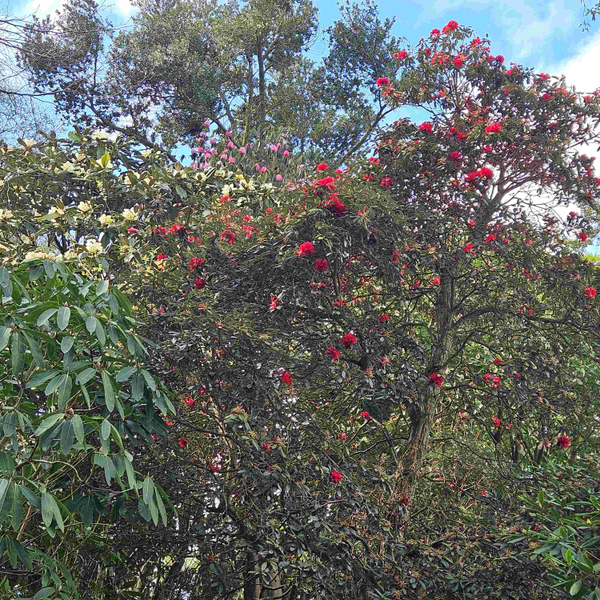
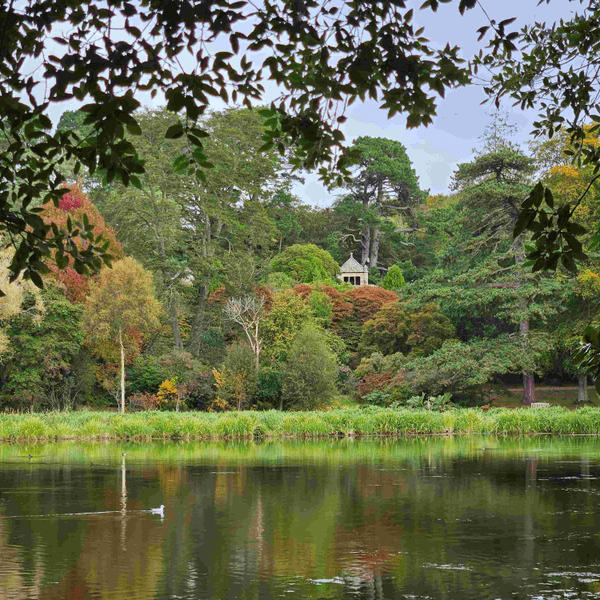
John If there is one species of plant that stands out here at Mount Stewart, it is the spectacular Rhododendron collection created during the early twentieth century by Edith Lady Londonderry. The gardens benefit from the warm, moist air created by Strangford Lough and are not dissimilar in that respect to the moist air drawn up into the eastern Himalayas from the Bay of Bengal, albeit on a much smaller scale and without the heavy monsoon rains. This unusually mild and damp climate allows Rhododendrons to flourish, just as they do in their native mountains and valleys. The huge number and variety of Rhododendrons are planted throughout the woodland areas and around the lake, providing a breathtaking display of colour and sense each late spring and early summer. But even when not in flower, the evergreen leaves provide texture and presence, ensuring the garden feels alive in every season. One of the main routes into the Himalayas, followed by the early plant hunters, was through Burma, where many spectacular varieties were discovered, and it is fitting that I was able to meet Thaw Zin to hear about his encounters with the tree like specimens, examples of which you could hardly miss as you walk around the lake that grow in the northwest of his country on Mount Victoria.

Thaw Zin The flowers grow in Chin states, mostly in Chin state, which is in the western part of Burma. So, the Chin state is homeland to the Chin people who are one of the ethnic minority groups of Burma.

John You were telling me that the flag has a rhododendron on it?

Thaw Zin Yeah. So many, many ethnic groups in Burma tend to have their national symbols and the national animals, flora, fauna and the Chin people’s symbol is the Rhododendron the flower and which is commonly known in Burma as taung‑za‑lap, and also, the national animal is the hornbill, and the flower is the symbol of the chin people. They are featured on the flag.

John Lady Londonderry had Rhododendron seeds sent from all over northern Burma and into Tibet, the Yangtze area and Sikkim. So, there's a whole hill called Rhododendron Hill, and it's just covered in Rhododendrons from all over Asia. It's most famous for the Burmese plants, because she paid for a man called Kingdon Ward to go to Burma, collect the seeds and send them back.

Thaw Zin It was in the Nineteen Thirties.

John Right. He went many times. But also on these expeditions, they were way out in the wilds and there was nobody to rescue them. He got lost on more than one occasion and eventually found his way back to the main party. And there was one time when he fell down a cliff and he landed on a bamboo, which went straight through him, and he had to break it off and pull it out. When people go to the chin state, particularly to Mount Victoria, they tend to go see the flowers. And you've been there?

Thaw Zin Yeah, I've been there. And we went up to the mountain top for one day.

John So, it's a popular destination. And now, of course, people go to Mount Stewart as tourists to see the same Rhododendrons that you went to see on Mount Victoria. That's what brings all the world together.

Thaw Zin Yeah. That's right.

1 sound

Monterey Pine

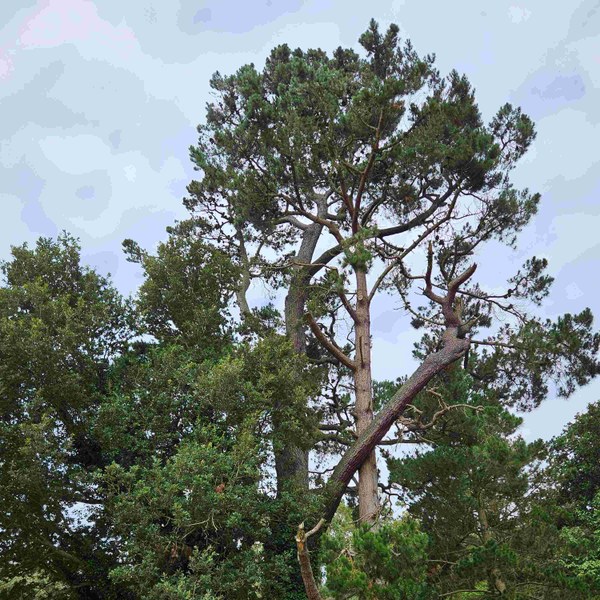
John You could hardly miss the giant Californian redwood on the lawn beside us. But that's not why we stopped. Turn your back on this tree and look across to the other side where, rising above the other trees, you can see the dark outline of pine trees. And these pine trees also come from California, from Monterey. Hence, they're called the Monterey Pine. It's a tree with one of the most extraordinary journeys in this whole garden and in its native habitat it survives in only three tiny pockets along the Californian coast. And you can walk across one of them in an afternoon. And yet this species has become one of the most widely planted trees on earth. I recently met Nicky, who's grown up and spent much time in California, and who knows these groves. So, Nikki, what is this actually like to stand in a natural Monterey pine forest?

Nikki It's surprisingly intimate. The fog hangs low, drifting between the trunks, so the forest seems to appear and disappear as you move. And the trees in California; they're nothing like the pines that we see here. They twist, they lean, they brace themselves against the Pacific winds. Some look like they've been sculpted by the weather. John So, it seems quite different to what we're talking about.

Nikki Completely. The bark is dark and cracked, the branches creak and the air smells of resin and salt. You hear the ocean when you can't see it. It feels like a forest living right on the edge of the world. It's fragile weather, beaten, but incredibly atmospheric.

John It's amazing to think that from those small, fog washed groves, the trees made such a huge leap because in the eighteen thirties, The Scottish botanist David Douglas collected cones and sent them back to Britain, and from there settlers carried the seeds to New Zealand of all places.

Nikki And, you know, that's what I find really fascinating, the fact that that's where the tree really found its stride in New Zealand.

John Yeah, it did. New Zealand's climate, mild, maritime generous with rain, suited it even better than California. It grew faster, straighter, taller. It can grow up to two meters in one year, I believe. And within decades it became the backbone of New Zealand's forestry industry.

Nikki And then it travels again. But this time as timber.

John As timber. Exactly. And much of that New Zealand grown Monterey pine is now shipped all the way to the Netherlands, where it's transformed into something called Accoya, which is a modified wood that's incredibly stable and durable, and it ends up in windows and doors and bridges and even musical instruments.

Nikki That's really quite a journey for a species that started in three tiny, foggy groves in California.

John It is. you're not just looking at a pine. You're looking at a species that's travelled through science, empire, industry and innovation. And it's still reinventing itself.

1 sound

Monterey Cypress

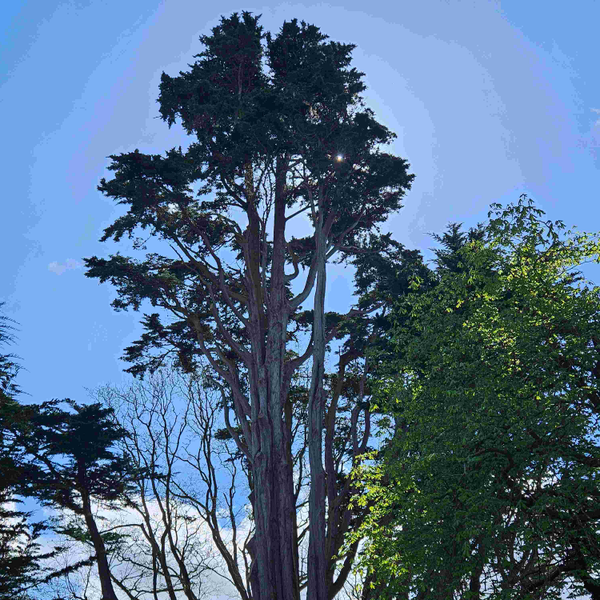
John If you stand here for a moment and look up, you can see exactly what the winter storms did to this Monterey cypress. Those huge limbs that tore away they are dramatic, almost violent. And yet the tree itself feels steady, as if this kind of battering is simply part of its life. And I'm here with Nikki, who's actually seen Monterey Cypress in the wild in the only two places on earth where still grows naturally.

Nikki Yes. And that's why this tree feels so familiar to me. My grandmother lived in the Del Monte Forest, which is one of those two places. When I was a kid, we used to visit. Often the trees twist, lean and those limbs all the time; they don't grow neatly, they endure. And the groves aren't just botanical relics; they're part of the cultural landscape of the Ohlone people who lived with these trees for thousands of years. They used the aromatic foliage medicinally, and the resin and leaves were part of their healing traditions. So when you stand here under a Monterey cypress, you're standing inside a very old relationship between people and place.

John That's amazing. And the poet Robinson Jeffers. I understand he's an icon of the mid twentieth century environmental movement. Lived just a few miles from those last wild cypresses. He watched them in storms like the one that tore the limbs off this big tree.

Nikki He did. Jeffers understood these trees in a way few writers ever have. In one poem, he describes “my sapling cypresses writhing in the fury of his passage”. And when you look at this tree after the winter we've had, you can see exactly what he meant. He imagined the sky turning into a single sheet of cloud, the wind hissing through the grass, the young trees twisting under its force, never dreaming they would one day endure centuries of tempests. That's the Monterey cypress, shaped by violence but built for longevity.

John And yet, from that tiny, storm lashed foothold, the species travelled the world. The Victorian collectors brought it back to Britain in the eighteen thirties. Eventually, it found its way to Mount Stewartt. Here it finds something familiar; a mild climate by the sea that echoes that Californian coast. But I imagine it's not very similar to the Californian coast that you know.

Nikki Um, yeah. You're right. It is very different here. And it didn't just settle in, it became a parent. The Monterey Cypress is one half of the Leyland Cypress, the world's most famous hedging plant. The other parent is the Nootka Cypress from the far northwest of North America. So Leylandii is a meeting of the two coasts, the foggy cliffs of California, and the cold, wet shores of Alaska. And that hybrid vigour is why it grows so fast.

John So the Monterey cypress is a paradox, a species almost extinct in the wild, yet thriving in places like Mount Stuart, a tree shaped by storms but adapted into gardens for its beauty. And when you stand beside this one on the shores of Strangford Lough, rather than on the cliffs of California, you realize that every plant in this garden has a journey, a history, and a home far beyond these paths.

1 sound

Wollemi Pine

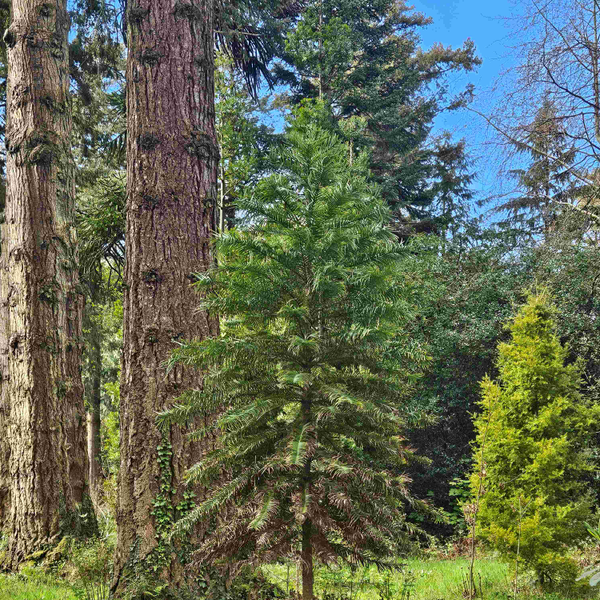
John They may not look it, but under the canopy of tall firs beside the path, there are five very special young trees. These are Wollemi pine. They are actually members of the two hundred-million-year-old Araucariaceae family and the relatives of the monkey puzzle and Bunya Bunya trees, both of which also grow here in the gardens. In nineteen ninety-four, David Noble, a ranger with the New South Wales National Parks and Wildlife Service, was exploring a remote, rugged section of the Wollemi National Park in Australia. Whilst abseiling into a deep, narrow sandstone gorge, he noticed a cluster of unusual trees with fern like foliage and distinctive knobbly bark features, unlike anything he had ever seen before. So, he collected samples and sent them back to Sydney for identification, and when botanists realised they had stumbled on a species known only from fossil records, they named it after him Wollemia Nobilis. The authorities kept the exact site confidential and launched a propagation program through the Botanic Gardens of Sydney to distribute young Wollemi pines worldwide, so that no single disaster; fire, disease or vandalism, could wipe the species out. By the early two thousands, cultivated Wollemi pines reached Europe. The National Trust applied for specimens, knowing that Mount Stewart's mild micro-climate, thanks to Strangford Lough and the Gulf Stream, was perfect for trial planting. The first specimens were planted here in around two thousand and five, making it one of the earliest Northern Irish homes for the species. I was recently in Australia and caught up with one of the garden staff in the beautiful Ballarat Botanical Gardens near Melbourne. We had a wonderful conversation that typified the enthusiasm for this wonderful twenty first century find of a two hundred-million-year-old lost plant.

Gardener In their natural habitat, they grow quite upright, like this one, among other trees. So, the other trees give them protection here and then they'll find as they get taller, their canopy expands a bit. It was an off chance they found them. And then they thought, what is this? And that's how the whole Wollemi Pine story began. The location is very top secret. A few years ago, they had fires down that way, and they were really concerned that the Wollemis were going to be, uh, destroyed. And so, they took great care in firebombing around the area so that the Wollemis survived. But they're a beautiful looking tree; so unique. The foliage is very nice to touch and feel and, as it grows, the bottom foliage drops off and discolours, and becomes old, and the new foliage is up top.

John So, this was also thought to be a fossil. Is that right?

Gardener That's it. That's it. An ancient tree, going back to the Jurassic period. So very much an old tree, and I assume they've figured that out over time with imprints in stone, or they've got records of it going back to that time.

John and Gardener Yeah, yeah. Could you imagine finding a fossil for real? I know, I know.

1 sound

DOWNLOAD OUR APP TO DISCOVER THIS TOUR AND MANY OTHERS.

play-storeapp-store

Or start creating tours, treasure hunts, POI maps... Just let your imagination guide you.


Other walks nearby


Are you a creator?

START HERE

Privacy & cookie policy / Terms and conditions

© ECHOES. All rights reserved / ECHOES.XYZ Limited is a company registered in England and Wales, Registered office at Merston Common Cottage, Merston, Chichester, West Sussex, PO20 1BE

v2.5.15 © ECHOES. All rights reserved.